 Back
BackStudy Guide: Trigonometric Functions, Angles, and Applications
Study Guide - Smart Notes
 Tailored notes based on your materials, expanded with key definitions, examples, and context.
Q1. Convert each angle in degrees to radians: a. 30°, b. 90°, c. -135°
Background
Topic: Angle Conversion (Degrees to Radians)
This question tests your ability to convert angles from degrees to radians, which is essential for working with trigonometric functions in physics and mathematics.
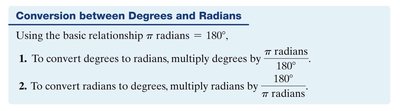
Key formula:
To convert degrees to radians:
Step-by-Step Guidance
Write down the degree value for each angle.
Set up the conversion formula for each:
Substitute the degree value into the formula for each angle.
Simplify the fraction, but do not calculate the final numeric value yet.
Try solving on your own before revealing the answer!
Final Answer:
a. radians b. radians c. radians
Each answer is obtained by multiplying the degree value by and simplifying.
Q2. Convert each angle in radians to degrees: a. radians, b. radians, c. 1 radian, d. 2.3 radians
Background
Topic: Angle Conversion (Radians to Degrees)
This question tests your ability to convert angles from radians to degrees, which is important for interpreting angles in different units.
Key formula:
To convert radians to degrees:
Step-by-Step Guidance
Write down the radian value for each angle.
Set up the conversion formula for each:
Substitute the radian value into the formula for each angle.
Simplify the fraction, but do not calculate the final numeric value yet.
Try solving on your own before revealing the answer!
Final Answer:
a. radians = b. radians = c. 1 radian = d. 2.3 radians =
Each answer is obtained by multiplying the radian value by and simplifying.
Q3. Find the value of each of the six trigonometric functions of in Figure 4.34
Background
Topic: Right Triangle Trigonometry
This question tests your ability to use the sides of a right triangle to evaluate the six trigonometric functions: sine, cosine, tangent, cosecant, secant, and cotangent.

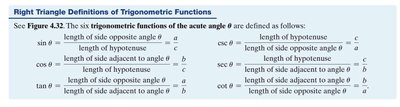
Key formulas:
Step-by-Step Guidance
Identify the sides: (opposite), (adjacent), (hypotenuse).
Use the Pythagorean theorem to find : .
Set up each trigonometric function using the side values.
Substitute the values for , , and into each formula, but do not compute the final numeric values yet.
Try solving on your own before revealing the answer!
Final Answer:
Each function is evaluated using the triangle sides and the Pythagorean theorem.
Q4. Determine the amplitude and period of and graph one period of the function.
Background
Topic: Graphs of Sine Functions
This question tests your understanding of how the coefficients in a sine function affect its amplitude and period, and your ability to graph one period.
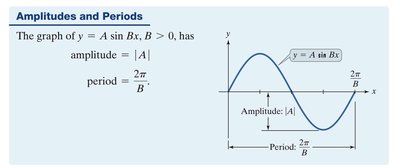
Key formulas:
Amplitude: where
Period:
Step-by-Step Guidance
Identify and in the function (, ).
Calculate the amplitude: .
Set up the formula for the period: .
Substitute into the period formula, but do not compute the final value yet.
Sketch the graph using the amplitude and period found, but do not complete the graph yet.

Try solving on your own before revealing the answer!
Final Answer:
Amplitude: $3 The graph will have a maximum of $3-3 units.
Q5. From a point on level ground 125 feet from the base of a tower, the angle of elevation is 57.2°. Approximate the height of the tower to the nearest foot.
Background
Topic: Applications of Trigonometric Functions (Right Triangle)
This question tests your ability to use trigonometric ratios to solve for unknown sides in a right triangle, a common application in physics and engineering.
Key formula:
Step-by-Step Guidance
Identify the known values: adjacent side = 125 ft, angle .
Set up the tangent formula: , where is the height of the tower.
Rearrange the formula to solve for : .
Prepare to substitute the value for , but do not calculate the final numeric value yet.
Try solving on your own before revealing the answer!
Final Answer:
Height ft The height is found by multiplying 125 by the tangent of 57.2°.
