 Back
Study Guide: Two-Dimensional Kinematics and Projectile Motion (Physics with Calculus)
Study Guide - Smart Notes
 Tailored notes based on your materials, expanded with key definitions, examples, and context.
Q1. The Eagle Descends
An eagle perched on a tree limb 19.5 m above the water spots a fish swimming near the surface. The eagle pushes off from the branch and descends toward the water, maintaining a constant speed of 3.10 m/s at an angle of 20.0° below the horizontal. (a) How much time does it take for the eagle to reach the water? (b) How far has the eagle traveled in the horizontal direction when it reaches the water?
Background
Topic: Projectile Motion with an Initial Angle (Two-Dimensional Kinematics)
This problem tests your understanding of how to break down motion into horizontal and vertical components, and how to use kinematic equations to solve for time and distance in projectile motion.
Key Terms and Formulas
Projectile motion: The motion of an object thrown or projected into the air, subject only to acceleration due to gravity.
Initial velocity components: (since the eagle is descending)
Vertical displacement equation:
Horizontal displacement equation:
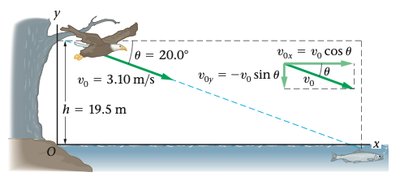
Step-by-Step Guidance
Break the initial velocity into horizontal and vertical components using the given angle and speed.
Set up the vertical motion equation, noting that the eagle starts at and ends at (the water's surface).
Substitute the known values (, , ) into the vertical displacement equation and rearrange to solve for the time it takes to reach the water.
Once you have the equation for , set up the horizontal displacement equation using and $t$.
Try solving on your own before revealing the answer!
Final Answer:
(a) The time for the eagle to reach the water is approximately 1.99 s.
(b) The horizontal distance traveled is approximately 5.80 m.
We used the kinematic equations for projectile motion, breaking the initial velocity into components and solving for time and distance.
Q2. A Chopper Accelerates Vertically
A helicopter is in level flight with a constant horizontal speed of 11 m/s. At , it begins to accelerate vertically at 0.80 m/s². Assuming the helicopter's acceleration remains constant for the time interval of interest, find (a) the horizontal and vertical distances through which it moves in 5.3 s and (b) its velocity components at s.
Background
Topic: Two-Dimensional Motion with Constant Acceleration
This question tests your ability to apply kinematic equations to both horizontal (constant velocity) and vertical (constant acceleration) motion, and to find displacement and velocity components after a given time.
Key Terms and Formulas
Horizontal motion (constant velocity):
Vertical motion (constant acceleration):
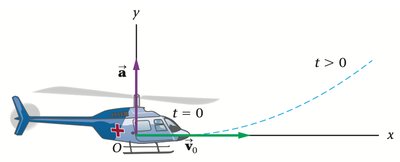
Step-by-Step Guidance
Identify the initial horizontal and vertical velocities. The helicopter starts with m/s and m/s.
Use the horizontal motion equation to find the distance traveled in the -direction after 5.3 s.
Use the vertical motion equation to find the distance traveled in the -direction after 5.3 s, using the given acceleration.
Calculate the vertical velocity at s using .
Try solving on your own before revealing the answer!
Final Answer:
(a) The helicopter moves 58.3 m horizontally and 11.2 m vertically in 5.3 s.
(b) At s, the velocity components are m/s and m/s.
We used the kinematic equations for constant velocity and constant acceleration to find the required distances and velocities.
Q3. Dropping a Ball from a Skateboard
A person skateboarding with a constant speed of 1.30 m/s releases a ball from a height of 1.25 m above the ground. Given that m/s and m, find and for (a) s and (b) s. (c) Find the velocity, speed, and direction of motion of the ball at $t = 0.500$ s.
Background
Topic: Projectile Motion with Zero Launch Angle
This problem involves analyzing the motion of a projectile released horizontally from a certain height, requiring you to use kinematic equations for both and directions.
Key Terms and Formulas
Horizontal motion:
Vertical motion:
Velocity components:
Speed:
Direction angle:
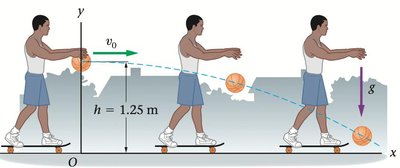
Step-by-Step Guidance
For each time value, use the horizontal motion equation to find .
Use the vertical motion equation to find at each time.
For part (c), calculate and at s.
Set up the expressions for speed and direction angle using the velocity components.
Try solving on your own before revealing the answer!
Final Answer:
(a) At s, m, m.
(b) At s, m, m.
(c) At s, m/s, m/s, speed m/s, direction angle (below horizontal).
We used the kinematic equations for horizontal and vertical motion, and combined the velocity components to find speed and direction.
Q4. Jumping a Crevasse
A mountain climber encounters a crevasse in an ice field. The opposite side of the crevasse is 2.74 m lower and is separated horizontally by a distance of 4.10 m. To cross the crevasse, the climber gets a running start and jumps in the horizontal direction. (a) What is the minimum speed needed by the climber to safely cross the crevasse? (b) If the climber's speed is 6.00 m/s, where does the climber land?
Background
Topic: Projectile Motion with a Drop in Height
This problem involves finding the minimum initial speed required to clear a horizontal gap when the landing point is lower than the starting point, and determining the landing distance for a given speed.
Key Terms and Formulas
Time to fall a vertical distance :
Horizontal distance:
Minimum speed:
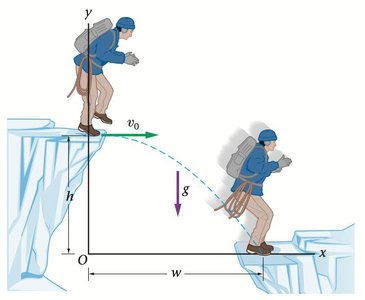
Step-by-Step Guidance
First, calculate the time it takes to fall the vertical distance using the vertical motion equation.
Use this time to set up the equation for the required horizontal distance .
Rearrange the equation to solve for the minimum initial speed needed to cross the crevasse.
For part (b), use the given speed to calculate the actual horizontal distance the climber will travel before landing.
Try solving on your own before revealing the answer!
Final Answer:
(a) The minimum initial speed needed is approximately 3.44 m/s.
(b) With a speed of 6.00 m/s, the climber lands about 7.15 m away.
We used the time to fall the vertical distance and related it to the required horizontal distance to solve for the minimum speed and landing position.
Q5. Position of a Projectile
A projectile is launched from the origin with an initial speed of 20.0 m/s at an angle of 35.0° above the horizontal. Find the and positions of the projectile at the times (a) s, (b) s, and (c) s.
Background
Topic: Two-Dimensional Projectile Motion
This question tests your ability to use the equations of motion for a projectile launched at an angle to find its position at various times.
Key Terms and Formulas
Initial velocity components:
Horizontal position:
Vertical position:
Step-by-Step Guidance
Calculate the initial velocity components using the given angle and speed.
For each time value, use the horizontal position equation to find .
For each time value, use the vertical position equation to find .
Set up the calculations for each time, but stop before plugging in the final numbers.
Try solving on your own before revealing the answer!
Final Answer:
(a) At s, m, m.
(b) At s, m, m.
(c) At s, m, m.
We used the kinematic equations for projectile motion to find the positions at each time.
Q6. Velocity of a Projectile
Find the velocity of the projectile in Quick Example 4-7 at the times (a) s, (b) s, and (c) s.
Background
Topic: Velocity Components in Projectile Motion
This question requires you to find the and components of velocity at different times, as well as the magnitude and direction of the velocity vector.
Key Terms and Formulas
Horizontal velocity: (constant)
Vertical velocity:
Speed:
Direction angle:
Step-by-Step Guidance
Recall the initial velocity components from the previous problem.
For each time, use the vertical velocity equation to find .
Combine and to set up the calculation for the speed and direction angle at each time.
Stop before plugging in the final numbers for speed and angle.
Try solving on your own before revealing the answer!
Final Answer:
(a) At s, m/s, m/s, m/s, .
(b) At s, m/s, m/s, m/s, .
(c) At s, m/s, m/s, m/s, .
We used the velocity component equations and combined them to find the speed and direction at each time.
Q7. A Rough Shot (Golf Ball Projectile)
Chipping from the rough, a golfer sends the ball over a 3.00-m-high tree that is 14.0 m away. The ball lands at the same level from which it was struck after traveling a horizontal distance of 17.8 m. The ball leaves the club at 54.0° above the horizontal and lands on the green 2.24 s later. (a) What was the initial speed of the ball? (b) How high was the ball when it passed directly over the tree?
Background
Topic: Projectile Motion with Known Range and Time
This problem involves finding the initial speed of a projectile given its range, launch angle, and time of flight, and then determining its height at a specific horizontal position.
Key Terms and Formulas
Horizontal motion:
Initial velocity components:
Vertical position at :

Step-by-Step Guidance
Use the total horizontal distance and time of flight to set up an equation for and solve for .
Calculate using the launch angle and the value of found in the previous step.
Find the time it takes for the ball to reach the tree (using m).
Use this time in the vertical position equation to set up the calculation for the height above the ground when the ball passes over the tree.
Try solving on your own before revealing the answer!
Final Answer:
(a) The initial speed of the ball is approximately 10.0 m/s.
(b) The height of the ball when it passed over the tree was about 4.1 m.
We used the horizontal and vertical motion equations to solve for the initial speed and the height at a specific position.
