 Back
BackStudy Notes: Applications of Waves and Sound in Physics
Study Guide - Smart Notes
 Tailored notes based on your materials, expanded with key definitions, examples, and context.
Waves & Sound: Resonance and Standing Waves
Resonance in Air Columns
Resonance occurs in air columns when sound waves reflect and interfere to produce standing waves. The frequency at which resonance occurs depends on the length of the air column and whether the ends are open or closed.
Fundamental Frequency (First Harmonic): For a tube closed at one end and open at the other, the fundamental frequency is given by: where v is the speed of sound in air and L is the length of the air column.
Higher Harmonics: Only odd harmonics are present in a tube closed at one end: , where n = 1, 3, 5, ...
Example Application: Blowing across the top of a bottle produces a sound corresponding to the fundamental frequency of the air column inside the bottle. If the frequency is 440 Hz and the speed of sound is 343 m/s, the effective length of the air column can be calculated.
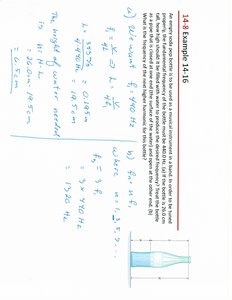
Calculation Example:
Given: Hz, m/s
Find: m
The height of water in the bottle can be found by subtracting the air column length from the total bottle height.
Standing Waves on Strings
Standing waves are formed on strings fixed at both ends when the string vibrates at certain frequencies. The frequency depends on the length, tension, and mass per unit length of the string.
Fundamental Frequency (First Harmonic): where L is the length of the string, T is the tension, and μ is the mass per unit length.
Effect of Tension: Increasing the tension increases the frequency. If the tension is quadrupled, the frequency doubles:
Example Application: If a guitar string tuned to 440 Hz is tightened so that the tension increases by a factor of 4, the new frequency is: Hz
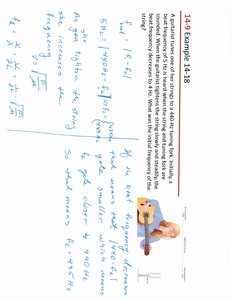
Physical Interpretation: Tightening a string increases the pitch (frequency) of the sound produced.
Summary Table: Comparison of Standing Waves in Air Columns and Strings
System | Boundary Conditions | Fundamental Frequency Formula | Harmonics Present |
|---|---|---|---|
String (fixed at both ends) | Node at both ends | All harmonics (n = 1, 2, 3, ...) | |
Air column (open at one end) | Node at closed end, antinode at open end | Odd harmonics only (n = 1, 3, 5, ...) |
Additional info: The examples provided illustrate the practical application of resonance and standing waves in musical instruments, such as bottles (air columns) and guitar strings. Understanding these principles is essential for analyzing sound production and pitch control in physics and music.
