Back
BackStudy Notes: Energy, Work, and Power (Physics Ch. 7)
Study Guide - Smart Notes
 Tailored notes based on your materials, expanded with key definitions, examples, and context.
Energy, Work, and Power
Energy
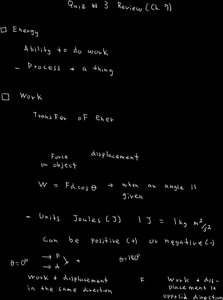
Energy is defined as the ability to do work. It can be considered both as a process and as a property of a system or object.
Ability to do work: Energy enables objects or systems to perform work.
Process vs. Thing: Energy can be transferred or transformed but is not a tangible substance.
Work
Work is the transfer of energy that occurs when a force acts upon an object to cause displacement.
Formula: $W = F d \cos \theta$ where F is the force, d is the displacement, and \theta is the angle between the force and displacement vectors.
Units: Joules (J), where $1\,J = 1\,kg\,m^2/s^2$
Work can be positive (force and displacement in the same direction) or negative (force and displacement in opposite directions).
Work-Energy Theorem
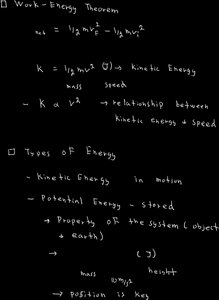
The work-energy theorem states that the net work done on an object is equal to its change in kinetic energy.
Equation: $W_{net} = \Delta KE = \frac{1}{2}mv_f^2 - \frac{1}{2}mv_i^2$
Kinetic Energy (KE): $KE = \frac{1}{2}mv^2$ where m is mass and v is speed.
Kinetic energy is proportional to the square of the speed ($KE \propto v^2$).
Types of Energy
There are two main types of mechanical energy: kinetic and potential energy.
Kinetic Energy: Energy of motion.
Potential Energy: Stored energy due to position or configuration. For gravitational potential energy:
Equation: $PE = mgh$
Depends on mass (m), gravitational acceleration (g), and height (h).
Potential energy is a property of the system (object and Earth).
Position is key for potential energy.
Power
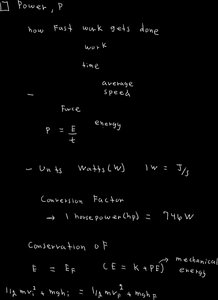
Power is the rate at which work is done or energy is transferred.
Formula: $P = \frac{E}{t}$ where E is energy (or work) and t is time.
Units: Watts (W), where $1\,W = 1\,J/s$
Conversion factor: $1$ horsepower (hp) $= 746$ W
Conservation of Mechanical Energy
The conservation of mechanical energy principle states that the total mechanical energy (kinetic + potential) in a system remains constant if only conservative forces (like gravity) are acting.
Equation: $E_i = E_f$ or $KE_i + PE_i = KE_f + PE_f$
Mechanical energy is the sum of kinetic and potential energy.