Back
BackStudy Notes: Gravity (Conceptual Physics, Chapter 9)
Study Guide - Smart Notes
 Tailored notes based on your materials, expanded with key definitions, examples, and context.
Gravity
The Universal Law of Gravity
The law of universal gravitation describes the fundamental force of gravity, which acts between all masses in the universe. This law states that every object attracts every other object with a force that is directly proportional to the product of their masses and inversely proportional to the square of the distance between their centers.
Key Point 1: Everything pulls on everything else—gravity is a universal force.
Key Point 2: Mathematical Formulation: The force of gravity between two masses is given by: where and are the masses, and is the distance between their centers.
Example: The greater the masses, the greater the force; the greater the distance, the weaker the force.
The Universal Gravitational Constant (G)
The gravitational constant, G, quantifies the strength of gravity in the universe. Gravity is the weakest of the four fundamental forces, but it acts over infinite distances and affects all matter.
Key Point 1: Equation with G:
Key Point 2: Value of G:
Example: Using G, the mass of Earth was calculated as kg.
Gravity and Distance: The Inverse-Square Law
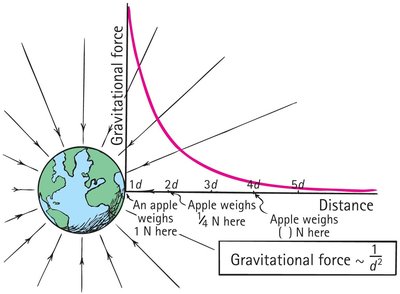
Gravity follows an inverse-square law, meaning the force decreases rapidly as the distance between objects increases. This law is fundamental to understanding planetary motion and the behavior of objects under gravity.
Key Point 1: Inverse-Square Law:
Key Point 2: Application: If the distance doubles, the force becomes one-fourth as strong.
Example: An apple weighing 1 N at Earth's surface would weigh 1/4 N at twice the distance from Earth's center.
Einstein's Theory of Gravitation
Einstein's theory of gravitation, or General Relativity, describes gravity not as a force, but as a curvature of space-time caused by mass. Massive objects warp the fabric of space-time, affecting the motion of other objects.
Key Point 1: Space-Time Warping: Mass creates a 'dent' in space-time, similar to a heavy ball on a waterbed.
Key Point 2: Motion in Curved Space-Time: Objects move along paths determined by this curvature.
Example: A marble rolling toward the dent on a waterbed is analogous to objects gravitating toward massive bodies.

Weight and Weightlessness
Weight is the force of gravity acting on an object's mass. Weightlessness occurs when objects are in freefall, experiencing no support force from a surface.
Key Point 1: Real Weight: The force of gravity on your mass, .
Key Point 2: Apparent Weight: The force with which a supporting surface pushes back on you; can differ from real weight depending on motion.
Example: Astronauts in orbit are in continuous freefall, appearing weightless.

Ocean Tides
Tides are periodic changes in ocean levels caused primarily by the gravitational pull of the Moon and, to a lesser extent, the Sun. The difference in gravitational force across Earth's diameter leads to two high tides and two low tides each day.
Key Point 1: High and Low Tides: Occur due to the Moon's gravitational pull creating bulges in Earth's oceans.
Key Point 2: Spring and Neap Tides: Spring tides occur when the Sun and Moon align, causing higher tides; neap tides occur when they are at right angles, causing lower tides.
Example: There are two spring tides and two neap tides per month.