 Back
BackStudy Notes: Newton's Laws of Motion and Types of Forces
Study Guide - Smart Notes
 Tailored notes based on your materials, expanded with key definitions, examples, and context.
Newton's Laws of Motion: Forces
Introduction to Forces
Forces are fundamental to understanding motion and interactions in physics. A force is a push or pull resulting from the interaction between two objects. Forces are vector quantities, meaning they have both magnitude and direction.
Definition: A force is an interaction that changes the motion of an object.
Unit: The SI unit of force is the Newton (N).
Types of Forces: Contact forces (e.g., friction, tension) and non-contact forces (e.g., gravity).
Common Forces in Physics
Several forces frequently appear in physics problems, each with distinct characteristics and effects.
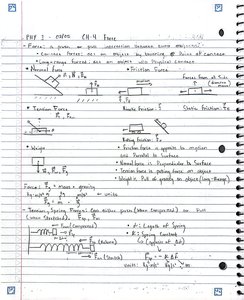
Normal Force (\(F_N\)): The support force exerted by a surface perpendicular to the object.
Friction Force (\(F_f\)): The force that opposes motion between two surfaces in contact.
Tension Force (\(T\)): The force transmitted through a string, rope, or cable when it is pulled tight.
Weight (\(W\)): The force due to gravity, calculated as \(W = mg\), where \(m\) is mass and \(g\) is acceleration due to gravity.
Friction Forces
Friction is a resistive force that acts parallel to the surfaces in contact. It is classified as static or kinetic friction.
Static Friction (\(F_{s,max}\)): The maximum force before motion begins. \(F_{s,max} = \mu_s F_N\)
Kinetic Friction (\(F_k\)): The force during motion. \(F_k = \mu_k F_N\)
Coefficients: \(\mu_s\) (static) and \(\mu_k\) (kinetic) are dimensionless constants.
Free-Body Diagrams
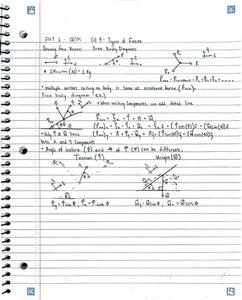
Free-body diagrams are essential tools for visualizing forces acting on an object. Each force is represented as an arrow pointing in the direction of action.
Purpose: To analyze the net force and predict motion.
Steps: Identify all forces, draw arrows from the object, label each force.
Inclined Plane Forces
When an object is on an inclined plane, forces must be resolved into components parallel and perpendicular to the surface.
Weight Components: \(W_{\parallel} = mg \sin \theta\), \(W_{\perp} = mg \cos \theta\)
Normal Force: \(F_N = mg \cos \theta\)
Friction: Acts parallel to the surface, opposing motion.
Types of Forces
Drawing Force Vectors
Force vectors are drawn from the object, showing both direction and magnitude. Multiple forces can be combined using vector addition.
Vector Addition: Forces are added tip-to-tail to find the resultant.
Equilibrium: An object is in equilibrium if the net force is zero.
Resolving Forces
Forces at angles can be resolved into horizontal and vertical components using trigonometric functions.
Component Formulas:
\(F_x = F \cos \theta\)
\(F_y = F \sin \theta\)
Applications: Used in analyzing inclined planes, tension in ropes, and projectile motion.
Summary Table: Common Forces
Force | Symbol | Formula | Description |
|---|---|---|---|
Weight | W | Force due to gravity | |
Normal Force | F_N | Perpendicular support force | |
Friction (Static) | F_{s,max} | Maximum before motion | |
Friction (Kinetic) | F_k | During motion | |
Tension | T | -- | Force in ropes/cables |
Example: Block on Inclined Plane
Consider a block of mass \(m\) on an inclined plane at angle \(\theta\). The forces acting are weight, normal force, and friction. Resolve weight into components:
Parallel:
Perpendicular:
Normal force:
Friction:
Application: These principles are used to analyze motion, predict acceleration, and solve equilibrium problems.
