 Back
BackStudy Notes on Gauss's Law and Electric Flux
Study Guide - Smart Notes
 Tailored notes based on your materials, expanded with key definitions, examples, and context.
Gauss's Law and Electric Flux
Introduction to Gauss's Law
Gauss's Law is a fundamental principle in electromagnetism, relating the electric flux through a closed surface to the charge enclosed by that surface. It is a cornerstone of Chapter 22 in college physics, and is closely linked to Coulomb's Law and the superposition principle.
Gauss's Law: The net electric flux through any closed surface is proportional to the net charge enclosed within that surface.
Coulomb's Law: Describes the force between two point charges.
Superposition Principle: The total electric field is the vector sum of fields produced by each charge.
Electric Flux
Electric flux quantifies the number of electric field lines passing through a surface. It is defined using the area vector, which has a magnitude equal to the area and a direction perpendicular to the surface.
Area Vector: By definition, points perpendicular to the surface.
Electric Flux Formula:
Interpretation: The flux represents the number of field lines passing through the surface.
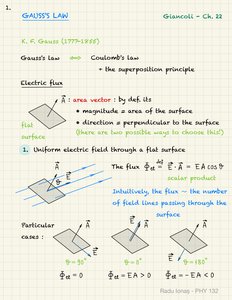
Uniform Electric Field Through a Flat Surface
When the electric field is uniform and the surface is flat, the calculation of electric flux simplifies. The angle between the field and the area vector determines the sign and magnitude of the flux.
Flux Calculation:
Special Cases:
: (maximum flux)
: (no flux)
: (negative flux)
General Electric Field Through a General Surface
For non-uniform fields or curved surfaces, the electric flux is calculated using an integral over the surface.
Electric Flux Integral:
Interpretation: The net number of field lines passing through the surface.
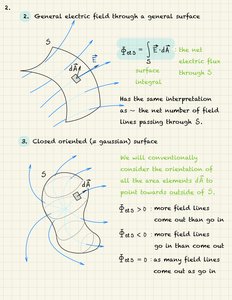
Closed Oriented (Gaussian) Surface
When considering a closed surface, the orientation of the area vector is conventionally outward. The sign of the flux indicates whether more field lines enter or exit the surface.
Positive Flux: More field lines exit than enter.
Negative Flux: More field lines enter than exit.
Zero Flux: Equal number of field lines enter and exit.
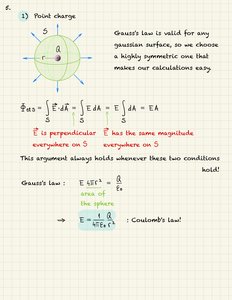
Gauss's Law for a Point Charge
Gauss's Law is valid for any Gaussian surface, but calculations are easiest with highly symmetric surfaces. For a point charge, the electric field is perpendicular and has the same magnitude everywhere on a spherical surface.
Flux Calculation:
Gauss's Law:
Electric Field of a Point Charge:
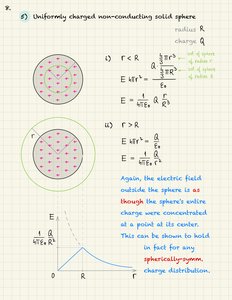
Uniformly Charged Non-Conducting Solid Sphere
For a uniformly charged solid sphere, the electric field outside the sphere behaves as if all the charge were concentrated at the center. Inside the sphere, the field varies with distance from the center.
Outside the Sphere ():
Inside the Sphere ():
Application: This result holds for any spherically symmetric charge distribution.
Conductors in Electric Fields
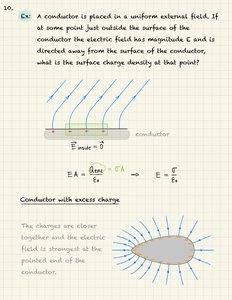
When a conductor is placed in a uniform external electric field, the field inside the conductor is zero. The surface charge density at a point on the conductor is related to the external field.
Surface Charge Density Formula:
Conductor with Excess Charge: Charges accumulate at the surface, and the field is strongest at points of high curvature.
Summary Table: Key Formulas and Concepts
Concept | Formula | Interpretation |
|---|---|---|
Electric Flux (Flat Surface) | Field lines through a flat surface | |
Electric Flux (General Surface) | Field lines through any surface | |
Gauss's Law | Relates flux to enclosed charge | |
Point Charge Field | Field outside a point charge | |
Solid Sphere (Inside) | Field inside a uniformly charged sphere | |
Surface Charge Density | Charge density on conductor's surface |
