 Back
BackStudy Notes: Solids (Conceptual Physics, Chapter 12)
Study Guide - Smart Notes
 Tailored notes based on your materials, expanded with key definitions, examples, and context.
Solids
Crystal Structure
Solids are characterized by the arrangement of their atoms. The atomic structure determines many physical properties of solids.
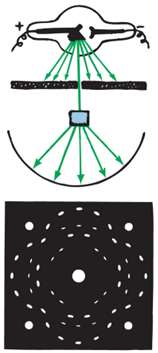
Crystalline solids have atoms arranged in a regular, repeating array. This structure can be detected by X-ray diffraction, which produces a distinct pattern.
Amorphous solids lack a regular atomic arrangement.
The types of atomic bonds in solids include ionic, covalent, metallic, and Van der Waals (the weakest).
The properties of a solid depend on the type of bond between its atoms.
Density
Density is a fundamental property of matter, describing how much mass is contained in a given volume.
Density is defined as mass per unit volume:
Units: or
Example: Density of water is or
Weight density is weight per unit volume:
Units:
Weight density relates to density by:
Density depends on the mass of atoms and their spacing, and is an intrinsic property independent of the amount of material or gravity.
Elasticity
Elasticity describes how materials respond to external forces, specifically their ability to return to their original shape after deformation.
An object is elastic if it returns to its original shape after being deformed.
Materials requiring more force to stretch are more elastic.
Inelastic materials do not return to their original shape after deformation.
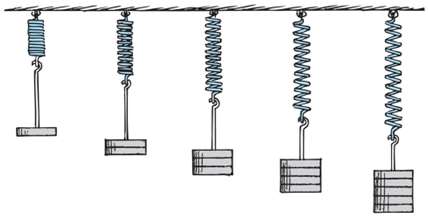
Hooke's Law: The extension of a spring is directly proportional to the force applied: or where is the spring constant.
Tension and Compression
Solids can experience two main types of stress: tension and compression. These stresses are important in engineering and construction.
Tension: Occurs when a material is pulled.
Compression: Occurs when a material is squashed.
In a distorted girder, one side is under tension and the other under compression.
I-beams are designed to maximize strength and minimize weight, placing most material where stress is greatest.



Arches
Arches are architectural structures that efficiently support weight by utilizing the compressive strength of materials like stone.
Older buildings used many columns for support.
Arches allow for fewer columns by distributing weight through compression.
The ideal shape for an arch supporting its own weight is a catenary (the natural shape of a hanging chain).
Rotating an arch forms a dome.





Scaling
Scaling examines how changes in size affect the strength, weight, and surface area of objects. This is crucial in biology, engineering, and physics.
Strength is related to cross-sectional area (measured in ).
Weight is related to volume (measured in ).
When linear dimensions increase:
Cross-sectional area and strength grow as the square of the increase.
Volume and weight grow as the cube of the increase.
The surface area to volume ratio decreases as size increases.


Property | Relation to Size |
|---|---|
Strength (Area) | Proportional to size2 |
Weight (Volume) | Proportional to size3 |
Surface Area/Volume Ratio | Decreases with increasing size |
Additional info: Scaling principles explain why large animals need thicker bones and why small objects have relatively more surface area for their volume.
