 Back
BackStudy Notes: The Electric Field (Chapter 23, PHYA22-2026)
Study Guide - Smart Notes
 Tailored notes based on your materials, expanded with key definitions, examples, and context.
The Electric Field
Introduction to Fields in Physics
The concept of a field is fundamental in physics, describing how physical quantities are distributed in space and time. Fields can be scalar or vector, and are used to model phenomena such as gravity and electromagnetism.
Scalar Field: Assigns a single value (e.g., temperature) to every point in space.
Vector Field: Assigns a vector (magnitude and direction, e.g., wind velocity or electric field) to every point in space.

Example: The gravitational field is a vector field, assigning a gravitational force vector to every point in space.
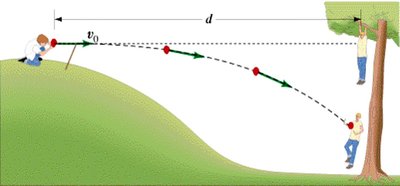
Action-at-a-Distance vs. Field Theory
Historically, forces like gravity and electricity were considered to act instantaneously across space (action-at-a-distance). Michael Faraday introduced the concept of fields, where the influence propagates through space and requires time to affect other objects.
Newton: Forces act instantly across space.
Faraday: Forces are mediated by fields, and changes propagate at finite speed.

Gravitational and Electric Fields
Gravitational Field
The gravitational field is produced by mass and points towards the mass. Its strength is proportional to the mass and inversely proportional to the square of the distance.
Field Strength: (larger masses create stronger fields)
Distance Dependence:
Direction: Points towards the source mass.

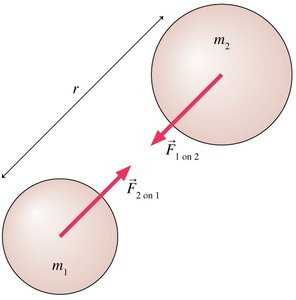
Electric Field Model of a Point Charge
An electric field is created by a source charge and exerts a force on other (test) charges placed in the field. The electric field vector at a point is defined as the force per unit charge at that point.
Definition:
Direction: For positive source charge, field points away; for negative, towards.
Independence: The field at a point depends only on the source charge, not the test charge.

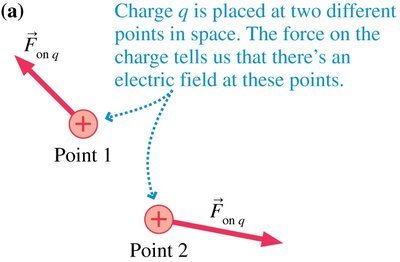
Formula for Point Charge:
Comparison: Gravitational vs. Electric Fields
Gravitational Field:
Electric Field:
Both fields follow an inverse-square law and are vector fields.


Visualizing Electric Fields
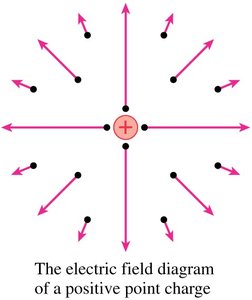
Electric Field Diagrams
Electric field diagrams use arrows to represent the direction and strength of the field at various points. The length of the arrow indicates the relative magnitude.
Field exists at all points in space, not just where arrows are drawn.
Each vector represents the field at a single point.

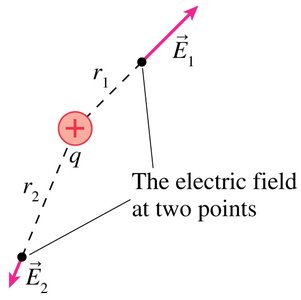
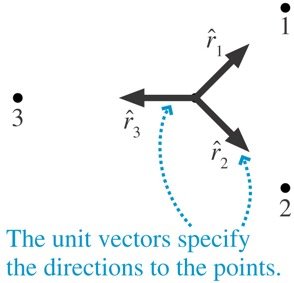
Unit Vector Notation
Unit vectors are used to specify the direction of the electric field relative to the source charge.
Unit vector points from the source charge to the location where the field is measured.

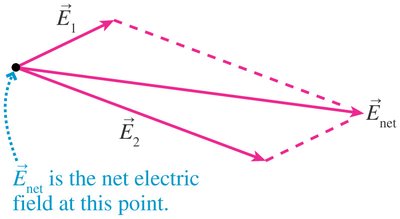
Electric Field Superposition
The principle of superposition states that the net electric field at a point due to multiple charges is the vector sum of the fields produced by each charge.
Superposition Formula:
Divide complex charge distributions into point charges and sum their fields.

Typical Electric Field Strengths
Electric field strengths vary widely depending on the environment and physical context.
Field location | Field strength (N/C) |
|---|---|
Inside a current-carrying wire | |
Near the earth's surface | – |
Near objects charged by rubbing | – |
Electric breakdown in air | |
Inside an atom |

Examples and Applications
Calculating the Electric Field
To calculate the electric field at specific points due to a point charge, use the formula:
Apply the formula to each point, considering the direction and distance from the charge.

The Electric Field of a Proton
In a hydrogen atom, the electron orbits the proton at a fixed radius. The electric field at the electron's position is calculated using the same formula for a point charge.
Proton charge: C
Radius: nm
Electric field at electron:

Field Lines and Visualization
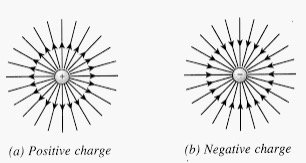
Field Line Properties
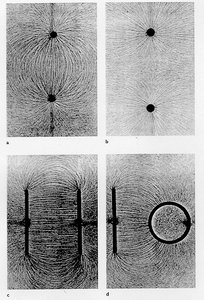
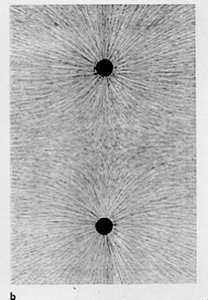
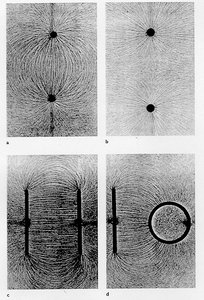
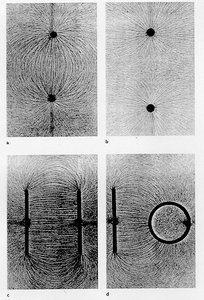
Field lines are a graphical tool to visualize electric fields. They start on positive charges and end on negative charges. The density of lines indicates field strength, and lines never cross.
Number of lines leaving/entering a charge is proportional to the magnitude of the charge.
Field line density indicates field strength.
Field lines never cross.


Electric Dipoles
Definition and Properties
An electric dipole consists of two equal and opposite charges separated by a fixed distance. The dipole moment is defined as .
Net charge is zero, but the dipole creates a distinct field pattern.
Dipoles are common in nature and are important in molecular physics.

Electric Field of a Dipole
The electric field at a point on the perpendicular bisector of a dipole is given by:
This formula applies only to points along the perpendicular bisector.
Field direction and magnitude depend on the dipole moment and distance.
Example: Calculate the field at point P, a distance L from the dipole.
Additional info: The dipole field decreases rapidly with distance, as , unlike the monopole field which decreases as .
