 Back
BackStudy Notes: Units, Physical Quantities, and Vectors (PHYS2325 Chapter 1)
Study Guide - Smart Notes
 Tailored notes based on your materials, expanded with key definitions, examples, and context.
Units, Physical Quantities, and Vectors
Physical Units and Unit Systems
Understanding physical units is fundamental in physics, as all measurements are expressed in terms of units. The International System of Units (SI) is the most widely used system, with base units for length (meter, m), mass (kilogram, kg), and time (second, s). Derived units are formed from these base units, and unit conversion is essential for solving problems across different unit systems.
Base Units: Fundamental quantities such as meter (m), kilogram (kg), and second (s).
Derived Units: Combinations of base units, e.g., velocity (m/s), force (kg·m/s2).
Unit Conversion: Changing from one unit system to another using conversion factors.
Example: Converting 1 hour to seconds:
Types of Physical Quantities: Scalars and Vectors
Physical quantities are classified as either scalars or vectors. Scalars are described by magnitude alone, while vectors require both magnitude and direction.
Scalar: A quantity with only magnitude (e.g., mass, temperature).
Vector: A quantity with both magnitude and direction (e.g., velocity, force).
Notation: Vectors are often denoted with an arrow above the letter, such as .
Example: Velocity is a vector; speed is a scalar.
Vector Representation and Properties
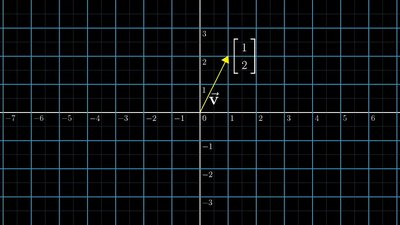
Vectors are graphically represented as arrows, where the length indicates magnitude and the arrow points in the direction. The tail is the starting point, and the tip is the endpoint.
Magnitude: The length of the vector.
Direction: The orientation of the arrow.
Example: A vector from (0,0) to (1,2) has magnitude and direction.
Vector Addition: Tail-to-Head Method
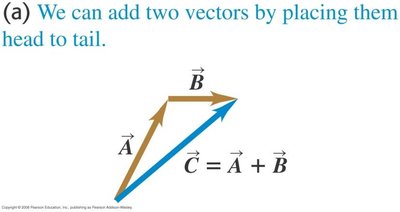
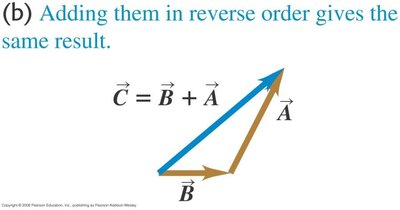
Vectors can be added graphically using the tail-to-head method. Place the tail of the second vector at the head of the first; the resultant vector connects the tail of the first to the head of the last.
Resultant Vector: The sum of two or more vectors.
Order Independence: Vector addition is commutative; the order does not affect the result.
Example:
Vector Addition with Multiple Vectors
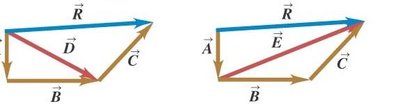
When adding three or more vectors, the tail-to-head method can be extended. The resultant vector is drawn from the tail of the first to the head of the last vector.
Resultant: The vector sum of all individual vectors.
Example:
Vector Components and Coordinate Systems
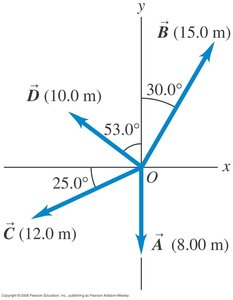
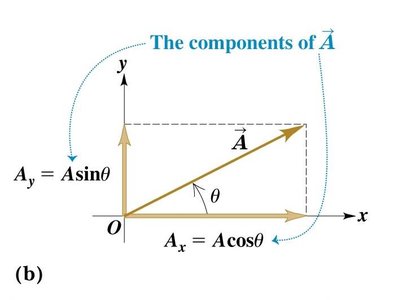
Vectors can be resolved into components along the axes of a coordinate system. The x- and y-components are found using trigonometric functions if the angle is known.
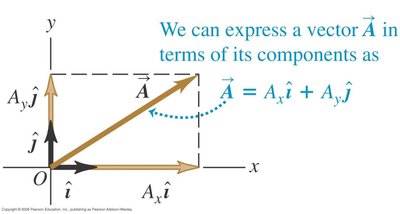
Component Form:
Finding Components: ,
Quadrant Awareness: The sign of the components depends on the quadrant.
Vector Subtraction
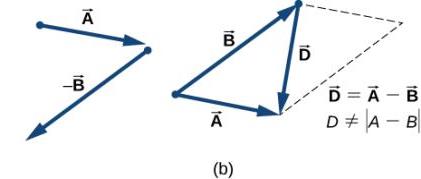
Vector subtraction is performed by adding the negative of the second vector. The negative of a vector has the same magnitude but opposite direction.
Subtraction:
Negative Vector: points in the opposite direction to .
Scaling Vectors
Multiplying a vector by a scalar changes its magnitude and possibly its direction (if the scalar is negative). The units may also change if the scalar has units.
Scaling:
Example: Doubling a velocity vector doubles its speed.
Unit Vectors
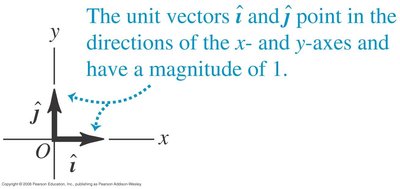
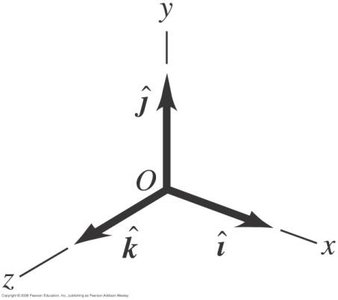
Unit vectors indicate direction and have a magnitude of 1. In Cartesian coordinates, , , and point along the x-, y-, and z-axes, respectively.
Unit Vector: (x-axis), (y-axis), (z-axis)
Usage: Any vector can be written as a sum of its components multiplied by unit vectors.
Vector Operations by Components
Vectors can be added, subtracted, and scaled using their components. The resultant vector's components are the sum or difference of the individual components.
Addition: ,
Subtraction: ,
Example: ,
Calculating Magnitude and Direction
The magnitude of a vector is found using the Pythagorean theorem, and the direction is determined using the arctangent function.
Magnitude:
Direction:
Example: , ,
Summary Table: Vector Operations
Operation | Formula | Description |
|---|---|---|
Addition | Sum of two vectors | |
Subtraction | Difference of two vectors | |
Scaling | Multiplying by a scalar | |
Component Form | Expressing in terms of unit vectors | |
Magnitude | Length of the vector | |
Direction | Angle with respect to x-axis |
Practice Example
Given and :
Sum:
Magnitude:
Direction:
Additional info:
These notes expand on the lecture slides and images, providing full academic context for vector operations, unit systems, and vector components. All formulas are given in LaTeX format for clarity and exam preparation.
