 Back
BackStudy Notes: Vectors and Their Components in Physics
Study Guide - Smart Notes
 Tailored notes based on your materials, expanded with key definitions, examples, and context.
Chapter 1: Models, Measurements & Vectors
1. Introduction to Vectors in Physics
Vectors are fundamental mathematical objects in physics, representing quantities that have both magnitude and direction. Understanding vectors and their components is essential for solving problems in mechanics, electromagnetism, and many other areas of physics.
Vector Quantity: A physical quantity described by both magnitude and direction (e.g., displacement, velocity, force).
Scalar Quantity: A physical quantity described only by magnitude (e.g., mass, temperature, energy).
2. Components of a Vector
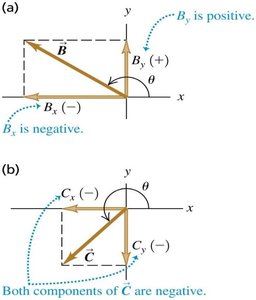
Any vector in a plane can be resolved into two perpendicular components, typically along the x- and y-axes. This process simplifies vector addition and other operations.
Component Form: A vector \( \vec{A} \) can be written as \( \vec{A} = A_x \hat{i} + A_y \hat{j} \), where \( A_x \) and \( A_y \) are the x- and y-components, respectively.
Magnitude: The length of the vector, found using the Pythagorean theorem.
Direction: The angle \( \theta \) the vector makes with the positive x-axis.
2.1 Calculating Components
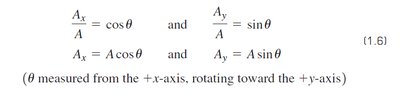
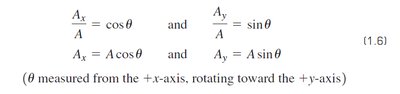
Given a vector \( \vec{A} \) with magnitude \( A \) and direction \( \theta \) (measured from the +x-axis):
x-component: \( A_x = A \cos \theta \)
y-component: \( A_y = A \sin \theta \)
These relationships are derived from the definitions of the sine and cosine functions in a right triangle.
2.2 Magnitude and Direction from Components
Magnitude: \( A = \sqrt{A_x^2 + A_y^2} \)
Direction: \( \theta = \tan^{-1} \left( \frac{A_y}{A_x} \right) \)
These formulas allow you to reconstruct the original vector from its components.
3. Vector Addition Using Components
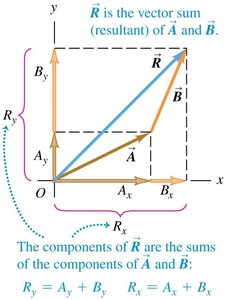
Vectors can be added graphically (tip-to-tail method) or algebraically by adding their respective components. The resultant vector is the vector sum of two or more vectors.
Component Addition: For vectors \( \vec{A} \) and \( \vec{B} \):
\( R_x = A_x + B_x \)
\( R_y = A_y + B_y \)
The resultant vector \( \vec{R} \) has components \( (R_x, R_y) \).
4. Examples and Applications
Example 1: A vector has a magnitude of 5 units and makes an angle of 53° with the x-axis. Its components are:
\( A_x = 5 \cos(53^\circ) = 3 \)
\( A_y = 5 \sin(53^\circ) = 4 \)
Example 2: Two displacement vectors: Raoul walks 500 m at 35° north of east, Maria walks 700 m at 55° south of west. Their x- and y-components can be found using the above formulas, and their resultant displacement can be calculated by adding components.
5. Trigonometric Functions in Vector Analysis
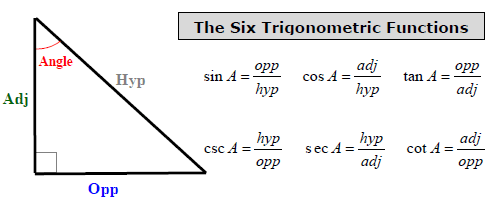
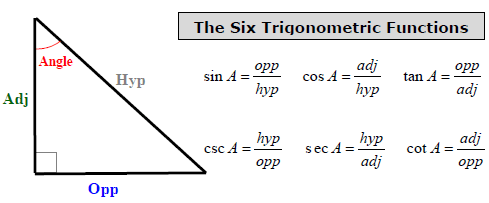
Trigonometric functions are essential for resolving vectors into components and for reconstructing vectors from their components. The six basic trigonometric functions relate the angles and sides of right triangles, which is the geometric basis for vector decomposition.
Sine: \( \sin \theta = \frac{\text{opposite}}{\text{hypotenuse}} \)
Cosine: \( \cos \theta = \frac{\text{adjacent}}{\text{hypotenuse}} \)
Tangent: \( \tan \theta = \frac{\text{opposite}}{\text{adjacent}} \)
6. Vectors in Three Dimensions
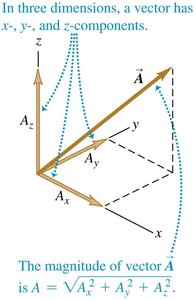
In three-dimensional space, a vector has x-, y-, and z-components. The magnitude is found using the three-dimensional Pythagorean theorem:
\( A = \sqrt{A_x^2 + A_y^2 + A_z^2} \)
7. Summary Table: Vector Components and Operations
Operation | Equation | Description |
|---|---|---|
Component (x) | x-component of vector | |
Component (y) | y-component of vector | |
Magnitude | Length of vector | |
Direction | Angle with x-axis | |
Resultant (x) | Sum of x-components | |
Resultant (y) | Sum of y-components |
Additional info: The above notes cover the essential concepts of vector decomposition, vector addition, and the use of trigonometric functions in physics, as outlined in Chapter 1 of a typical college physics course.
