 Back
BackSuperposition and Standing Waves: Step-by-Step Study Guidance
Study Guide - Smart Notes
 Tailored notes based on your materials, expanded with key definitions, examples, and context.
Q1. A 170 Hz sound wave in air has a wavelength of 2.0 m. The frequency is now doubled to 340 Hz. What is the new wavelength? (The speed of sound in air at 20℃ is 343 m/s.)
Background
Topic: Wave Speed and Wavelength Relationship
This question tests your understanding of the relationship between wave speed, frequency, and wavelength for sound waves in air.
Key formula:
Where:
= speed of sound (in m/s)
= frequency (in Hz)
= wavelength (in m)
Step-by-Step Guidance
Recall the formula and identify the known values: m/s, Hz, m.
Check that the initial values satisfy the formula: .
Now, the frequency is doubled: Hz. The speed of sound remains the same.
Set up the formula for the new wavelength: .
Try solving on your own before revealing the answer!
Final Answer: 1.0 m
m
Doubling the frequency halves the wavelength, since the speed of sound remains constant.
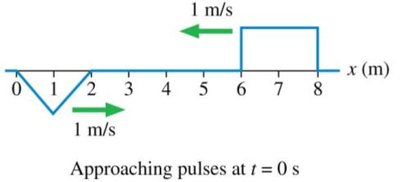
Q2. Two wave pulses on a string approach each other at speeds of 1 m/s. There will be a moment when the superposition of these waves will look like both pulses have disappeared (complete destructive interference).
Background
Topic: Principle of Superposition and Interference
This question tests your understanding of how wave pulses interact and the concept of destructive interference.
Key Terms:
Superposition: The displacement of the medium at any point is the sum of the displacements from each wave.
Destructive Interference: When two waves overlap and their displacements cancel each other out.
Step-by-Step Guidance
Visualize the two pulses moving toward each other at equal speeds.
Consider what happens when the pulses overlap: their displacements add according to the principle of superposition.
If the pulses are equal in magnitude but opposite in sign, their sum can be zero at the point of overlap.
Think about whether this situation describes complete destructive interference.
Try solving on your own before revealing the answer!
Final Answer: True
Complete destructive interference occurs when the pulses are equal and opposite, resulting in a momentary disappearance of the wave.
Q3. What is the mode number of this standing wave?

Background
Topic: Standing Waves and Mode Numbers
This question tests your ability to identify the mode number (harmonic) of a standing wave based on its pattern.
Key Terms:
Node: Point of zero displacement in a standing wave.
Antinode: Point of maximum displacement in a standing wave.
Mode Number (): The number of antinodes or the harmonic number of the standing wave.
Step-by-Step Guidance
Count the number of antinodes (points of maximum displacement) in the standing wave pattern.
Recall that the mode number corresponds to the number of antinodes for a string fixed at both ends.
Check if the ends are nodes (fixed points), which is typical for strings.
Compare your count to the answer choices provided.
Try solving on your own before revealing the answer!
Final Answer: 5
There are 5 antinodes, so the mode number is 5.
