 Back
BackTemperature and Heat: Foundations of Thermodynamics
Study Guide - Smart Notes
 Tailored notes based on your materials, expanded with key definitions, examples, and context.
Temperature and Heat
Introduction to Temperature and Heat
Temperature and heat are fundamental concepts in thermodynamics, describing the energy content and energy transfer between objects. Understanding these concepts is essential for analyzing thermal phenomena in physics.
Temperature is a measure of the average kinetic energy of the particles in a substance.
Heat is the energy transferred between objects due to a temperature difference.
An object does not "contain" heat; it contains internal energy, and heat refers specifically to energy in transit.
Temperature Scales
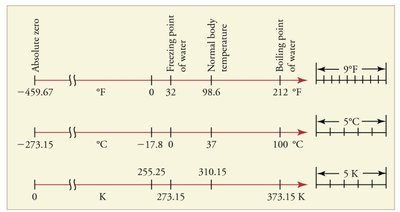
There are three primary temperature scales used in physics: Fahrenheit, Celsius, and Kelvin. Each scale has different reference points for freezing and boiling of water.
Fahrenheit (°F): Freezing point of water is 32 °F, boiling point is 212 °F.
Celsius (°C): Freezing point of water is 0 °C, boiling point is 100 °C.
Kelvin (K): Freezing point of water is 273.15 K, boiling point is 373.15 K. Kelvin is the SI unit for temperature and starts at absolute zero.
Converting Between Temperature Scales
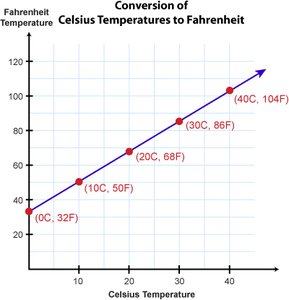
Temperature values can be converted between scales using the following equations:
From Celsius to Fahrenheit:
From Fahrenheit to Celsius:
From Celsius to Kelvin:
From Fahrenheit to Kelvin:
Absolute Zero
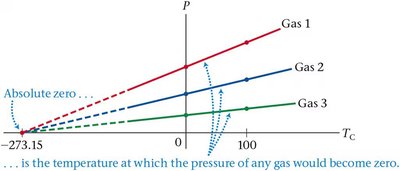
Absolute zero is the lowest possible temperature, at which all molecular motion ceases. It is 0 K, or -273.15 °C, or -459.67 °F. This concept is fundamental in thermodynamics and sets the baseline for the Kelvin scale.
Key Thermal Terms
Heat (Q): Energy transferred due to temperature difference.
Thermal energy (internal energy): Total energy contained within a substance.
Thermal contact: Condition where heat can flow between objects.
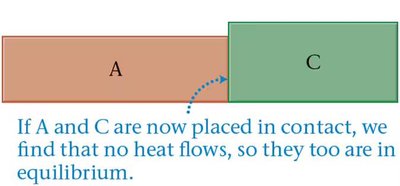
Thermal equilibrium: State where objects in thermal contact have equal temperatures and no net heat flows between them.
Thermodynamics: The study of heat, work, and energy transfer.
The Zeroth Law of Thermodynamics
The Zeroth Law establishes the concept of temperature and thermal equilibrium. It states: If object A is in thermal equilibrium with object B, and object C is also in thermal equilibrium with object B, then objects A and C are in thermal equilibrium with each other.
Thermal Expansion
Introduction to Thermal Expansion
Most substances expand when heated due to increased molecular motion. This phenomenon is important in engineering and everyday life, affecting structures like bridges, power lines, and hot air balloons.
Linear expansion: Change in length.
Area expansion: Change in surface area.
Volume expansion: Change in volume.
Thermal Expansion Equations
Linear expansion:
Area expansion:
Volume expansion:
Where is the coefficient of linear expansion, is the coefficient of volume expansion, is original length, is original area, is original volume, and is the temperature change.
Examples of Thermal Expansion
Linear Expansion Example: The Eiffel Tower, made of iron, increases in height on hot days due to thermal expansion.
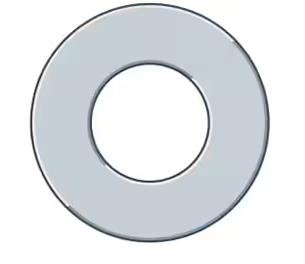
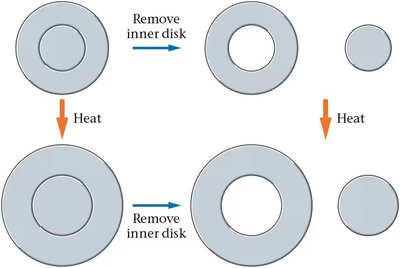
Area Expansion Example: When a washer is heated, the hole expands along with the rest of the washer, not shrinks or stays the same.
Bimetallic Strips
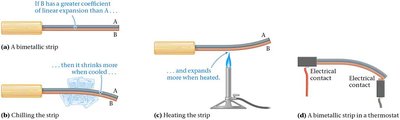
Bimetallic strips are made of two metals with different coefficients of linear expansion. When heated or cooled, the strip bends due to the different rates of expansion or contraction. This principle is used in thermostats and other temperature-sensing devices.
Special Properties of Water
Density Anomaly of Water
Unlike most substances, water is densest at 4 °C. As water cools from 4 °C to 0 °C, it expands, which is why ice floats on liquid water. This property is crucial for aquatic life and environmental processes.
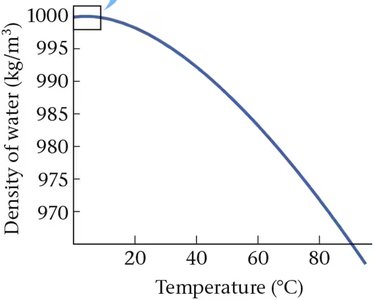
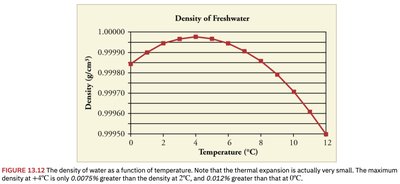
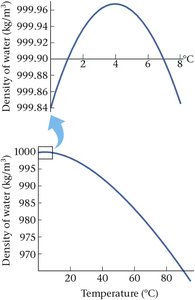
Example: Ice floats because its density is lower than that of liquid water, a result of the molecular structure of ice.
Additional info: The density anomaly of water is due to hydrogen bonding, which causes water molecules to arrange in an open hexagonal structure in ice, making it less dense than liquid water.
