 Back
BackThe Atomic Nucleus and Radioactivity: Structure, Forces, and Applications
Study Guide - Smart Notes
 Tailored notes based on your materials, expanded with key definitions, examples, and context.
Chapter 33: The Atomic Nucleus and Radioactivity
Introduction to Alchemy and Transmutation
Historically, alchemy was the pursuit of transmuting elements, such as turning lead into gold. While alchemy is now considered a pseudoscience, it contributed to the development of modern chemistry and physics by inspiring the study of matter and its transformations.

Discovery of X-rays and Radioactivity
The late 19th century saw the discovery of X-rays and radioactivity, which revolutionized our understanding of atomic structure and nuclear processes.
X-rays were discovered by Wilhelm Roentgen in 1895. They are high-frequency electromagnetic waves emitted by the de-excitation of innermost orbital electrons.
X-rays can penetrate many layers of atoms before being absorbed or scattered, making them useful in medical imaging.
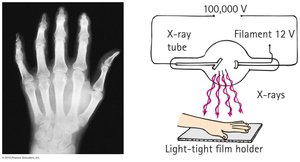
Radioactivity was discovered by Henri Becquerel in 1896 when he observed that uranium salts could darken photographic plates without exposure to sunlight, indicating a new type of spontaneous emission from the atom.
Marie and Pierre Curie further studied these emissions, coined the term radioactivity, and discovered new radioactive elements such as polonium and radium.
Types of Radioactive Emissions: Alpha, Beta, and Gamma Rays
Radioactive elements emit three main types of radiation, each with distinct properties:
Alpha (α) rays: Helium nuclei (2 protons, 2 neutrons), positively charged, low penetration power.
Beta (β) rays: High-speed electrons, negatively charged, moderate penetration power.
Gamma (γ) rays: High-energy electromagnetic waves (photons), no charge, very high penetration power.
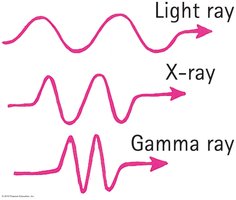
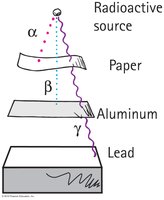
Relative penetration abilities:
Alpha particles are stopped by paper.
Beta particles are stopped by aluminum.
Gamma rays require thick lead to be significantly attenuated.
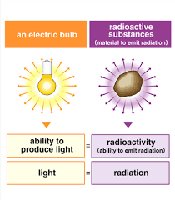
Radiation vs. Radioactivity
Radiation refers to the emission or transmission of energy through waves or particles. Radioactivity is the spontaneous emission of energy from the nucleus of an unstable atom as it undergoes nuclear decay. All radioactive emissions are forms of radiation, but not all radiation is due to radioactivity (e.g., visible light, microwaves).
Environmental Radiation
Most radiation in our environment comes from natural sources, such as cosmic rays, rocks, and radon gas. A smaller fraction comes from human activities, including medical procedures and consumer products.
99.9% of atoms in our environment are stable.
All elements with atomic number greater than 82 are radioactive.
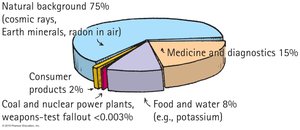
Units of Radiation Dosage
Gray (Gy): Unit of energy absorbed per kilogram of tissue (J/kg).
Sievert (Sv): Dosage adjusted for biological effect; 1 Sv = 1 Gy for beta/gamma, 1 Sv = 20 Gy for alpha particles.
Lethal dose (LD50) for humans is about 5 Sv (5000 mSv) over the whole body in a short period. Environmental exposure is typically well below 0.05 Sv per year.
Biological Effects and Applications of Radioactivity
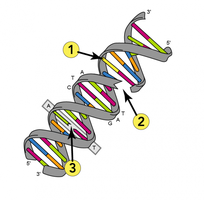
Radiation can ionize atoms in DNA, potentially causing mutations or cell death.
Radioactive isotopes are used as tracers in medicine and biology to track metabolic pathways and diagnose diseases.

Atomic Structure and Isotopes
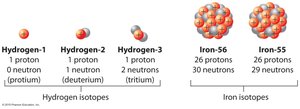
Elements are defined by their atomic number (number of protons). Isotopes are atoms of the same element with different numbers of neutrons. Isotopes have similar chemical properties but may have different nuclear properties, such as stability and radioactivity.
The Atomic Nucleus and the Strong Force
The atomic nucleus consists of protons and neutrons (nucleons) held together by the strong nuclear force. This force is much stronger than the electrical repulsion between protons but acts only over very short distances. Neutrons act as 'nuclear cement,' increasing stability, especially in larger nuclei.
Radioactive Decay Processes
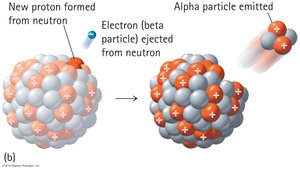
Alpha decay: Emission of a helium nucleus (alpha particle), reducing atomic number by 2 and mass number by 4.
Beta decay: Conversion of a neutron to a proton with emission of an electron (beta particle), increasing atomic number by 1.
Gamma decay: Emission of high-energy photons (gamma rays) from the nucleus, with no change in atomic number or mass number.
Transmutation of Elements
Transmutation is the conversion of one element into another, occurring naturally via radioactive decay or artificially in laboratories through nuclear reactions. Alpha and beta decays change the atomic number, resulting in a new element.
Radioactive Half-Life
The half-life of a radioactive isotope is the time required for half of a sample to decay. Radioactive decay is random for individual atoms but predictable for large samples. Many isotopes decay through a series of steps (decay chains) until a stable nucleus is formed.
Uranium-238 decays to lead-206 through a series of alpha and beta decays.
Carbon-14 has a half-life of 5,730 years and decays to nitrogen-14 via beta decay.
Radiometric Dating
Radiometric dating uses the known half-lives of radioactive isotopes to estimate the age of materials. Carbon-14 dating is used for organic materials, while uranium-lead dating is used for rocks and the Earth itself.
Living organisms maintain a constant ratio of C-14 to C-12. After death, C-14 decays and the ratio decreases, allowing age estimation.
Earth's age is estimated at about 4.54 billion years using uranium-lead dating of ancient minerals.
Summary Table: Types of Radiation
Type | Nature | Charge | Penetration | Effect on Atomic Number |
|---|---|---|---|---|
Alpha (α) | Helium nucleus | +2 | Low (stopped by paper) | -2 |
Beta (β) | Electron | -1 | Moderate (stopped by aluminum) | +1 |
Gamma (γ) | Photon (EM wave) | 0 | High (requires lead) | 0 |
Key Equations
Radioactive decay law:
Half-life:
Relationship between absorbed dose and biological effect:
Additional info: This summary integrates foundational concepts of nuclear physics, including the structure and stability of the nucleus, types of radioactive decay, and practical applications such as radiometric dating and medical tracers. The included images and tables reinforce key distinctions and processes relevant to the atomic nucleus and radioactivity.
