 Back
BackThe Carnot Cycle and Real Engine Cycles in Thermodynamics
Study Guide - Smart Notes
 Tailored notes based on your materials, expanded with key definitions, examples, and context.
The Carnot Cycle
Overview of the Carnot Cycle
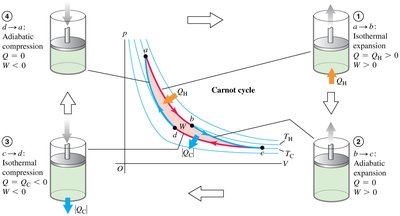
The Carnot cycle is a theoretical thermodynamic cycle that provides the maximum possible efficiency for a heat engine operating between two temperature reservoirs. It consists of four reversible processes: two isothermal (constant temperature) and two adiabatic (no heat exchange) steps. The Carnot cycle is fundamental in understanding the limitations imposed by the Second Law of Thermodynamics on the efficiency of heat engines.
Step 1: Isothermal Expansion at High Temperature (TH) – The system absorbs heat QH from the hot reservoir while expanding at constant temperature.
Step 2: Adiabatic Expansion – The system continues to expand without exchanging heat, causing its temperature to drop from TH to TC.
Step 3: Isothermal Compression at Low Temperature (TC) – The system is compressed at constant temperature, rejecting heat QC to the cold reservoir.
Step 4: Adiabatic Compression – The system is compressed further without heat exchange, raising its temperature back to TH.
Each step is reversible, making the entire cycle reversible and ensuring maximum efficiency.
Key Properties and Equations
First Law of Thermodynamics: For a complete cycle, the net work done by the system is the difference between the heat absorbed and the heat rejected:
Isothermal Processes: Internal energy does not change (), so all heat absorbed or released is converted to work.
Adiabatic Processes: No heat is exchanged (); temperature changes as work is done on or by the system.
Calculations in the Carnot Cycle
For an ideal gas undergoing a Carnot cycle, the following relationships are used:
Isothermal Expansion/Compression:
Adiabatic Expansion/Compression: , where
At each stage, temperature, pressure, and internal energy can be calculated using these equations and the properties of the ideal gas.
Efficiency of the Carnot Engine
The efficiency of a Carnot engine depends only on the temperatures of the hot and cold reservoirs. It is given by:
where is the absolute temperature of the hot reservoir and is that of the cold reservoir. No real engine operating between these two temperatures can be more efficient than a Carnot engine.

Real Engine Cycles
Maximizing Engine Efficiency
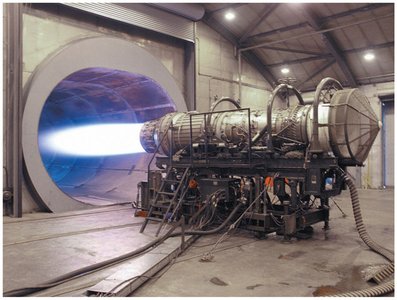
To maximize the efficiency of a real engine, designers aim to increase the intake temperature () and decrease the exhaust temperature (). This is why advanced materials are used in jet engines to withstand extremely high temperatures, improving their efficiency.
The Otto Cycle (Gasoline Engine)
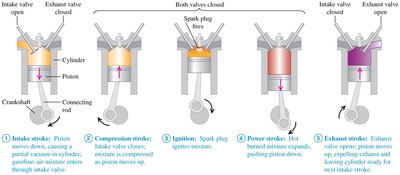
The Otto cycle is an idealized model of the thermodynamic processes in a typical gasoline engine. It consists of four main strokes:
Intake Stroke: The piston moves down, drawing in a fuel-air mixture.
Compression Stroke: The piston moves up, compressing the mixture adiabatically.
Ignition/Power Stroke: The mixture is ignited at constant volume, causing a rapid increase in pressure and temperature, pushing the piston down (adiabatic expansion).
Exhaust Stroke: The piston moves up again, expelling exhaust gases at constant volume.
The Otto cycle differs from the Carnot cycle in that heat addition and rejection occur at constant volume, not constant temperature.
The Diesel Cycle
The Diesel cycle is another idealized engine cycle, used to model diesel engines. Its main steps are:
Adiabatic compression of air (no fuel present, so higher compression ratios are possible).
Heat addition at constant pressure (fuel is injected and combusts).
Adiabatic expansion (power stroke).
Heat rejection at constant volume.
The higher compression ratio in diesel engines leads to improved efficiency compared to gasoline engines.
Summary Table: Comparison of Carnot, Otto, and Diesel Cycles
Cycle | Heat Addition | Heat Rejection | Compression/Expansion | Efficiency |
|---|---|---|---|---|
Carnot | Isothermal (TH) | Isothermal (TC) | Adiabatic | Maximum possible |
Otto | Constant volume | Constant volume | Adiabatic | Lower than Carnot |
Diesel | Constant pressure | Constant volume | Adiabatic | Higher than Otto (for same compression ratio) |
Additional info: The Carnot cycle is a theoretical construct; real engines (Otto and Diesel) are modeled with practical constraints and differ in how heat is added and rejected.
