 Back
BackThe Earth System: Structure, Energy, and Dynamics
Study Guide - Smart Notes
 Tailored notes based on your materials, expanded with key definitions, examples, and context.
The Earth System
Introduction to Earth as a System
The Earth is a complex, dynamic system composed of interdependent parts that interact within a defined boundary. Understanding Earth as a system is fundamental to studying its physical processes and the interactions that sustain life and shape the planet's surface.
System Definition: A system is a collection of interdependent parts within a defined boundary that function together as a whole.
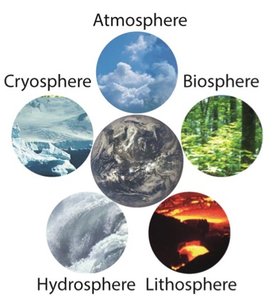
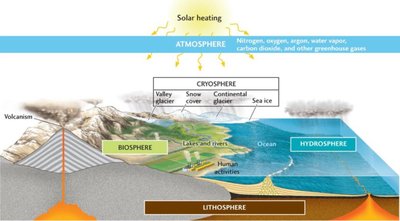
Earth's Spheres: The Earth system consists of five major spheres: the atmosphere, hydrosphere, cryosphere, biosphere, and geosphere (lithosphere).
Interconnectedness: These spheres are connected by the transfer of energy and matter, meaning that changes in one sphere can affect others.
Analogy: The human body, with its interdependent organ systems, serves as an analogy for Earth's interconnected spheres.
The Five Spheres of Earth
Each sphere of the Earth system plays a unique role, and their interactions drive many of the planet's dynamic processes.
Atmosphere: The layer of gases surrounding Earth, essential for weather, climate, and supporting life.
Hydrosphere: All water on Earth, including oceans, rivers, lakes, and groundwater.
Cryosphere: All frozen water, such as glaciers, ice caps, and sea ice.
Biosphere: All living organisms and the ecosystems they form.
Geosphere (Lithosphere): The solid Earth, including rocks, minerals, and landforms.
Interactions Between Spheres
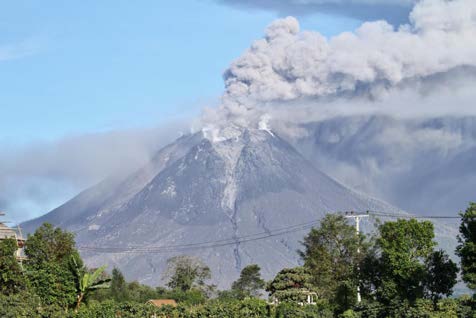
Earth's surface processes often involve interactions between multiple spheres. For example, volcanic eruptions (geosphere) release gases into the atmosphere, which can affect climate (atmosphere) and influence the biosphere.
Example 1: Active volcanism involves the solid Earth and atmosphere; volcanic gases can impact climate.
Example 2: Braided rivers involve the geosphere and hydrosphere, with processes like erosion and sediment transport.
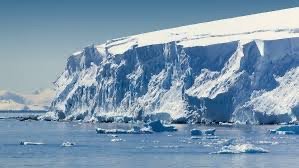
Example 3: Antarctic ice involves the cryosphere, hydrosphere, atmosphere, and geosphere, illustrating complex interactions.
Example 4: Vegetated deltas involve the hydrosphere, biosphere, and geosphere, showing the role of living organisms in shaping landforms.


Earth as an Open or Closed System
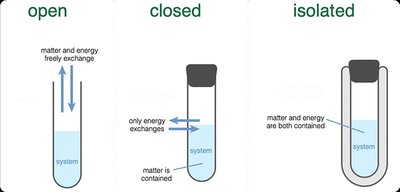
System Types: Open, Closed, and Isolated
Systems can be classified based on their exchange of matter and energy with their surroundings:
Open System: Exchanges both matter and energy with the environment.
Closed System: Exchanges only energy, not matter, with the environment.
Isolated System: Exchanges neither matter nor energy.
Earth's Classification
Energy: Earth is an open system for energy, primarily receiving solar radiation from the Sun and radiating energy back into space.
Matter: Earth is nearly a closed system for matter, with only minor exchanges such as the loss of atmospheric gases (e.g., hydrogen, helium) and the gain of material from meteorites and comets.

Energy Sources Driving the Earth System
External Energy: Solar Radiation
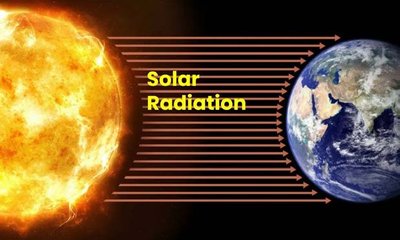
The primary external energy source for Earth's surface processes is solar radiation. The Sun's energy drives weather, climate, and the water cycle, and supports life through photosynthesis.
Solar Energy: Drives atmospheric and oceanic circulation, weather patterns, and climate.
Distribution: Solar radiation is not evenly distributed across Earth's surface, leading to temperature gradients and dynamic processes.
Internal Energy: Primordial Heat, Gravitational Heat, and Radioactive Decay
Earth's internal energy comes from three main sources:
Primordial Heat: Residual heat from Earth's formation, including accretion and core/mantle cooling (about 50% of internal heat).
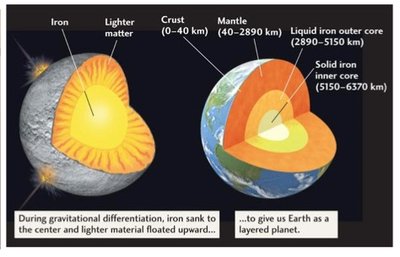
Gravitational Heat: Generated during the differentiation of Earth's layers, as dense materials (iron, nickel) sank to form the core, releasing heat through friction.
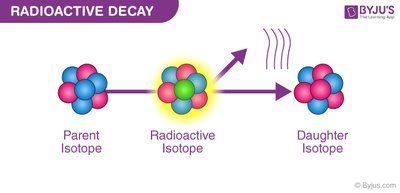
Radioactive Decay: Heat produced by the spontaneous decay of radioactive isotopes (e.g., uranium, thorium) in Earth's interior (about 50% of internal heat).
Earth's Energy Budget and Climate Regulation
Energy Balance and the Greenhouse Effect
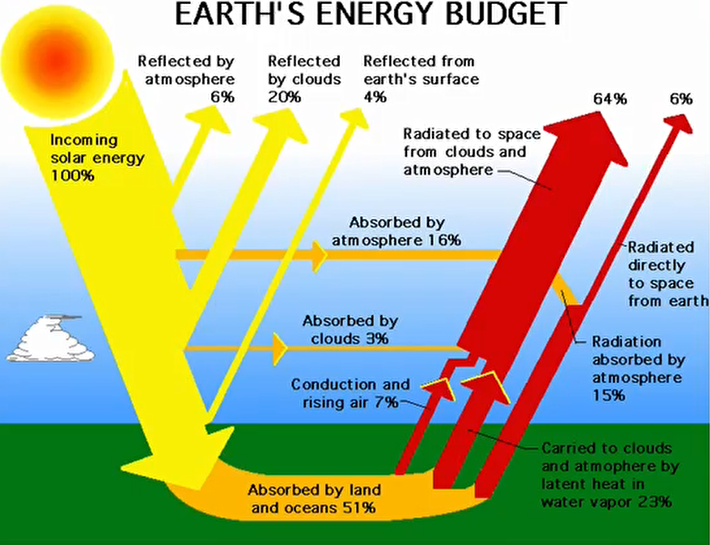
Earth's climate is regulated by a balance between incoming solar radiation and outgoing long-wave (infrared) radiation. The atmosphere, clouds, aerosols, and Earth's surface properties (albedo) influence this balance.
Albedo: The reflectivity of Earth's surface, which affects how much solar energy is absorbed or reflected.
Greenhouse Effect: Some outgoing long-wave radiation is trapped by greenhouse gases (e.g., CO2, methane, water vapor), warming the planet and maintaining habitable temperatures.
Climate Regulation: The energy budget is crucial for maintaining Earth's climate and supporting life.
Monitoring Earth's Energy Budget
Satellites such as NASA's CERES (Clouds and Earth's Radiant Energy System) monitor the Earth's radiation budget, providing data on solar energy reflected or radiated back into space. This information is essential for understanding climate change and feedback mechanisms.
Summary of Key Concepts
Earth is a unique, dynamic, and evolving system composed of five interacting spheres.
It is open to energy exchanges (mainly solar radiation) and nearly closed to matter exchanges.
Earth's surface processes are driven by both external (solar) and internal (primordial, gravitational, radioactive) energy sources.
The energy balance, regulated by the atmosphere and Earth's position relative to the Sun, maintains a habitable climate.
Understanding these interactions is fundamental to the study of physical processes on Earth.
