 Back
BackThe First Law of Thermodynamics and Internal Energy of Ideal Gases
Study Guide - Smart Notes
 Tailored notes based on your materials, expanded with key definitions, examples, and context.
First Law of Thermodynamics
Definition and Fundamental Concepts
The First Law of Thermodynamics is a statement of energy conservation applied to thermodynamic systems. It relates the change in internal energy (U) of a system to the heat (Q) added to the system and the work (W) done by the system:
Internal energy (U): The total energy contained within a system, including kinetic and potential energies of its particles.
Heat (Q): Energy transferred between a system and its surroundings due to temperature difference.
Work (W): Energy transferred when a system does work on its surroundings or vice versa.
The mathematical form of the First Law is:
In differential form for infinitesimal changes:
Key Points:
Both Q and W depend on the process (path) taken between states, but ΔU depends only on the initial and final states.
The First Law is a generalization of the conservation of energy, formally defining internal energy.
Special Cases of the First Law
Cyclic Process: The system returns to its initial state, so and .
Isolated System: No heat or work exchange (, ), so .
Constant Volume Process: If , then .
Adiabatic Process: If , then .
Energy Bookkeeping in Thermodynamic Processes
The First Law of Thermodynamics is used to track energy changes in a system. The change in internal energy can be positive, negative, or zero depending on the relative magnitudes of heat added and work done.
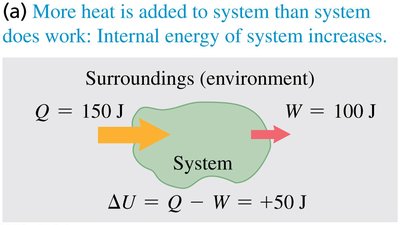
ΔU > 0: Internal energy increases when more heat is added than work done by the system.
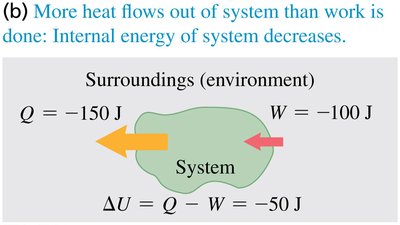
ΔU < 0: Internal energy decreases when more heat leaves the system than work done.
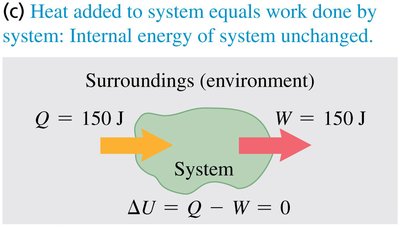
ΔU = 0: Internal energy remains unchanged when heat added equals work done.
Examples of Energy Bookkeeping
These examples illustrate the application of the First Law:
Example 1: More heat is added to the system than the system does work. , ,
Example 2: More heat flows out of the system than work is done. , ,
Example 3: Heat added to the system equals work done by the system. , ,
Internal Energy of an Ideal Gas
Dependence on Temperature
For an ideal gas, the internal energy is a function of temperature only, due to the absence of intermolecular interactions:
Isothermal Process: When temperature is constant (), internal energy does not change (), so .
General Process: For any process, the change in internal energy is proportional to the change in temperature.
The change in internal energy for an ideal gas is given by:
= number of moles
= molar heat capacity at constant volume
= change in temperature
Heat Capacities of an Ideal Gas
Heat capacity specifies how much heat is required to change the temperature of a substance. For ideal gases, two important heat capacities are:
: Molar heat capacity at constant volume. Measured by heating gas in a rigid container.
: Molar heat capacity at constant pressure. Measured by heating gas while allowing it to expand at constant pressure.
At constant pressure, more heat is required for the same temperature change because some energy goes into work to expand the gas. Thus:
Relationship Between and
For an ideal gas, the molar heat capacities are related by:
= universal gas constant
This relationship is fundamental in thermodynamics and is used in calculations involving ideal gases.
Summary Table: Heat Capacities of an Ideal Gas
Heat Capacity | Condition | Equation |
|---|---|---|
Constant Volume | ||
Constant Pressure |
Example: If 1 mole of an ideal gas is heated at constant volume and its temperature increases by 10 K, the change in internal energy is .
Additional info: The relationship between and is also connected to the adiabatic process coefficient for ideal gases, where .
