 Back
BackThe First Law of Thermodynamics and Work in Thermodynamic Processes
Study Guide - Smart Notes
 Tailored notes based on your materials, expanded with key definitions, examples, and context.
The First Law of Thermodynamics
Definition and Fundamental Principle
The First Law of Thermodynamics is a cornerstone of classical physics, expressing the conservation of energy in thermodynamic systems. It states that the change in the internal energy (U) of a system is equal to the heat (Q) added to the system minus the work (W) done by the system on its surroundings:
Internal Energy (U): The total energy contained within a system, including kinetic and potential energies of its molecules.
Heat (Q): Energy transferred between the system and surroundings due to temperature difference.
Work (W): Energy transferred when the system changes its volume against an external pressure.
The mathematical expression is:
This law generalizes the principle of energy conservation to thermodynamic processes.
Example of a Thermodynamic System
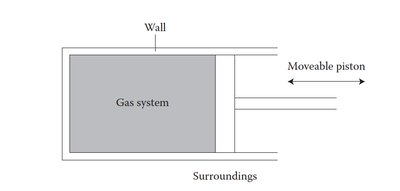
A common model for thermodynamic analysis is a gas contained in a cylinder with a moveable piston. The system's volume can change during expansion or compression, affecting pressure (p) and temperature (T). If the walls are diathermal, the system can exchange energy with its surroundings.
Microscopic View of Work During Volume Changes
Sign Convention and Molecular Interactions
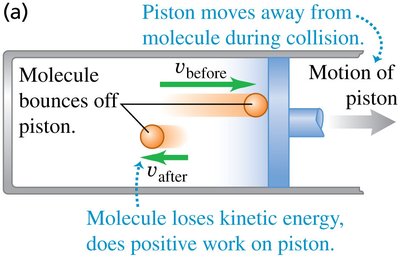
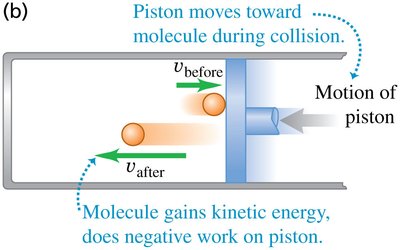
The sign convention for work in thermodynamics can be understood by considering the behavior of gas molecules colliding with a moving piston:
Expansion (Piston moves outward): Gas molecules lose kinetic energy when they collide with the piston, doing positive work on the piston.
Compression (Piston moves inward): Gas molecules gain kinetic energy during collision, and negative work is done on the piston.
Work Done During Volume Changes
Mathematical Formulation
Work done by a system during a small expansion (dx) can be expressed as:
Infinitesimal Work:
Finite Volume Change:
Here, p is the pressure, A is the area of the piston, and dV is the change in volume.
Types of Thermodynamic Processes
Classification and Characteristics
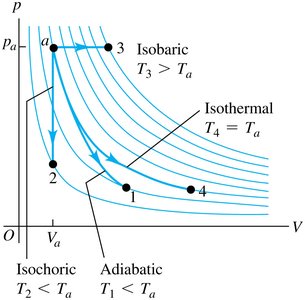
Thermodynamic processes are classified based on which variables are held constant:
Isothermal: Constant temperature (T).
Isochoric: Constant volume (V); so .
Isobaric: Constant pressure (p); .
Adiabatic: No heat exchange (Q = 0); equation derived in later lectures.
Work on a pV-Diagram
Graphical Interpretation
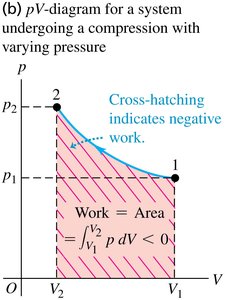
The work done by a system during a process is represented by the area under the curve on a pV-diagram:
Expansion: , area is positive, .
Compression: , area is negative, .
Special Cases
Isochoric Process: , , .
Isobaric Process: , .
Path Dependence of Work
Work Depends on the Thermodynamic Path
The amount of work done by a system depends on the specific path taken between the initial and final states on a pV-diagram. Different processes connecting the same states can yield different values of work:
Path 1: Expansion at higher pressure () yields more work.
Path 2: Expansion at lower pressure () yields less work.
Path 3: Smooth curve (e.g., isothermal process) yields an intermediate amount of work.

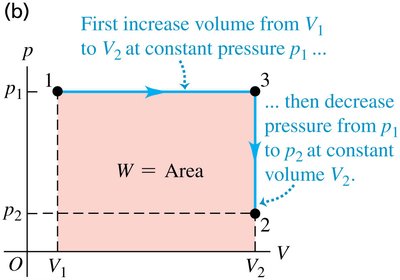
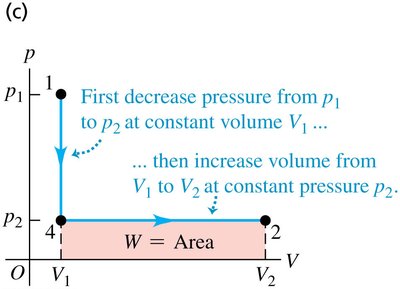
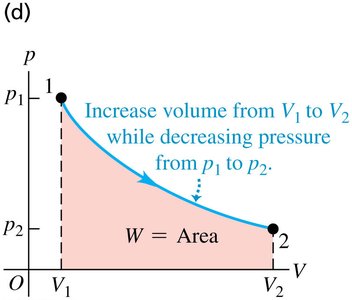
Conclusion: To calculate the work done in a thermodynamic process, the path (i.e., the process) must be specified.
Summary Table: Types of Thermodynamic Processes
Process | Variable Held Constant | Work Done (W) | Heat Exchange (Q) |
|---|---|---|---|
Isothermal | Temperature (T) | Q ≠ 0 | |
Isochoric | Volume (V) | Q = ΔU | |
Isobaric | Pressure (p) | Q ≠ 0 | |
Adiabatic | No heat exchange (Q) | Q = 0 |
Additional info: The equations for isothermal and adiabatic work are provided for completeness; derivations are typically covered in subsequent lectures.
