 Back
BackThe First Law of Thermodynamics: Energy, Heat, and Work
Study Guide - Smart Notes
 Tailored notes based on your materials, expanded with key definitions, examples, and context.
Chapter 19: The First Law of Thermodynamics
Introduction to Thermodynamics
Thermodynamics is the study of energy, heat, and work at the macroscopic level. It is built upon empirical laws derived from experimental observations, most notably the First and Second Laws of Thermodynamics. These laws are foundational for understanding the behavior of thermal machines and natural processes.
Thermodynamic Systems and Processes
A thermodynamic system is defined by its state variables, typically pressure (p), volume (V), and temperature (T). The relationship between these variables is given by an equation of state, such as the ideal gas law:
Equation of State:
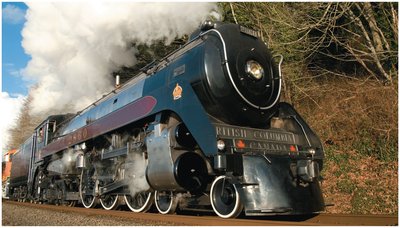
On a p-V diagram, each state of the system corresponds to a point, and a thermodynamic process is represented by a line connecting different states as the system evolves. Thermal machines, such as steam engines and rocket engines, operate by undergoing cycles of thermodynamic processes, converting heat into mechanical work or vice versa.

Heat, Work, and Energy Exchange
During a thermodynamic process, a system can exchange energy with its surroundings in two primary ways:
Heat (Q): Energy transferred due to temperature difference.
Work (W): Energy transferred when the system exerts a force over a distance (e.g., expansion or compression of a gas).
Both heat and work are mechanisms for changing the energy of a system, as demonstrated by Joule's experiments.
Joule's Experiments: Equivalence of Work and Heat
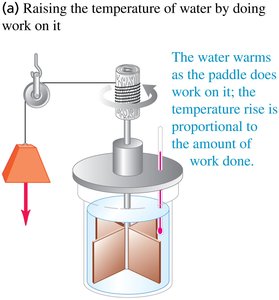
James Joule established the direct equivalence of heat and work as forms of energy. In one experiment, he showed that stirring water with a paddle wheel (mechanical work) increased its temperature, and in another, that adding heat directly produced the same temperature change. This demonstrated that both heat and work can change a system's internal energy.
The Law of Conservation of Energy
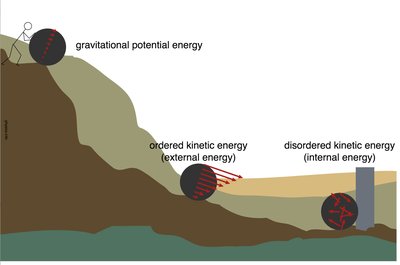
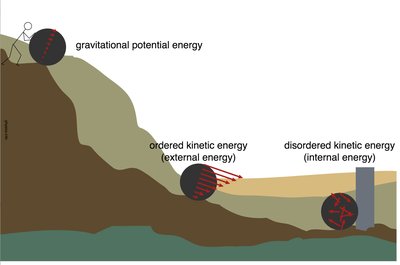
The principle of conservation of energy states that energy cannot be created or destroyed, only transformed from one form to another. In mechanics, this is observed as the transformation between kinetic and potential energy. However, when energy appears to be 'lost' (e.g., a rock comes to rest after hitting a wall), it is actually converted into internal energy (microscopic motion and heat within the object).
Internal Energy
Internal energy (U) is the total energy contained within a system, including the kinetic energy of all particles and the potential energy of their interactions. It is a state function, meaning it depends only on the current state of the system, not on the path taken to reach that state. A change in internal energy is given by:

The First Law of Thermodynamics
The First Law of Thermodynamics is a formal statement of energy conservation, incorporating both heat and work:
Statement: The change in the internal energy of a system is equal to the heat added to the system minus the work done by the system.
Mathematical Form:
Differential Form (for infinitesimal changes):
Here, is positive when heat enters the system, and is positive when work is done by the system (expansion). Both and depend on the process path, but depends only on the initial and final states.
Sign Conventions for Heat and Work
It is crucial to use the correct sign conventions when applying the First Law:
Heat (Q): Positive when entering the system, negative when leaving.
Work (W): Clausius convention (used in University Physics): Positive when done by the system (expansion), negative when done on the system (compression).
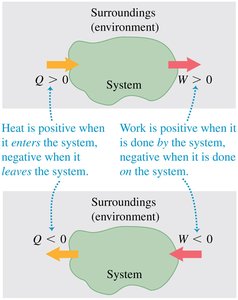
Alternative (Planck) Convention: Used in some physics textbooks, where is positive when work is done on the system (compression) and negative when done by the system (expansion). The choice of convention does not affect the physical results as long as it is used consistently.
Summary Table: Sign Conventions for Work
Convention | Work Done By System (Expansion) | Work Done On System (Compression) |
|---|---|---|
Clausius (University Physics) | W > 0 | W < 0 |
Planck (Alternative) | W < 0 | W > 0 |
Key Equations
First Law of Thermodynamics:
Differential Form:
Internal Energy Change:
Example Applications
Steam Engines: Convert heat from fuel into mechanical work, following the First Law.
Rocket Engines: Use combustion heat to perform mechanical work and propel rockets.
Everyday Systems: Car engines, refrigerators, and even living organisms operate according to the laws of thermodynamics.
Additional info: The First Law of Thermodynamics is universally applicable to all physical, chemical, and biological systems, making it a cornerstone of both classical and modern physics.
