Back
BackThe Nature and Properties of Light
Study Guide - Smart Notes
 Tailored notes based on your materials, expanded with key definitions, examples, and context.
The Nature of Light
Introduction to Light
Light is a fundamental aspect of physics, exhibiting both wave-like and particle-like properties. Its behavior can be explained through various phenomena such as reflection, refraction, interference, diffraction, and dispersion. Understanding light is essential for exploring optics, electromagnetic theory, and modern physics. 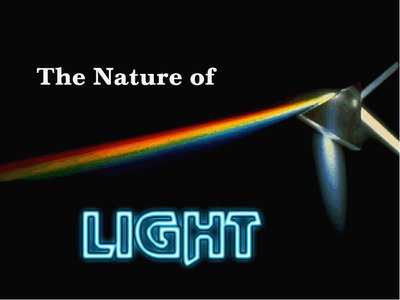
Wave Properties of Light
Light as a Wave
The wave model of light successfully explains many of its behaviors, including reflection, refraction, diffraction, and interference. By the mid-19th century, the wave theory was widely accepted due to its explanatory power.
Reflection: The bouncing of light off a surface.
Refraction: The bending of light as it passes from one medium to another.
Diffraction: The spreading of light as it passes through a narrow opening or around obstacles.
Interference: The combination of two or more light waves resulting in constructive or destructive patterns.
Dispersion: The separation of light into its component colors due to different wavelengths bending by different amounts.
The Wave Equation
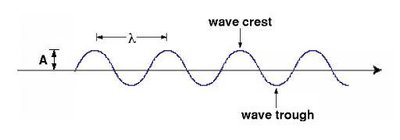
The relationship between the speed, frequency, and wavelength of a wave is given by the wave equation: For light in a vacuum, the speed is replaced by , the speed of light. Where:
c: Speed of light in vacuum ( m/s)
f: Frequency (Hz)
\lambda: Wavelength (m)
The Search for the Medium of Light: Aether
The Aether Hypothesis
Historically, scientists believed that light, as a wave, required a medium (called "aether") to travel through, similar to how sound waves require air.
The Michelson-Morley Experiment
The Michelson-Morley experiment (1887) was designed to detect Earth's movement through the aether by measuring changes in the speed of light in different directions. The experiment used an interferometer to compare the speed of light along perpendicular paths. 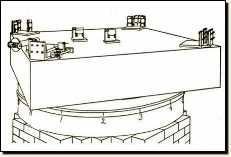
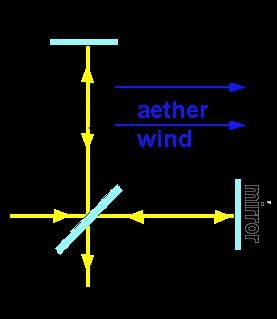
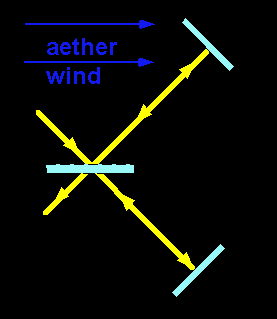
Result: No aether drift was detected; the speed of light was the same in all directions.
Conclusion: There is no aether; light does not require a medium to propagate.
Maxwell's Contribution
James Clerk Maxwell's equations showed that light is an electromagnetic wave, consisting of oscillating electric and magnetic fields that can propagate through a vacuum. This explained why the Michelson-Morley experiment found no evidence for aether.
Key Point: The speed of light is constant in all inertial frames of reference.
The Electromagnetic Nature of Light
Light as an Electromagnetic Wave
Light consists of self-regenerating electric and magnetic fields oscillating perpendicular to each other and to the direction of propagation. 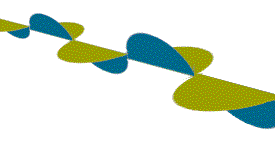
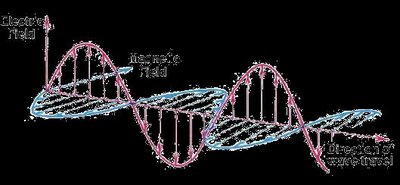
Source of Light: Accelerating electric charges emit electromagnetic waves (light).
The Speed of Light
Measurement and Value
The speed of light in a vacuum is a universal constant, denoted by .
Value: m/s (or about 300,000 km/s)
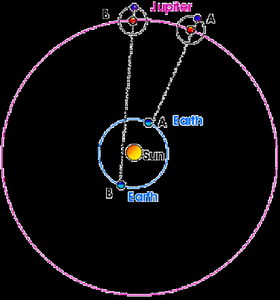
Historical Measurement: Ole Rømer first measured the speed of light in 1676 by observing the eclipses of Jupiter's moons.

Wave Properties and Human Perception
Wavelength and Color
The wavelength of visible light determines its color, while the amplitude determines its brightness.
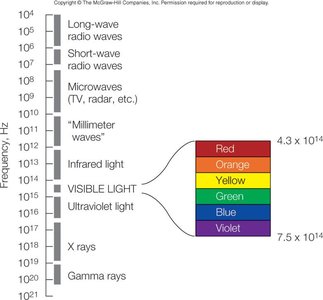
Wavelength (): Determines the color of light (e.g., red has a longer wavelength than blue).
Amplitude (A): Determines the brightness or intensity of light.
The Electromagnetic Spectrum
Light is part of the electromagnetic spectrum, which includes radio waves, microwaves, infrared, visible light, ultraviolet, X-rays, and gamma rays. Visible light is only a small portion of the spectrum. 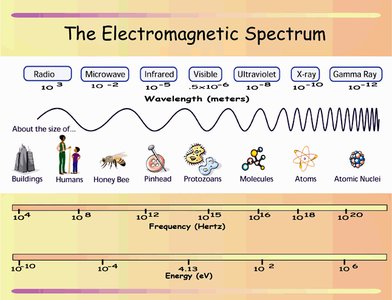
Color Addition and Dispersion
Primary Colors of Light
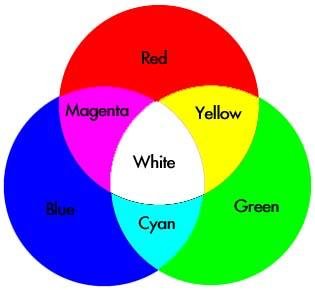
The primary colors of light are red, green, and blue. When combined, they produce white light. The absence of all colors results in black.
Red + Green + Blue = White
No light = Black
Dispersion of Light
Dispersion occurs when white light is separated into its component colors by a prism, due to different wavelengths bending by different amounts. 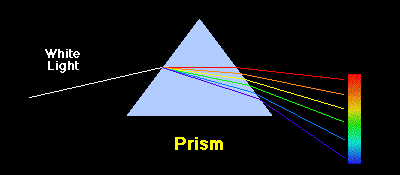
The Human Eye and Vision
Structure of the Eye
The human eye uses a convex lens to focus light onto the retina. The curvature of the lens is adjusted by muscles to change the focal distance, allowing us to focus on objects at different distances. 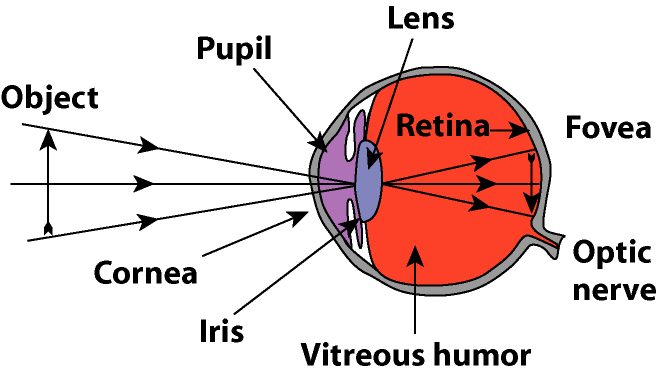
Vision Defects and Correction
Nearsightedness (Myopia): Images form in front of the retina; corrected with diverging lenses.
Farsightedness (Hyperopia): Images form behind the retina; corrected with converging lenses.
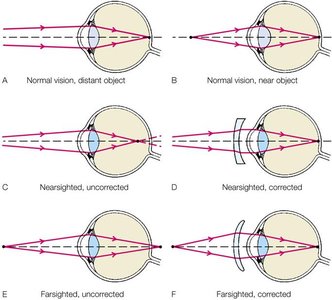
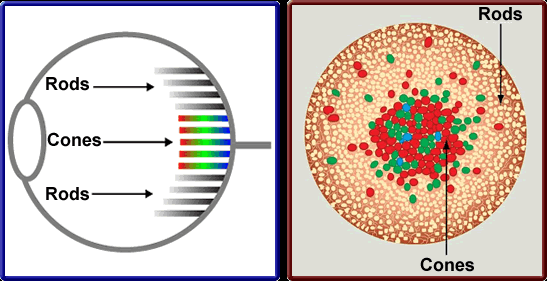
Rods and Cones
The retina contains two types of photoreceptor cells:
Rods: Sensitive to low light levels; responsible for night vision.
Cones: Sensitive to color; responsible for daylight and color vision.