 Back
BackThe Second Law of Thermodynamics: Direction, Efficiency, and Thermal Machines
Study Guide - Smart Notes
 Tailored notes based on your materials, expanded with key definitions, examples, and context.
CH20 – The Second Law of Thermodynamics
Reversible vs Irreversible Processes
The distinction between reversible and irreversible processes is fundamental in thermodynamics. A reversible process is an idealized transformation that occurs infinitely slowly, keeping the system and surroundings in near-perfect equilibrium at every stage. In contrast, an irreversible process involves finite differences in temperature or pressure, causing the system to deviate from equilibrium and making the process impossible to reverse by simply restoring the original conditions.
Reversible Process: The system is always nearly in equilibrium with its surroundings. Changes in temperature (T) and pressure (p) are infinitesimal, so Tsystem ≈ Tsurroundings and psystem ≈ psurroundings.
Irreversible Process: The system experiences finite changes in temperature or pressure, and may pass through non-equilibrium states. The process cannot be reversed by simply restoring the original conditions.
Examples of Reversible Processes: Slowly adding small weights to a piston (incremental pressure changes), or bringing a system into thermal contact with a series of reservoirs at slightly different temperatures.
Examples of Irreversible Processes: Sudden pressure changes, free expansion of a gas into a vacuum, or heat flow between objects with a finite temperature difference.
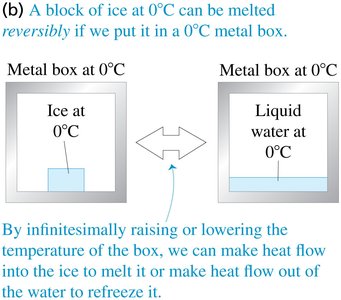
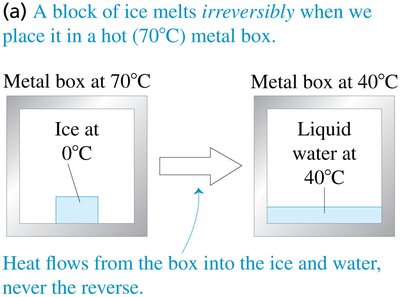
Additional info: In a reversible process, the system can be restored to its initial state without net change to the universe. In an irreversible process, restoring the initial state would require external intervention and would increase the entropy of the universe.
Direction of Thermodynamic Processes
Thermodynamic processes naturally proceed in a preferred direction. For example, heat flows spontaneously from a hot object to a cold one, but never the reverse. The direction of these processes is not determined by the First Law of Thermodynamics (energy conservation), but by the Second Law.
Spontaneous Processes: Heat flows from hot to cold, not cold to hot.
Mechanical to Heat Conversion: Mechanical energy can be completely converted to heat, but not all heat can be converted to mechanical energy.
Equilibrium: Thermodynamic equilibrium is achieved when there is no net flow of energy or matter.

Additional info: The Second Law introduces the concept of entropy, which quantifies the directionality and irreversibility of natural processes.
Limitations of the First Law of Thermodynamics
The First Law of Thermodynamics is a statement of energy conservation, but it does not specify the direction in which processes occur. It cannot explain why certain processes are impossible, such as heat flowing from cold to hot spontaneously, or the complete conversion of heat into work in a cyclic process.
First Law: (change in internal energy equals heat added plus work done on the system)
Limitation: The First Law allows for processes that do not occur in nature, such as a boat extracting heat from cold water and converting it entirely into work.
Additional info: The Second Law is needed to determine the feasibility and direction of thermodynamic processes.
The Second Law of Thermodynamics: Introduction
The Second Law of Thermodynamics determines the preferred direction for thermodynamic processes and introduces the concept of entropy. It can be stated in several equivalent ways, often in terms of the behavior of thermal machines such as heat engines and refrigerators.
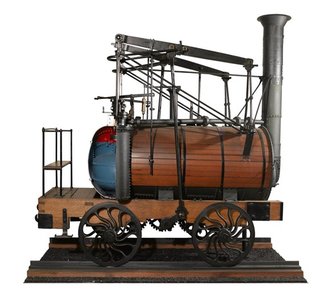
Heat Engines: Devices that convert heat into work (e.g., car engines, steam turbines).
Refrigerators: Devices that transfer heat from a cold region to a hot region, requiring work input.

Additional info: The Second Law sets a fundamental limit on the efficiency of all heat engines and refrigerators.
Heat Engines
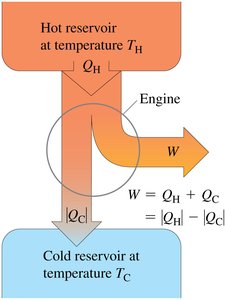
A heat engine is a device that operates in a cycle, absorbing heat from a high-temperature reservoir, converting part of it to work, and discarding the rest to a low-temperature reservoir. The Second Law states that it is impossible to convert all absorbed heat into work in a cyclic process.
Key Components: Hot reservoir (at temperature ), cold reservoir (at ), and the engine itself.
Energy Flow: The engine absorbs heat from the hot reservoir, does work , and expels heat to the cold reservoir.
Kelvin's Statement: It is impossible for any system to absorb heat from a single reservoir and convert it entirely into work in a cyclic process.
Equations:
First Law for a cycle: (if all heat is converted to work, which is impossible by the Second Law)
Actual heat engine:
Additional info: The Second Law ensures that some heat must always be expelled to the cold reservoir; perfect efficiency is unattainable.
Thermal Efficiency of a Heat Engine
The thermal efficiency () of a heat engine is the fraction of heat absorbed from the hot reservoir that is converted into useful work. It is always less than 1 (or 100%).
Definition:
Alternative Form:
Additional info: The efficiency depends on the temperatures of the reservoirs and the specific cycle used by the engine.
Refrigerators and Heat Pumps
A refrigerator is a device that transfers heat from a cold region (inside the refrigerator) to a hot region (the room), requiring an input of work. This process is essentially a heat engine operating in reverse.
Key Components: Cold reservoir (inside at ), hot reservoir (outside at ), and the refrigerator mechanism.
Energy Flow: The refrigerator removes heat from the cold reservoir, requires work , and expels heat to the hot reservoir.
Clausius Statement: It is impossible for any process to have as its sole result the transfer of heat from a cooler to a hotter body.
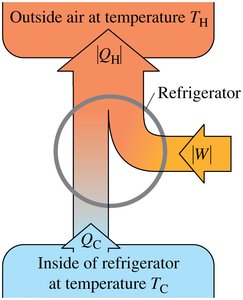
Equation:
Additional info: The Second Law prohibits the operation of a refrigerator without work input.
Coefficient of Performance (COP) of Refrigerators
The coefficient of performance () of a refrigerator measures its effectiveness. It is the ratio of the heat removed from the cold reservoir to the work input required.
Definition:
Interpretation: The higher the COP, the more efficient the refrigerator.
Additional info: For heat pumps (used for heating), the COP is defined as .
Equivalence of Kelvin and Clausius Statements
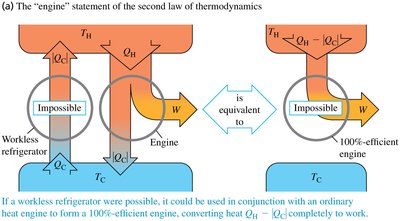
The Kelvin and Clausius statements of the Second Law are equivalent. If one could be violated, so could the other. For example, if a workless refrigerator (violating Clausius) were possible, it could be combined with a heat engine to create a 100%-efficient engine (violating Kelvin).
Kelvin Statement | Clausius Statement |
|---|---|
No engine can convert all heat from a single reservoir into work in a cycle. | No process can transfer heat from cold to hot without work input. |
Additional info: The equivalence is often demonstrated by constructing a hypothetical device that would violate both statements if either were false.
