 Back
BackThe Second Law of Thermodynamics: Heat Engines, Refrigerators, and Entropy
Study Guide - Smart Notes
 Tailored notes based on your materials, expanded with key definitions, examples, and context.
The Second Law of Thermodynamics
Irreversibility and Natural Processes
The second law of thermodynamics addresses the direction of natural processes and the concept of irreversibility. Many thermodynamic processes proceed spontaneously in one direction but not the reverse, due to the increase in entropy and the tendency toward greater disorder.
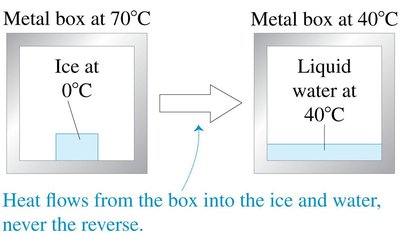
Irreversible Process: A process that cannot be reversed by an infinitesimal change in conditions. Most natural processes are irreversible.
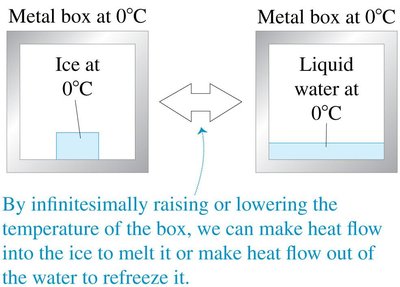
Reversible Process: A process that can be reversed by an infinitesimal change in a variable, with the system always in or near equilibrium.
Example: Melting of ice in a hot metal box is an irreversible process.

Heat Engines
Definition and Operation
A heat engine is a device that converts heat energy into mechanical work by operating in a cyclic process. All motorized vehicles (except purely electric ones) use heat engines for propulsion.
Working Principle: Heat engines absorb heat from a high-temperature source, perform work, and reject some heat to a low-temperature sink.
Cyclic Process: The working substance returns to its initial state after each cycle.
Energy Flow: Not all absorbed heat is converted to work; some is always wasted as rejected heat.

Thermal Efficiency
The thermal efficiency (e) of a heat engine is the fraction of input heat converted to useful work:
Formula:
Where: is the heat absorbed from the hot reservoir, is the heat rejected to the cold reservoir, and is the net work done.
Efficiency Limit: is always less than 1 (or 100%) due to unavoidable heat rejection.
Example: Gasoline Engine Efficiency
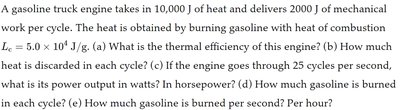
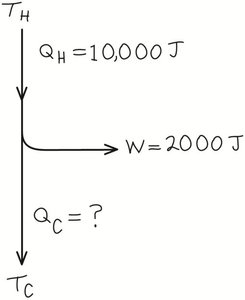
Consider a gasoline truck engine that takes in 10,000 J of heat and delivers 2,000 J of work per cycle. The thermal efficiency and other quantities can be calculated as follows:
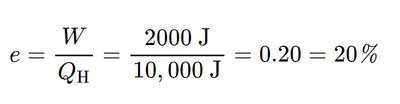
Thermal Efficiency:
Heat Discarded:
Power Output:
Horsepower:
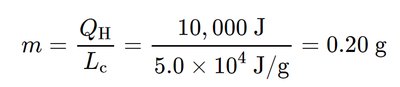
Gasoline Burned per Cycle:
Gasoline Burned per Second:
Gasoline Burned per Hour:


Internal-Combustion Engines
Four-Stroke Engine Cycle
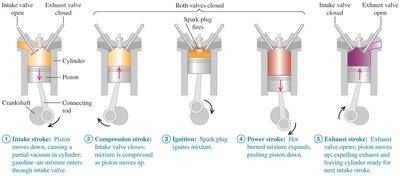
Internal-combustion engines, such as those in cars, operate on a four-stroke cycle:
Intake Stroke: Air-fuel mixture enters the cylinder.
Compression Stroke: Mixture is compressed adiabatically.
Power Stroke: Ignition causes rapid expansion, performing work.
Exhaust Stroke: Burned gases are expelled.

Otto Cycle (Gasoline Engine)
The Otto cycle is an idealized thermodynamic cycle describing the functioning of a typical gasoline engine. It consists of two adiabatic and two isochoric (constant volume) processes.
Adiabatic Compression (ab): The air-fuel mixture is compressed without heat exchange.
Isochoric Heating (bc): Combustion adds heat at constant volume.
Adiabatic Expansion (cd): The gas expands, performing work.
Isochoric Cooling (da): The gas is cooled at constant volume, rejecting heat.

Thermal Efficiency of Otto Cycle: Where is the compression ratio and is the ratio of heat capacities ().

Diesel Cycle
The Diesel cycle is similar to the Otto cycle but differs in the method of heat addition. In the Diesel engine, air is compressed to a higher ratio, and fuel is injected only after compression, allowing for higher efficiency and avoiding pre-ignition.
Key Difference: No fuel is present during the compression stroke, allowing for higher compression ratios and improved efficiency.
Refrigerators and Heat Pumps
Principle of Operation
A refrigerator is a device that transfers heat from a cold region (inside the refrigerator) to a warmer region (the room), requiring input of mechanical work. It operates as a heat engine in reverse.
Coefficient of Performance (K): The higher the value of , the more efficient the refrigerator.
Air Conditioners: Work on the same principle as refrigerators, transferring heat from inside to outside.
Statements of the Second Law
Kelvin–Planck Statement (Engine Statement)
It is impossible for any system to undergo a process in which it absorbs heat from a single reservoir and converts it entirely into work, with the system ending in its initial state.
Clausius Statement (Refrigerator Statement)
It is impossible for any process to have as its sole result the transfer of heat from a cooler to a hotter object.
The Carnot Cycle
Maximum Efficiency and Reversibility
The Carnot cycle is a theoretical, idealized heat engine cycle that achieves the maximum possible efficiency allowed by the second law. It consists of two isothermal and two adiabatic processes, all reversible.
Steps:
Isothermal expansion at (heat absorbed )
Adiabatic expansion (temperature drops to )
Isothermal compression at (heat rejected )
Adiabatic compression (returns to )
Carnot Efficiency:
No engine can be more efficient than a Carnot engine operating between the same two temperatures.
Entropy
Definition and Properties
Entropy is a measure of the randomness or disorder of a system. The second law can be restated in terms of entropy: in any natural process, the total entropy of all systems involved increases or remains constant (for reversible processes).
Entropy Change (Reversible Process):
SI Unit: Joule per kelvin (J/K)
For a reversible cyclic process: The total entropy change is zero.
For an irreversible process: The total entropy increases.
Statistical Interpretation: , where is the number of microscopic states corresponding to a macroscopic state.
Examples and Applications
Melting of Ice: Entropy increases as water molecules move from an ordered solid to a disordered liquid.
Mixing: Entropy increases as two substances mix and their molecules become more randomly distributed.
Adiabatic Process: For a reversible adiabatic process, (constant entropy).
Summary Table: Key Concepts in the Second Law of Thermodynamics
Concept | Definition | Key Equation |
|---|---|---|
Thermal Efficiency (e) | Fraction of heat converted to work | |
Carnot Efficiency | Maximum possible efficiency | |
Coefficient of Performance (K) | Efficiency of a refrigerator | |
Entropy Change () | Measure of disorder/randomness |
