 Back
BackThermal Energy, Specific Heat, and Entropy in Gases and Solids
Study Guide - Smart Notes
 Tailored notes based on your materials, expanded with key definitions, examples, and context.
Thermal Energy and Specific Heat
Thermal Energy in Monatomic Gases
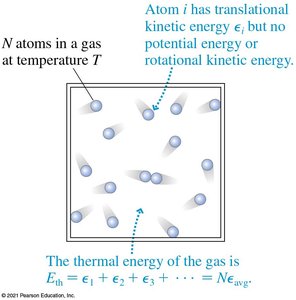
The thermal energy of a monatomic ideal gas is determined by the translational kinetic energy of its atoms. Each atom moves randomly, and the total energy is the sum of the kinetic energies of all atoms.
Thermal Energy Formula: For N atoms at temperature T, the total thermal energy is given by: where is the average kinetic energy per atom.
Monatomic Gas: Atoms have only translational kinetic energy, with no rotational or vibrational energy.
Specific Heat: The molar specific heat at constant volume for a monatomic gas is:
Degrees of Freedom
Degrees of freedom refer to the independent ways in which a system can store energy. For a monatomic gas, these are the three translational directions (x, y, z).
Translational Energy:
Other Modes: Diatomic and polyatomic molecules can also store energy in rotational and vibrational modes.
Definition: The number of degrees of freedom is the number of independent energy storage modes.
Equipartition Theorem
The equipartition theorem states that thermal energy is equally distributed among all degrees of freedom. For each degree of freedom, the energy per mole is or per particle .
Monatomic Gas: Three degrees of freedom (all translational):
Thermal Energy in Solids
Degrees of Freedom in Solids
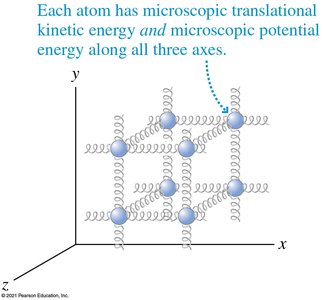
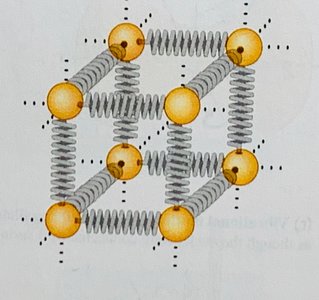
In solids, atoms are bound in a lattice and can vibrate about their equilibrium positions. Each atom has three translational and three vibrational (potential) degrees of freedom, totaling six.
Thermal Energy:
Potential and Kinetic Energy: Both contribute to the total energy in solids.
Dulong–Petit Law
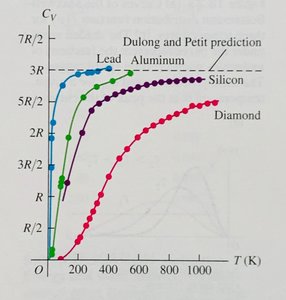
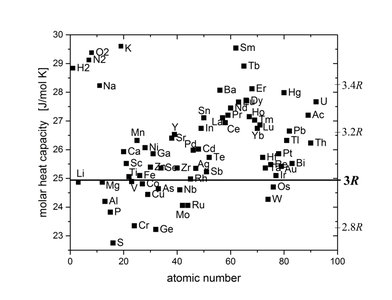
The Dulong–Petit law predicts that the molar heat capacity at constant volume for many solids is approximately at high temperatures. However, deviations occur at low temperatures or for certain materials.
Heat Capacity: for most solids at room temperature.
Deviations: Materials like diamond and silicon show lower heat capacities at low temperatures due to quantum effects.
Heat Transfer and Thermal Equilibrium
Thermal Interaction Between Systems
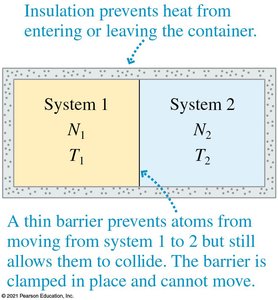
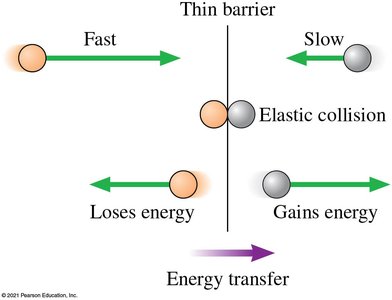
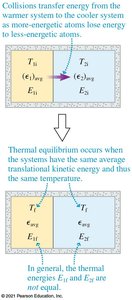
When two systems at different temperatures are separated by a thin barrier, energy is transferred via molecular collisions until thermal equilibrium is reached.
Energy Transfer: Heat flows from the hotter to the cooler system until both reach the same temperature.
Thermal Equilibrium: Achieved when the average kinetic energy (and thus temperature) is equal on both sides.
Irreversible and Reversible Processes
Irreversibility in Macroscopic Processes
Many natural processes, such as melting ice or mixing cream into coffee, are irreversible. The second law of thermodynamics explains this irreversibility through the concept of entropy.
Second Law of Thermodynamics: The entropy of an isolated system never decreases; it increases until equilibrium is reached.
Entropy: A measure of the dispersal of thermal energy.
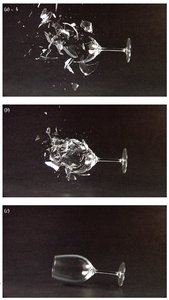
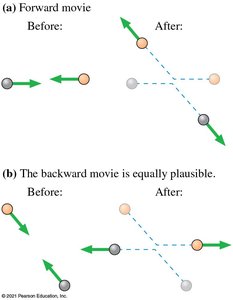
Microscopic Reversibility vs. Macroscopic Irreversibility
While molecular collisions are reversible, the overall dispersal of energy in a system is not. Energy spontaneously spreads out and does not reconcentrate in one place.
Entropy and Its Statistical Interpretation
Microstates, Macrostates, and Multiplicity
Entropy quantifies the number of microscopic arrangements (microstates) corresponding to a macroscopic state (macrostate). The multiplicity is the number of microstates for a given macrostate.
Entropy Formula:
Most Probable State: The equilibrium macrostate has the highest multiplicity and thus the highest entropy.
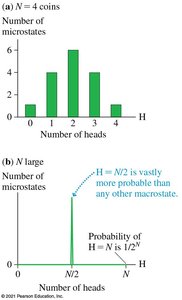
Entropy Change in Processes
The change in entropy for a reversible process is given by:
For an isothermal process:
Entropy in Phase Changes and Heating
Phase Change (e.g., melting ice): , where is the heat absorbed at constant temperature.
Heating at Constant Specific Heat:
Entropy of an Ideal Gas
The entropy change for an ideal gas can be calculated as:
For constant pressure:
Entropy and the Universe
Entropy in Isolated and Non-Isolated Systems
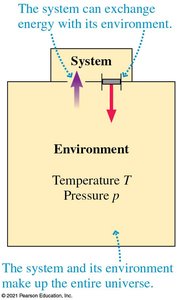
For an isolated system, the total entropy change is always non-negative:
For a system and its environment:
Free Expansion and Entropy
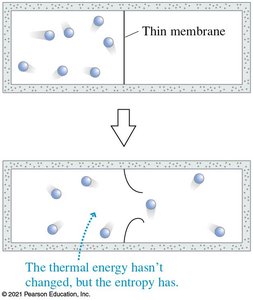
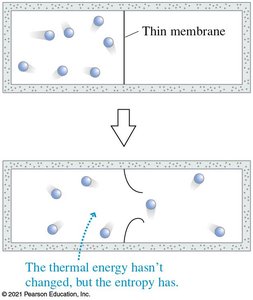
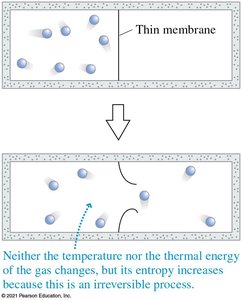
When a gas expands freely into a larger volume, its entropy increases even though its thermal energy does not change. This is an example of an irreversible process.
Summary Table: Degrees of Freedom and Specific Heat
System | Degrees of Freedom | Thermal Energy | Specific Heat |
|---|---|---|---|
Monatomic Gas | 3 (translational) | ||
Diatomic Gas | 5 (3 translational, 2 rotational) | ||
Solid | 6 (3 translational, 3 vibrational) |
Key Equations
Thermal Energy (Monatomic Gas):
Equipartition Theorem: (where is degrees of freedom)
Entropy (Statistical):
Entropy Change (Reversible):
Entropy Change (Heating):
Entropy Change (Ideal Gas):
Additional info: The notes above integrate the main textbook content, relevant equations, and the most directly relevant images to reinforce key concepts in thermal energy, specific heat, and entropy, as covered in college-level physics courses.
