 Back
BackThermal Expansion: Linear and Volume Expansion in Materials
Study Guide - Smart Notes
 Tailored notes based on your materials, expanded with key definitions, examples, and context.
Thermal Expansion
Introduction to Thermal Expansion
Thermal expansion refers to the tendency of matter to change its shape, area, and volume in response to a change in temperature. This phenomenon is important in understanding the behavior of solids, liquids, and gases under thermal conditions, and has significant practical implications in engineering and everyday life.
Linear Expansion: Change in length of an object due to temperature increase.
Volume Expansion: Change in volume of an object due to temperature increase.
Physical Properties Used in Thermometers
Thermometers utilize the thermal expansion of materials to measure temperature. The most common types use the expansion of liquids (such as mercury or ethanol) within a glass capillary.
Capillary tube: Small volume allows precise measurement of liquid expansion.
Glass wall: Provides structural support and thermal isolation.
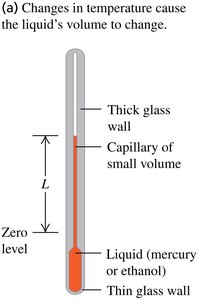
Linear Thermal Expansion
1D Case: Linear Expansion of a Rod
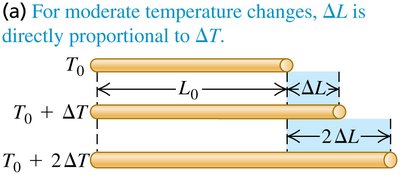
When a rod of material is heated, its length increases. For moderate temperature changes (typically less than 100°C), the change in length is linearly proportional to the temperature change.
Original length:
Temperature change:
Change in length:
Formula:
Coefficient of linear expansion: (units: )

Molecular Basis for Thermal Expansion
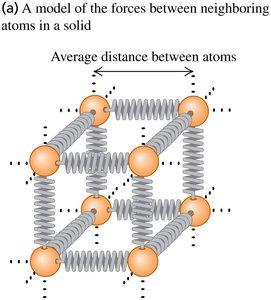
Atoms in solids are held together by interatomic forces, often modeled as springs. As temperature increases, atomic vibrations increase, leading to greater average distances between atoms and thus expansion in all dimensions.
Microscopic changes: Increased atomic separation with temperature.
Macroscopic effect: Observable increase in length and volume.
Coefficients of Linear Expansion
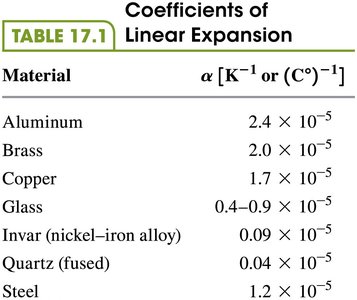
The coefficient of linear expansion quantifies how much a material expands per unit temperature change. Different materials have different values of , affecting their suitability for various applications.
Typical values: Solids: to per K.
Examples: Aluminum, brass, copper, glass, steel, quartz.
Material | Coefficient () |
|---|---|
Aluminum | |
Brass | |
Copper | |
Glass | |
Invar | |
Quartz | |
Steel |
Applications and Examples of Thermal Expansion
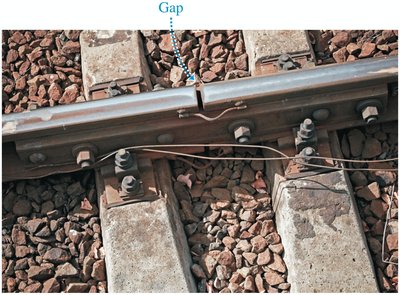
Thermal expansion is a small but significant effect in engineering. Gaps are left between segments of railroad tracks and bridges to accommodate expansion and prevent structural damage.
Railroad tracks: Gaps prevent buckling in hot weather.
Bridges: Expansion joints allow for movement.
Windows: Rubber spacers accommodate metal frame expansion.
Expanding Holes
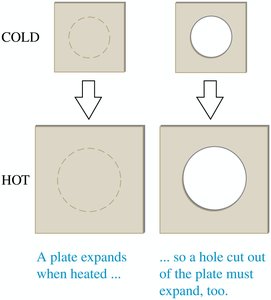
When an object with a hole is heated, every linear dimension—including the hole—expands. The hole does not shrink; it increases in size proportionally with the rest of the object.
Volume Expansion
3D Case: Volume Expansion
For three-dimensional objects, thermal expansion results in an increase in volume. The change in volume is given by:
Formula:
Coefficient of volume expansion:
Relationship: for isotropic solids
For a cube of side , . If is the temperature change:
Liquids can only expand in volume, not in linear dimensions. Liquids generally have higher coefficients of expansion than solids. Gases behave differently and are described by gas laws.
Volume Expansion Example
Consider a glass vessel filled with mercury. When heated, both the mercury and the glass expand, but mercury expands more, causing overflow.
Mercury volume increase:
Glass volume increase:
Overflow: Mercury overflows by the difference in expansion.
Thermal Expansion of Water
Anomalous Behavior of Water
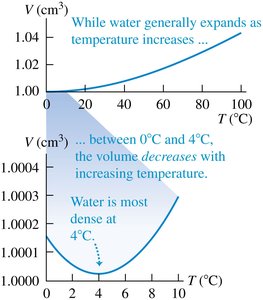
Most materials expand when heated, but water exhibits unique behavior. Between 0°C and 4°C, water decreases in volume with increasing temperature, showing negative . Water is most dense at 4°C, which has important ecological consequences.
Ice is less dense than liquid water: Causes ice to float and pipes to burst when frozen.
Density maximum at 4°C: Ensures lakes and rivers freeze from the top down, protecting aquatic life.
Summary Table: Thermal Expansion Properties
Type | Formula | Coefficient |
|---|---|---|
Linear Expansion | ||
Volume Expansion |
Key Points
Thermal expansion is a fundamental property of materials.
Linear and volume expansion are described by coefficients and .
Water has anomalous expansion behavior, crucial for environmental stability.
Additional info: The notes include expanded academic context and examples to ensure completeness and clarity for exam preparation.
