 Back
BackThermodynamics and the Ideal Gas Law: Study Notes
Study Guide - Smart Notes
 Tailored notes based on your materials, expanded with key definitions, examples, and context.
The Ideal Gas Model
Definition and Assumptions
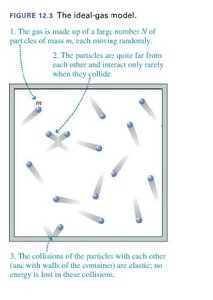
The ideal gas model is a theoretical framework in which gas molecules are treated as hard spheres that do not interact except during elastic collisions. This model is valid under conditions of low density, high temperature (well above condensation), and absence of chemical reactions.
Key Assumptions:
Large number of particles, each with mass m, moving randomly.
Particles are far apart and interact only during collisions.
Collisions are perfectly elastic; no energy is lost.
Applications: The ideal gas model is widely used to describe the behavior of real gases under standard laboratory conditions.
Pressure and Molecular Collisions
Microscopic and Macroscopic Views
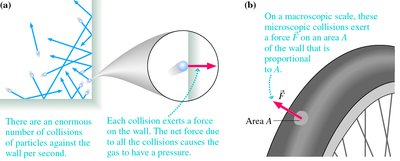
Gas pressure arises from the collective effect of countless molecular collisions with the walls of a container. Each collision imparts a force, and the sum of these forces over the area of the wall results in the observed pressure.
Microscopic View: Individual molecules collide with the wall, exerting force.
Macroscopic View: The total force F exerted on an area A is proportional to A.
The Ideal Gas Law
Empirical Relationships
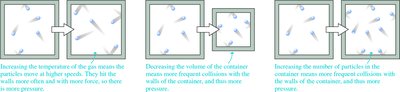
The ideal gas law relates the pressure, volume, temperature, and number of particles (or moles) in a gas. It is derived from experimental observations:
Pressure is proportional to temperature:
Pressure is inversely proportional to volume:
Pressure is proportional to the number of particles:
Mathematical Formulation
Ideal Gas Law (moles):
Ideal Gas Law (particles):
Universal Gas Constant:
Boltzmann Constant:
Molecules, Moles, and Avogadro's Number
Atomic and Molecular Mass
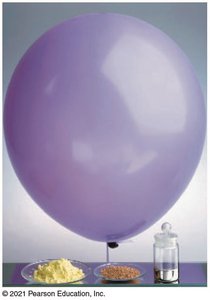
The mass of an atom is primarily determined by its protons and neutrons. The atomic mass unit (u) is defined such that the mass of a C atom is exactly 12 u.
Molecular Mass: Sum of atomic masses in a molecule (e.g., has 32 u).
One mole: particles (Avogadro's number, ).
Kinetic Theory of Gases
Average Kinetic Energy
The average kinetic energy of a gas molecule is directly proportional to the temperature:
Formula:

Distribution of Molecular Speeds
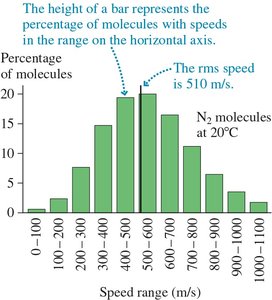
At a given temperature, not all molecules move at the same speed. The distribution of speeds is described by the Maxwell-Boltzmann distribution.
Root-mean-square (rms) speed: Typical speed of molecules at a given temperature.
pV Diagrams and Thermodynamic Processes
State Variables and pV Diagrams
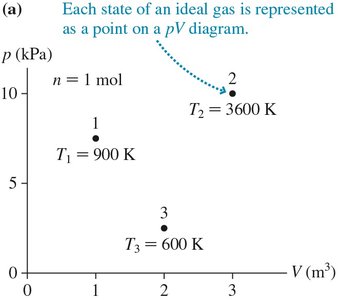
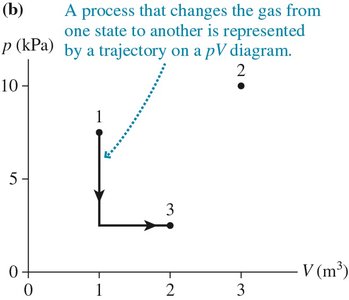
Each point on a pV diagram represents a unique state of the gas, defined by its pressure and volume. Changes in state are represented as trajectories on the diagram.
Work Done by/on a Gas
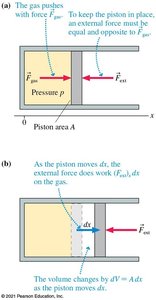
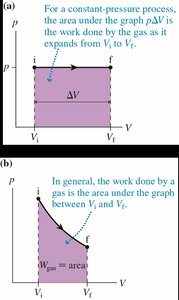
The work done by or on a gas during a volume change is given by the area under the pV curve:
General formula:
Constant pressure:
Special Thermodynamic Processes
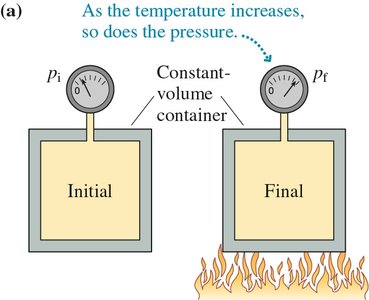
Constant Volume (Isochoric): , so ; all energy transfer is as heat.
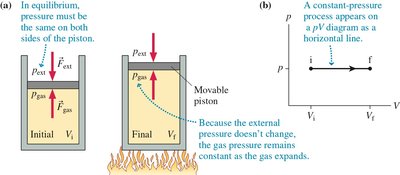
Constant Pressure (Isobaric): ; work is .
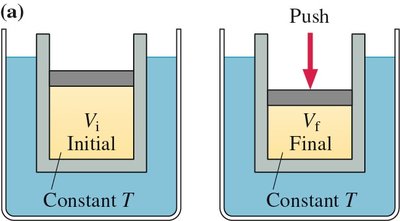
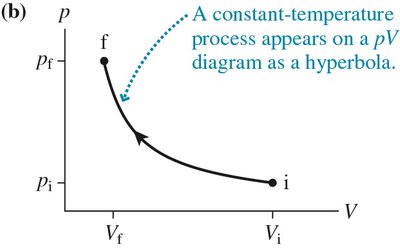
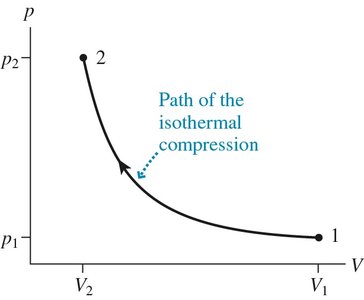
Constant Temperature (Isothermal): ; , process is a hyperbola on a pV diagram.
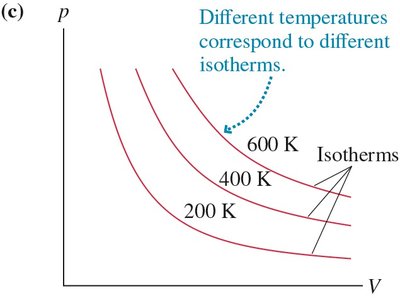
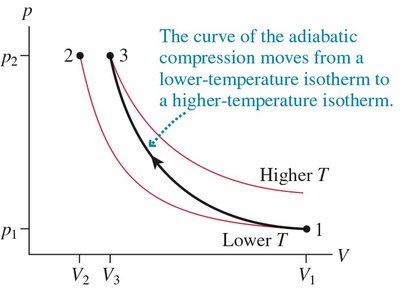
Adiabatic: ; all energy transfer is as work. Adiabatic processes move between isotherms on a pV diagram.
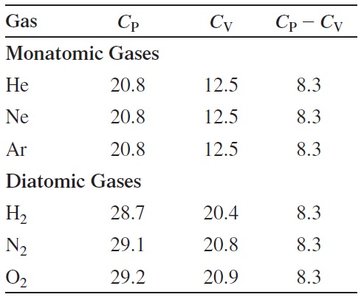
Specific Heats of Gases
Definitions and Values
The molar specific heat is the amount of heat required to raise the temperature of one mole of a substance by one kelvin. For gases, two specific heats are defined:
At constant volume:
At constant pressure:
Relationship:
Degrees of Freedom and the Equipartition Theorem
Degrees of Freedom
The number of independent ways in which a molecule can store energy is called its degrees of freedom. For example:
Monatomic gas: 3 translational degrees of freedom.
Diatomic gas: 5 degrees of freedom (3 translational + 2 rotational at room temperature).
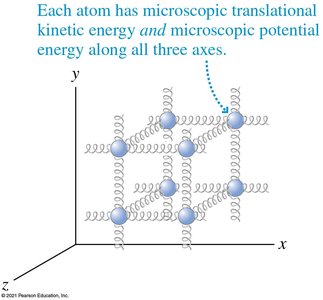
Solid: 6 degrees of freedom (3 translational + 3 vibrational).
Equipartition Theorem
The equipartition theorem states that each degree of freedom contributes to the average energy per molecule.
Monatomic gas:
Diatomic gas:
Solid:
Enthalpy and the First Law of Thermodynamics
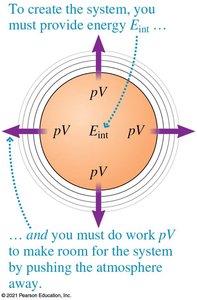
Enthalpy
Enthalpy () is a state variable defined as . For a constant-pressure process, the change in enthalpy equals the heat added to the system.
First Law of Thermodynamics
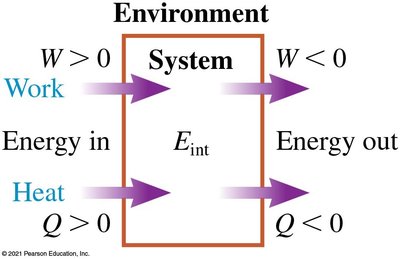
The first law of thermodynamics is a statement of energy conservation for thermodynamic systems:
Equation:
Interpretation: Internal energy changes due to heat added and work done on the system.
Summary Table: Molar Specific Heats of Gases
Gas | C_P | C_V | C_P - C_V |
|---|---|---|---|
He | 20.8 | 12.5 | 8.3 |
Ne | 20.8 | 12.5 | 8.3 |
Ar | 20.8 | 12.5 | 8.3 |
H2 | 28.7 | 20.4 | 8.3 |
N2 | 29.1 | 20.8 | 8.3 |
O2 | 29.2 | 20.9 | 8.3 |
