 Back
Thermodynamics, Energy, and Statistical Physics: Study Notes for Physics with Calculus
Study Guide - Smart Notes
 Tailored notes based on your materials, expanded with key definitions, examples, and context.
Thermodynamics and Statistical Physics
Introduction to Thermodynamics
Thermodynamics is the branch of physics that deals with heat, work, and the associated energy transformations. It is fundamental to understanding how energy is transferred and conserved in physical systems, and is especially relevant in the context of life sciences and engineering.
Thermal Energy: The internal energy of a system due to the random motion of its particles.
Heat: The transfer of thermal energy from one object to another due to a temperature difference.
Statistical Physics: Explains macroscopic properties (like temperature and pressure) in terms of microscopic behavior of atoms and molecules.
Key Laws of Thermodynamics
First Law of Thermodynamics (Law of Energy Conservation): Energy cannot be created or destroyed, only transferred or transformed. The total energy of an isolated system remains constant.
Second Law of Thermodynamics: The entropy of an isolated system always increases over time. This law explains why certain processes are irreversible and why heat flows from hot to cold objects.
Example: When a block is placed on a surface and allowed to cool, energy is transferred from the block to the air, increasing the entropy of the system.
Energy Forms and Equations
Energy in physics can take several forms, including kinetic energy, potential energy, and thermal energy. The following equations are fundamental:
Kinetic Energy (KE):
Potential Energy (PE):
Where m is mass, v is velocity, g is the acceleration due to gravity, and h is height.
Irreversibility and Entropy
While energy is always conserved (First Law), not all processes are reversible. The Second Law of Thermodynamics states that processes tend to increase the disorder (entropy) of a system. For example, heat spontaneously flows from a hot block to the cooler air, but the reverse process (heat flowing from air to the block) is extremely unlikely.
Irreversible Processes: Processes that cannot spontaneously reverse direction, such as heat transfer from hot to cold.
Entropy: A measure of the disorder or randomness in a system. Entropy increases in spontaneous processes.
Example: The cooling of a block in air is an irreversible process, governed by the Second Law.
Oscillations and Waves
Introduction to Oscillations
Oscillations refer to repetitive variations, typically in time, of some physical quantity about a central value. Waves are disturbances that transfer energy from one place to another without transferring matter.
Mechanical Oscillations: Occur in systems like springs and pendulums.
Wave Motion: Includes sound waves, light waves, and water waves.
Optics
Introduction to Optics
Optics is the study of light and its interactions with matter. It includes topics such as reflection, refraction, and the behavior of lenses and mirrors.
Ray Optics: Describes the propagation of light as rays.
Wave Optics: Considers the wave nature of light, including interference and diffraction.
Electric Fields and Circuits
Introduction to Electric Fields
Electric fields are regions around charged particles where other charges experience a force. Circuits involve the flow of electric current through various components.
Electric Field: A vector field representing the force per unit charge at each point in space.
Circuits: Arrangements of electrical components through which current flows.
Table: Comparison of Energy Types
Energy Type | Formula | Example |
|---|---|---|
Kinetic Energy | Moving car | |
Potential Energy | Elevated block | |
Thermal Energy | Depends on temperature and mass | Heated block |
Atomic Structure and Thermal Properties
Atomic Structure in Solids
Solids are composed of atoms arranged in a regular lattice structure. The thermal properties of solids are determined by the vibrations of these atoms within the lattice.
Lattice Structure: The regular, repeating arrangement of atoms in a solid.
Thermal Vibrations: Atoms vibrate about their equilibrium positions, contributing to the thermal energy of the solid.
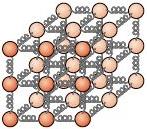
Example: The image above shows a typical atomic lattice structure, illustrating how atoms are connected and vibrate within a solid.
