 Back
BackThermodynamics: Temperature, Thermal Expansion, and Heat- lecture 27
Study Guide - Smart Notes
 Tailored notes based on your materials, expanded with key definitions, examples, and context.
Thermodynamics
Temperature
Temperature is a measure of the average molecular kinetic energy (internal energy) of a material. It is a fundamental concept in thermodynamics and is used to quantify how hot or cold an object is. The most common temperature scales are Celsius, Fahrenheit, and Kelvin.
Celsius (°C): Widely used in science, with 0°C as the freezing point and 100°C as the boiling point of water at 1 atm pressure.
Fahrenheit (°F): Common in the United States, with 32°F as the freezing point and 212°F as the boiling point of water.
Kelvin (K): The SI unit for temperature, starting at absolute zero (the lowest possible temperature). 0 K = -273.15°C.
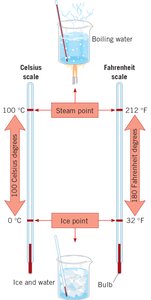
Temperature Conversion Formulas:
From Fahrenheit to Celsius:
From Celsius to Fahrenheit:
From Celsius to Kelvin:
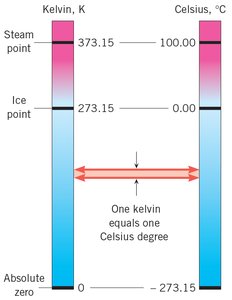
Key Points:
Temperature changes are measured in degrees Celsius (°C), Fahrenheit (°F), or kelvin (K).
1 K change is equivalent to a 1°C change.
Kelvin does not use the term "degree"; it is simply "kelvin" (K).
Thermal Expansion
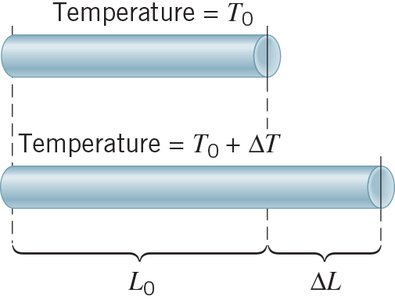
Thermal expansion is the tendency of matter to change its shape, area, and volume in response to a change in temperature. This occurs because particles move more and occupy more space as temperature increases.
Linear Thermal Expansion: The change in length () of an object is proportional to its original length () and the change in temperature ():
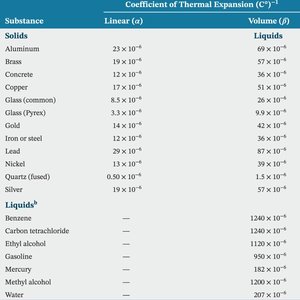
is the linear thermal expansion coefficient (unit: ).
Volume Thermal Expansion: The change in volume () is given by:
is the volume thermal expansion coefficient (unit: ).
For most solids, .
Different materials expand at different rates, characterized by their expansion coefficients.
Example: When a metal lid is stuck on a glass jar, running hot water over the lid causes it to expand more than the glass, making it easier to open.
Heat
Heat is the energy that flows from a hotter object to a colder one due to a temperature difference. The SI unit of heat is the joule (J). Another common unit is the calorie (cal), where 1 cal = 4.186 J. In nutrition, the Calorie (Cal) is used, which is equal to 1000 cal or 4186 J.
Heat transfer continues until thermal equilibrium is reached (no temperature difference).
Heat can cause a change in temperature or a change in phase (state) of a substance.
Heat and Temperature Change
The amount of heat () required to change the temperature of a mass () of a substance with specific heat capacity () by is:
Specific heat capacity (c): The amount of heat needed to raise the temperature of 1 kg of a substance by 1°C (unit: ).
Heat and Phase Change
When a substance undergoes a phase change (e.g., melting, boiling), the temperature remains constant until the phase change is complete. The heat required for a phase change is called latent heat ():
Latent heat of fusion (): For melting/freezing.
Latent heat of vaporization (): For boiling/condensing.
Latent heat of sublimation (): For sublimation/deposition.
Example: The total heat to raise a substance from below its boiling point to above its boiling point:
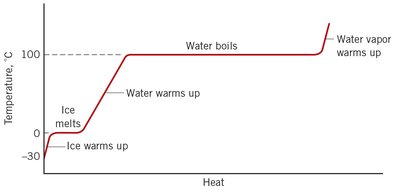
Key Points:
During a phase change, temperature does not change until the phase transition is complete.
Latent heat is measured in .
