 Back
Thermodynamics: The First Law and Thermodynamic Processes
Study Guide - Smart Notes
 Tailored notes based on your materials, expanded with key definitions, examples, and context.
The First Law of Thermodynamics
Introduction to the First Law
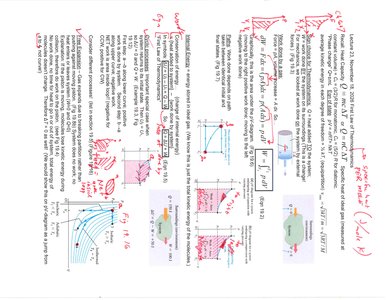
The First Law of Thermodynamics is a fundamental principle describing the conservation of energy in thermodynamic systems. It states that the change in internal energy of a system is equal to the heat added to the system minus the work done by the system on its surroundings.
Internal Energy (U): The total energy contained within a system, including kinetic and potential energies at the molecular level.
Heat (Q): Energy transferred between systems due to temperature difference.
Work (W): Energy transferred when a force is applied over a distance.
Mathematical Statement:
Where is the change in internal energy, is the heat added to the system, and is the work done by the system.
Thermodynamic Processes
Thermodynamic processes describe how a system changes from one state to another, often visualized on a Pressure-Volume (P-V) diagram. The main types of processes are:
Isothermal Process: Occurs at constant temperature (). For an ideal gas, .
Adiabatic Process: No heat exchange (). All energy change is due to work.
Isochoric Process: Constant volume (). No work is done ().
Isobaric Process: Constant pressure (). Work is given by .
Example: In an isothermal expansion of an ideal gas, the work done is:
where is the number of moles, is the gas constant, is the temperature, and are final and initial volumes.
Work, Heat, and Internal Energy in Thermodynamic Cycles
Thermodynamic Cycles
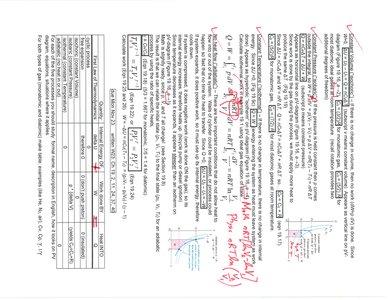
A thermodynamic cycle consists of a series of processes that return a system to its initial state. The net work done over a cycle is equal to the net heat added.
Work in Cycles: Represented by the area enclosed in a P-V diagram.
Heat Transfer: Can be positive (added to system) or negative (removed from system).
Internal Energy: Returns to original value after a complete cycle ().
Example: Carnot cycle, Otto cycle, and other engine cycles are analyzed using these principles.
Properties of Ideal Gases and State Variables
Ideal Gas Law and State Variables
The Ideal Gas Law relates the pressure, volume, and temperature of an ideal gas:
Pressure (P): Force per unit area exerted by gas molecules.
Volume (V): Space occupied by the gas.
Temperature (T): Measure of average kinetic energy of molecules.
Number of moles (n): Amount of substance.
State variables describe the condition of a system and are used to track changes during thermodynamic processes.
Tabular Comparison of Processes
The following table summarizes key properties of different thermodynamic processes:
Process | Constant Variable | Heat (Q) | Work (W) | Internal Energy Change () |
|---|---|---|---|---|
Isothermal | Temperature | Q = W | 0 | |
Adiabatic | No heat | 0 | Calculated from | |
Isochoric | Volume | 0 | ||
Isobaric | Pressure |
Sample Calculations and Problem Solving
Worked Example: Thermodynamic Cycle Calculation
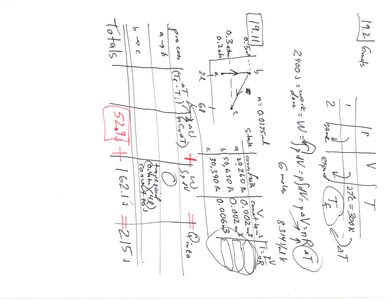
Sample calculations involve determining work, heat, and internal energy changes for each step in a cycle. The process typically includes:
Identifying the type of process (isothermal, adiabatic, etc.)
Applying the First Law of Thermodynamics
Using the Ideal Gas Law to relate variables
Calculating work and heat for each step
Summing values for the complete cycle
Example: Calculating total work and heat for a multi-step cycle involving changes in pressure, volume, and temperature.
Additional info: The notes include handwritten annotations and diagrams that reinforce the understanding of thermodynamic processes, cycles, and calculations. The content is directly relevant to Chapter 19: The First Law of Thermodynamics and Chapter 18: Thermal Properties of Matter.
