 Back
BackTranslational and Rotational Kinematics: Definitions, Key Terms, and Example Problems
Study Guide - Smart Notes
 Tailored notes based on your materials, expanded with key definitions, examples, and context.
Translational and Rotational Kinematics
Definitions
Kinematics is the branch of physics that describes the motion of objects without considering the forces that cause the motion. It is divided into two main types: translational kinematics (linear motion) and rotational kinematics (angular motion).
Translational Kinematics: Studies the motion of an object in which all parts move the same distance in the same direction over time.
Rotational Kinematics: Studies the motion of an object that rotates about a fixed axis, where different points move in circular paths around the axis.
Key Terms in Rotational and Translational Kinematics
Glossary of Important Terms
Understanding the following terms is essential for mastering kinematics:
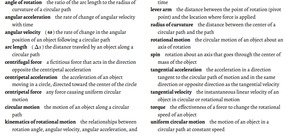
Angular displacement (θ): The angle of the arc length as it relates to the radius of curvature of a circular path.
Angular acceleration (α): The rate of change of angular velocity.
Angular velocity (ω): The rate of change in the angular position of an object following a circular path.
Arc length (s): The distance traveled by an object along a circular path.
Centrifugal force: A fictitious force that acts in the direction opposite to centripetal acceleration.
Centripetal acceleration: The acceleration of an object moving in a circle, directed toward the center of the circle.
Centripetal force: Any force causing uniform circular motion.
Circular motion: The motion of an object along a circular path.
Kinematics of rotational motion: The relationships between rotation angle, angular velocity, angular acceleration, and time.
Lever arm: The distance between the point of rotation (pivot point) and the location where force is applied.
Radius of curvature: The distance between the center of a circular path and the path.
Rotational motion: The circular motion of an object about an axis of rotation.
Axis of rotation: An axis that goes through the center of mass of the object.
Spin: Rotation about an axis that goes through the center of mass of the object.
Tangential acceleration: The acceleration in a direction tangent to the circular path of motion and in the same direction as the velocity vector.
Tangential velocity: The instantaneous linear velocity of an object in circular or rotational motion.
Torque (τ): The effectiveness of a force to change the rotational motion of an object.
Uniform circular motion: The motion of an object in a circular path at constant speed.
Translational Kinematics
Overview
Translational kinematics describes the motion of objects where every point moves identically. This includes both linear (straight-line) and curvilinear (curved path) motion.
Displacement (d): The change in position of an object.
Velocity (v): The rate of change of displacement.
Acceleration (a): The rate of change of velocity.
All points on the object have the same velocity and acceleration in translational motion.
Rotational Kinematics
Overview
Rotational kinematics focuses on objects rotating about a fixed axis. Different points on the object move in circular paths, and points farther from the axis move faster (greater linear speed).
Angular displacement (θ): The angle through which a point or line has been rotated in a specified sense about a specified axis.
Angular velocity (ω): The rate of change of angular displacement.
Angular acceleration (α): The rate of change of angular velocity.
Translational and Rotational Kinematics: Key Formulas and Relationships
Comparison Table
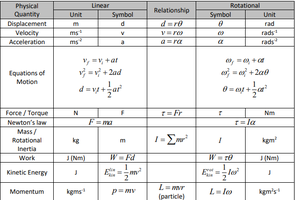
The following table summarizes the main physical quantities, their units, symbols, and the relationships between linear and rotational motion:
Physical Quantity | Linear | Rotational | |||
|---|---|---|---|---|---|
Unit | Symbol | Relationship | Symbol | Unit | |
Displacement | m | d | \theta | rad | |
Velocity | m\,s^{-1} | v | \omega | rad\,s^{-1} | |
Acceleration | m\,s^{-2} | a | \alpha | rad\,s^{-2} | |
Equations of Motion |
|
| |||
Force / Torque | |||||
Newton's Law | |||||
Mass / Rotational Inertia | kg | m | I | kgm^2 | |
Work | J (Nm) | J (Nm) | |||
Kinetic Energy | |||||
Momentum | |||||
Example Problem: Calculating the Acceleration of a Fishing Reel
Worked Example
A deep-sea fisherman hooks a big fish that swims away from the boat, pulling the fishing line from his fishing reel. The system is initially at rest, and the fishing line unwinds from the reel at a radius of 4.50 cm from its axis of rotation. The reel is given an angular acceleration of 110 rad/s2.
What is the final angular velocity of the reel after 2.00 s?
At what speed is the fishing line leaving the reel after 2.00 s?
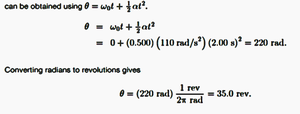
How many revolutions does the reel make in this time? To convert radians to revolutions:
How many meters of fishing line come off the reel in this time?
Additional info: The above example demonstrates the direct application of rotational kinematics equations to a real-world scenario, reinforcing the connection between angular and linear quantities.
