 Back
BackTraveling and Standing Waves: Step-by-Step Physics Guidance
Study Guide - Smart Notes
 Tailored notes based on your materials, expanded with key definitions, examples, and context.
Q15.5. How does the speed of a wave pulse on a string change if (a) the tension is doubled, (b) the mass is quadrupled, (c) the length is quadrupled, or (d) both mass and length are quadrupled?
Background
Topic: Wave Speed on a String
This question tests your understanding of how the speed of a wave on a string depends on the string's tension and linear mass density. You are asked to predict how changes in physical parameters affect the wave speed.
Key formula:
The speed of a wave on a stretched string is given by:
Where:
= wave speed (m/s)
= tension in the string (N)
= linear mass density (kg/m),
Step-by-Step Guidance
For each scenario, identify how (tension) and (linear mass density) change compared to the original string.
Recall that , so changes in mass or length will affect .
Substitute the new values of and into the wave speed formula to see how changes.
For each part (a)-(d), set up the ratio to compare the new speed to the original speed.
Express the new speed in terms of the original speed, but do not calculate the final value yet.
Try solving on your own before revealing the answer!
P15.8. A boat is at the crest of an ocean wave (wavelength 160 m, speed 56 km/h). How much time until it is first at the trough?
Background
Topic: Wave Motion and Period
This question tests your ability to relate wave speed, wavelength, and period, and to use these to find the time between a crest and a trough.
Key formulas:
Wave speed:
Period:
Step-by-Step Guidance
Convert the wave speed to m/s if necessary.
Use to solve for the frequency .
Calculate the period using .
Remember that the time from crest to trough is half a period ().
Try solving on your own before revealing the answer!
P15.18. For the wave , what are (a) the frequency, (b) the wavelength, and (c) the speed?
Background
Topic: Mathematical Description of a Traveling Wave
This question tests your ability to extract physical parameters from a wave equation in cosine form.
Key formulas:
General wave:
Wavenumber:
Angular frequency:
Wave speed:
Step-by-Step Guidance
Identify and from the equation and relate them to and .
Solve for the frequency using .
Solve for the wavelength using .
Set up the calculation for the wave speed .
Try solving on your own before revealing the answer!
P15.20. From the snapshot graph of a wave (see Figure P15.20), what are the amplitude, wavelength, and frequency?
Background
Topic: Reading Wave Properties from a Graph
This question tests your ability to extract amplitude, wavelength, and frequency from a displacement vs. position graph of a wave.
Key formulas:
Amplitude: Maximum displacement from equilibrium
Wavelength: Distance between consecutive peaks
Frequency:
Step-by-Step Guidance
Identify the amplitude by measuring the maximum displacement on the graph.
Determine the wavelength by finding the distance between two consecutive peaks.
Use the given wave speed and the measured wavelength to set up the calculation for frequency using .
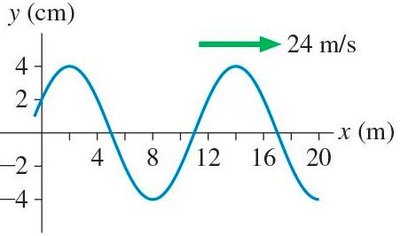
Try solving on your own before revealing the answer!
P15.21. From the history graph at m (see Figure P15.21), what are the amplitude, frequency, and wavelength of the wave moving right at 2 m/s?
Background
Topic: Reading Wave Properties from a History Graph
This question tests your ability to extract amplitude, period, and then use wave speed to find wavelength from a displacement vs. time graph at a fixed position.
Key formulas:
Amplitude: Maximum displacement from equilibrium
Period: Time for one complete cycle
Frequency:
Wavelength:
Step-by-Step Guidance
Identify the amplitude by measuring the maximum displacement on the graph.
Determine the period by measuring the time for one complete cycle.
Calculate the frequency using .
Set up the calculation for the wavelength using .
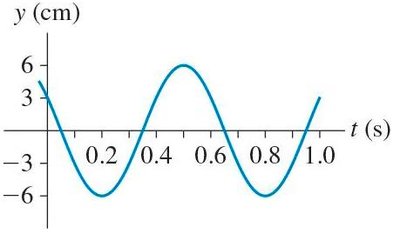
Try solving on your own before revealing the answer!
Q16.2. After two wave pulses (one large, one small) pass through each other on a string, which statement is correct?
Background
Topic: Superposition Principle for Waves
This question tests your understanding of what happens when two wave pulses overlap and then separate on a string.
Key concept:
Superposition Principle: When two waves overlap, the resulting displacement is the sum of the individual displacements. After passing through each other, each wave continues unaffected.
Step-by-Step Guidance
Recall that the superposition principle means waves add their displacements only while overlapping.
After the pulses pass, each continues in its original direction with its original amplitude and speed (unless there is a boundary or energy loss).
Review each statement and eliminate those that contradict the principle of superposition.
Try solving on your own before revealing the answer!
P16.5. For two waves approaching each other at 1 m/s on a string (see Figure P16.5), what is the displacement at m at 1 s intervals from to s?
Background
Topic: Superposition and Wave Motion
This question tests your ability to track the motion of two wave pulses and apply the principle of superposition to find the net displacement at a specific point over time.
Key concepts:
Wave translation: Each pulse moves at 1 m/s, so after seconds, each has moved meters.
Superposition: The net displacement at a point is the sum of the displacements from both waves at that point and time.
Step-by-Step Guidance
At each time interval, determine the new position of each pulse relative to m.
For each time, add the displacements from both pulses at m.
Repeat for to s, noting when the pulses overlap or are absent at m.
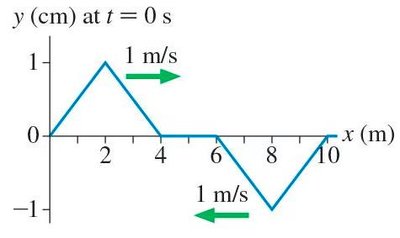
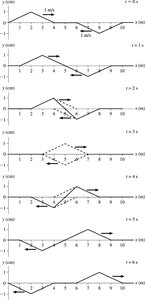
Try solving on your own before revealing the answer!
P16.9. A 2.0-m string fixed at both ends forms a standing wave (see Figure P16.9) with wave speed 40 m/s. What is the frequency of this standing wave?
Background
Topic: Standing Waves on a String
This question tests your ability to relate the length of the string, the number of wavelengths, and the wave speed to find the frequency of a standing wave.
Key formulas:
Wavelength for standing waves: , where is the number of antinodes (or loops)
Wave speed:
Step-by-Step Guidance
Count the number of wavelengths present in the string from the figure.
Calculate the wavelength using the string length and the number of wavelengths.
Set up the calculation for the frequency using .

Try solving on your own before revealing the answer!
P16.15. A guitar string (2.0 g/m, 60 cm long) forms a standing wave with three antinodes at 420 Hz. What are (a) the frequency of the fifth harmonic and (b) the tension in the string?
Background
Topic: Harmonics and Tension in a Vibrating String
This question tests your understanding of harmonics, standing waves, and the relationship between frequency, wavelength, and tension in a string.
Key formulas:
Harmonic frequencies:
Wavelength for th harmonic:
Wave speed:
Tension:
Step-by-Step Guidance
Identify the harmonic number for three antinodes and relate it to the given frequency.
Calculate the fundamental frequency and use it to find the fifth harmonic frequency .
Find the wavelength for the relevant harmonic using the string length.
Calculate the wave speed using .
Set up the calculation for the tension using , making sure to convert units as needed.
Try solving on your own before revealing the answer!
