 Back
Traveling Waves and Sound: Physics with Calculus Study Notes
Study Guide - Smart Notes
 Tailored notes based on your materials, expanded with key definitions, examples, and context.
Traveling Waves and Sound
Introduction to Waves
Traveling waves are fundamental phenomena in physics, describing the propagation of disturbances through a medium or field. This chapter explores the properties, types, and mathematical descriptions of waves, with a focus on mechanical and sound waves.
The Wave Model
Wave Model: Describes the basic properties of waves, emphasizing behaviors common to all waves.
Traveling Wave: An organized disturbance that moves with a well-defined speed through a medium.
Medium: The substance through which a mechanical wave travels.
Energy Transfer: Waves transfer energy, not material, from the source outward.
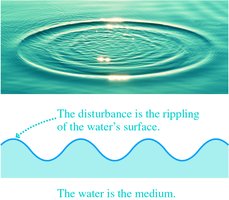
Mechanical and Electromagnetic Waves
Mechanical Waves: Require a material medium (e.g., water, air, string).
Electromagnetic Waves: Waves of electromagnetic fields (e.g., light, radio waves) that do not require a medium and can travel through a vacuum.
Types of Waves
Transverse and Longitudinal Waves
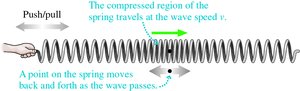
Waves are classified based on the direction of particle motion relative to wave propagation:
Transverse Waves: Particles move perpendicular to the direction of wave travel (e.g., waves on a string).
Longitudinal Waves: Particles move parallel to the direction of wave travel (e.g., sound waves, spring compression).
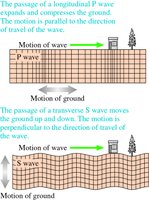
Earthquake Waves
S Waves (Transverse): Move ground up and down, perpendicular to wave direction.
P Waves (Longitudinal): Compress and expand ground, parallel to wave direction.
Wave Propagation and Medium Response
Motion of Wave vs. Motion of Medium
Wave Motion: The disturbance moves through the medium.
Medium Motion: Particles oscillate but do not travel with the wave.
Newton's Laws: Apply to the medium's particles, not the wave itself.
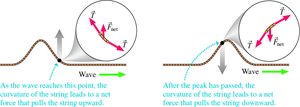
Waves on a String
Transverse Pulse: Created by an external force, continues due to internal dynamics.
Each Point: Moves perpendicular to wave direction.
Sound Waves
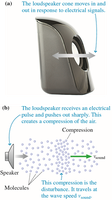
Sound: Longitudinal wave caused by compression and rarefaction of air molecules.
Loudspeaker Example: Cone compresses air, creating a traveling disturbance.
Wave Speed and Properties of the Medium
Wave Speed on a String
Depends on: Tension and linear density (mass per unit length).
Higher Tension: Increases wave speed.
Higher Linear Density: Decreases wave speed.
Wave Speed Formula (String)
For a string, the speed is given by: where is tension and is linear density.
Wave Speed in Gases (Sound)
Depends on temperature and molecular mass, not pressure or density.
Speed increases with temperature and decreases with molecular mass.
Speed of sound in air at 20°C: 343 m/s.
Wave Speed of Light
Electromagnetic waves travel at speed in vacuum:
Mathematical and Graphical Descriptions of Waves
Snapshot and History Graphs
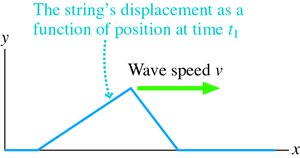
Snapshot Graph: Shows displacement as a function of position at a single instant.
History Graph: Shows displacement of a single point over time.
Sinusoidal Waves
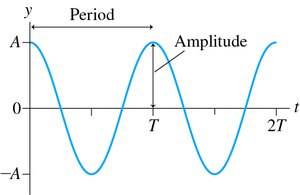
Produced by: Sources oscillating with simple harmonic motion.
Amplitude (A): Maximum displacement.
Wavelength (\lambda): Distance spanned in one cycle.
Period (T): Time to complete one cycle.
Frequency (f): Number of cycles per second, .
Mathematical Description
Displacement as a function of position and time: For a wave traveling to the left:
Wave Velocity Relationship
During one period , a crest travels one wavelength .
Wave speed is:
Examples and Applications
Spider Sensing Vibrations
Wave pulse travels along silk thread; speed determined by tension and linear density.
Time to sense prey:
Lightning and Thunder
Light travels almost instantaneously; sound travels slower.
Distance to lightning:

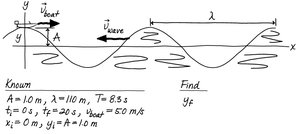
Boat on Ocean Waves
Boat's vertical displacement determined by wave equation and boat's position over time.
Amplitude, wavelength, and period used to calculate displacement.
Summary Table: Types of Waves
Type | Medium Required? | Particle Motion | Examples |
|---|---|---|---|
Transverse | Yes | Perpendicular | String, S waves |
Longitudinal | Yes | Parallel | Sound, P waves |
Electromagnetic | No | N/A | Light, radio |
Key Equations
Wave speed on string:
Wave speed (general):
Frequency:
Sinusoidal wave:
Additional info:
Wave speed in solids & liquids is higher than in gases due to stronger intermolecular forces.
Snapshot and history graphs are essential for visualizing both wave propagation and particle motion.
