 Back
BackTraveling Waves and Sound: The Wave Model, Properties, and Interference
Study Guide - Smart Notes
 Tailored notes based on your materials, expanded with key definitions, examples, and context.
The Wave Model
Introduction to Waves
Unlike the particle model, which describes the motion of rigid objects by tracking a single point, the wave model is used to describe disturbances that are spread out over space. In a wave, the motion at one point in space differs from another, so the particle model is insufficient. Waves are characterized by the propagation of a disturbance through a medium, with the medium itself not traveling with the wave.
Wave: A disturbance that travels through a medium, transferring energy without transferring matter.
Medium: The material or substance through which the wave travels (e.g., water, air, string).
Mechanical Wave: A wave that requires a medium to propagate (e.g., sound, water waves, waves on a string).
Source: The origin of the disturbance (e.g., a rock thrown in a pond).
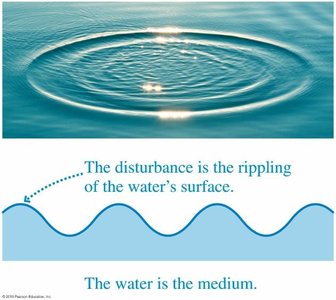
Types of Mechanical Waves
Transverse and Longitudinal Waves
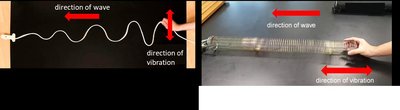
Mechanical waves can be classified based on the direction of particle displacement relative to the direction of wave propagation:
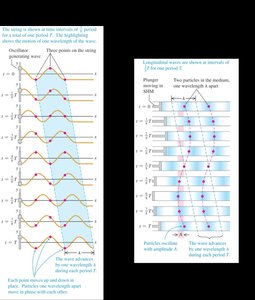
Transverse Wave: The displacement of the medium is perpendicular to the direction of wave travel (e.g., waves on a string).
Longitudinal Wave: The displacement of the medium is parallel to the direction of wave travel (e.g., sound waves in air).
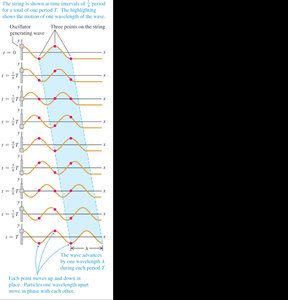
Key Point: The velocity of the wave is not the same as the velocity of the particles in the medium. The medium's particles oscillate around their equilibrium positions, but do not travel with the wave.
Example: The Wave at a Stadium
When spectators at a sporting event perform "The Wave," the disturbance (the wave) moves horizontally through the crowd, but each person moves up and down. This is an example of a transverse wave, as the displacement of the medium (people) is perpendicular to the direction of wave travel.

Traveling Waves
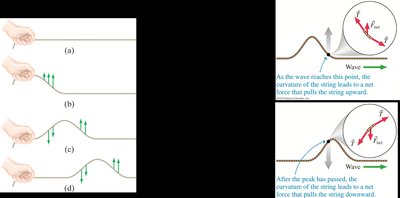
Waves on a String
A wave pulse is a single disturbance moving through a medium, such as a bump traveling along a string. If the source vibrates continuously, a continuous (periodic) wave is produced. The source of any continuous wave is a vibration, which propagates outward through the medium as a wave.
Sound Waves
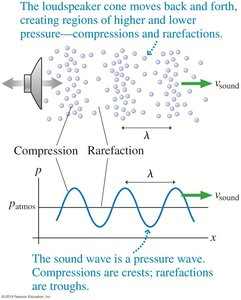
Sound is a mechanical wave that propagates as a longitudinal wave through solids, liquids, and gases. A loudspeaker creates sound waves by vibrating back and forth, compressing and expanding the air to produce regions of high and low pressure (compressions and rarefactions).
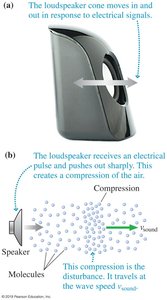
When the loudspeaker vibrates in simple harmonic motion, it produces a sinusoidal sound wave. The alternating compressions and rarefactions travel outward from the source as a pressure wave.
Wave Speed
Wave Speed is a Property of the Medium
The speed of a mechanical wave depends only on the properties of the medium, not on the shape, size, or method of generation of the wave. For example:
Transverse wave on a string: where is the tension in the string and is the linear density (, with the mass and the length of the string).
Speed of sound in air at 20°C:
To increase the speed of a wave on a string, you can increase the tension or use a lighter string (lower ).
Graphical and Mathematical Description of Waves
Sinusoidal Waves
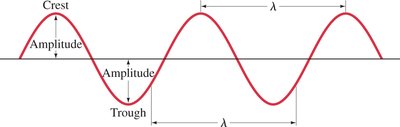
If the source vibrates in simple harmonic motion (SHM) and the medium is elastic, the resulting wave is sinusoidal in both space and time. Important terms include:
Amplitude (A): Maximum displacement from equilibrium (meters).
Wavelength (\lambda): Distance between two successive crests or troughs (meters).
Frequency (f): Number of cycles passing a point per second (Hz).
Period (T): Time for one complete cycle (seconds).
The Fundamental Relationship for Sinusoidal Waves
For any traveling sinusoidal wave, the speed, wavelength, and frequency are related by:
This relationship holds for both transverse and longitudinal sinusoidal waves. The wave travels a distance in time , so .
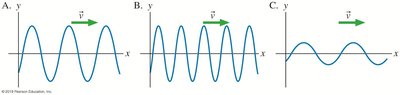
Example: Comparing Frequencies
For waves traveling at the same speed, the wave with the shortest wavelength has the highest frequency, according to .
Superposition and Interference
Principle of Superposition
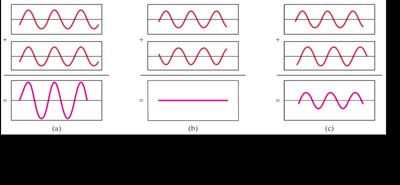
When two or more waves pass through the same region of space at the same time, their displacements add algebraically. This is known as the principle of superposition:
Constructive Interference: When waves add to produce a larger displacement.
Destructive Interference: When waves add to produce a smaller (or zero) displacement.
Equation Summary
Concept | Equation or Description |
|---|---|
Speed of transverse wave on a string | |
Speed of sound in air at 20°C | |
General formula for the speed of a sinusoidal wave |
