 Back
Traveling Waves: Physics with Calculus Study Notes
Study Guide - Smart Notes
 Tailored notes based on your materials, expanded with key definitions, examples, and context.
Traveling Waves
Introduction to Waves
Waves are fundamental phenomena in physics, representing disturbances that transfer energy through space and matter. Understanding waves is essential for analyzing sound, light, and many other physical systems.
Wave: A disturbance that travels through a medium, transferring energy without transporting matter.
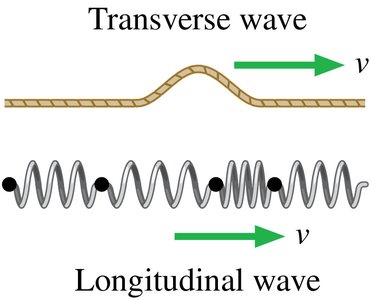
Transverse Wave: Displacement is perpendicular to the direction of wave travel.
Longitudinal Wave: Displacement is parallel to the direction of wave travel.
Examples: Sound waves (longitudinal), light waves (transverse), water waves (transverse at the surface).
Basic Properties of Waves
Waves are characterized by several measurable properties that define their behavior and effects.
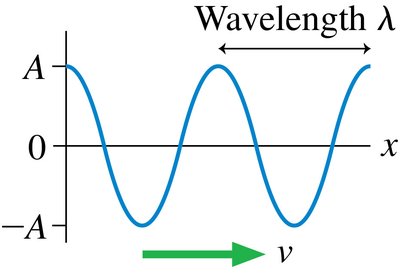
Wave Speed (v): The rate at which the wave propagates through the medium.
Wavelength (λ): The distance between two consecutive crests or troughs in a wave.
Frequency (f): The number of oscillations per second, measured in hertz (Hz).
Amplitude (A): The maximum displacement from equilibrium.
Types of Waves
Waves can be classified based on their nature and the medium through which they travel.
Mechanical Waves: Require a material medium (e.g., sound in air, waves on a string).
Electromagnetic Waves: Do not require a medium and can travel through a vacuum (e.g., light, radio waves).
Wave Energy and Intensity
Waves carry energy as they propagate. The rate at which energy is delivered by a wave to a surface is called intensity.
Intensity (I): Power per unit area, , where P is power and a is area.
Sound Intensity Level: Measured in decibels (dB), , where .
The Wave Model
The wave model describes how organized disturbances travel through a medium with a well-defined speed.
Medium: The substance through which a mechanical wave moves.
Wave Speed on a String: , where T is tension and is linear mass density ().
Transverse and Longitudinal Waves
Transverse and longitudinal waves differ in the direction of particle displacement relative to wave propagation.
Transverse: Displacement is perpendicular to wave direction (e.g., waves on a string).
Longitudinal: Displacement is parallel to wave direction (e.g., sound waves in air).


Wave Graphs: Snapshot and History
Waves can be analyzed using two types of graphs:
Snapshot Graph: Displacement as a function of position at a fixed time.
History Graph: Displacement as a function of time at a fixed position.



Mathematical Description of Sinusoidal Waves
Sinusoidal waves are generated by sources undergoing simple harmonic motion and are described mathematically as follows:
General Equation:
Wave Number:
Angular Frequency:
Wave Speed:
Wave Equation for a String
The wave equation governs the motion of waves on a string:
Wave Equation:
This equation is analogous to Newton's second law for a particle.
Sound Waves
Sound waves are longitudinal mechanical waves that propagate through fluids and solids.
Speed of Sound in Air (20°C):
Frequency Range for Human Hearing: 20 Hz to 20 kHz
Ultrasonic Waves: Frequencies above 20 kHz, used in medical imaging.
Electromagnetic Waves
Electromagnetic waves, such as light, do not require a medium and travel at the speed of light in a vacuum.
Speed of Light:
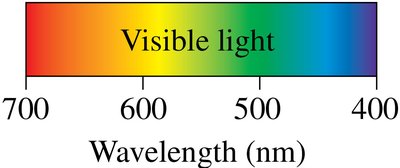
Electromagnetic Spectrum: Includes radio waves, microwaves, visible light, ultraviolet, etc.
Index of Refraction
The speed of light in a material is less than in a vacuum and is characterized by the index of refraction.
Index of Refraction:
Wavelength in Material:
Material | Index of Refraction (n) |
|---|---|
Vacuum | 1.00 |
Air | 1.0003 |
Water | 1.33 |
Glass | 1.50 |
Diamond | 2.42 |
Waves in Two and Three Dimensions
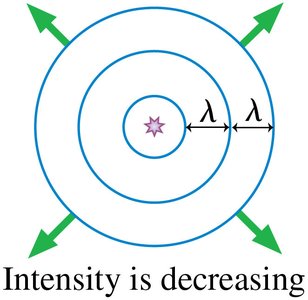
Waves can propagate in more than one dimension, forming circular or spherical wave fronts.
Wave Fronts: Lines or surfaces of constant phase (e.g., crests).
Plane Waves: At large distances, spherical waves appear as plane waves.
Phase and Phase Difference
The phase of a wave describes the position within the cycle of oscillation. The phase difference between two points depends on their separation and the wavelength.
Phase:
Phase Difference:
Power and Intensity of Waves
The power of a wave is the rate at which it transfers energy. Intensity is the power per unit area.
Intensity of Spherical Waves:
The Doppler Effect
The Doppler effect describes the change in frequency and wavelength of a wave as observed by someone moving relative to the source of the wave.
Approaching Source:
Receding Source:
Observer Moving Toward Source:
Observer Moving Away from Source:
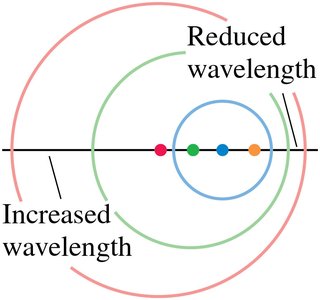
The Doppler Effect for Light
For electromagnetic waves, the Doppler effect results in redshift (receding source) or blueshift (approaching source):
Receding Source:
Approaching Source:
Summary Table: Key Wave Equations
Physical Quantity | Equation |
|---|---|
Wave Speed (string) | |
Wave Speed (sound) | |
Wave Speed (light in medium) | |
Sinusoidal Wave | |
Wave Number | |
Angular Frequency | |
Intensity | |
Sound Intensity Level | |
Doppler Effect (sound, source moving) | , |
Applications of Waves
Communication systems (radio, cell phones, fiber optics)
Medical imaging (ultrasound)
Music and acoustics
Weather radar and astronomy (Doppler effect)
