 Back
Traveling Waves, Sound, and the Doppler Effect: Physics with Calculus Study Notes
Study Guide - Smart Notes
 Tailored notes based on your materials, expanded with key definitions, examples, and context.
Traveling Waves and Sinusoidal Motion
Wave Properties and Mathematical Description
Waves are organized disturbances that transfer energy through a medium or space. The most fundamental type is the sinusoidal wave, which can be described mathematically and analyzed using calculus-based physics.
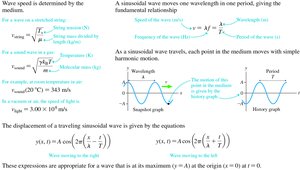
Wavelength (\(\lambda\)): The distance between two consecutive crests or troughs of a wave.
Frequency (\(f\)): The number of wave cycles passing a point per second, measured in hertz (Hz).
Wave Speed (\(v\)): The rate at which the wave propagates through the medium, given by \(v = f\lambda\).
Amplitude (\(A\)): The maximum displacement from the equilibrium position.
Period (\(T\)): The time for one complete cycle, \(T = 1/f\).
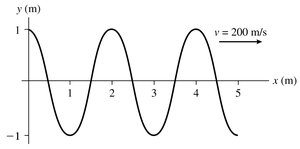
The displacement \(y\) of a traveling sinusoidal wave can be described by:
or equivalently, using angular frequency \(\omega = 2\pi f\) and wave number \(k = 2\pi/\lambda\):
Snapshot Graph: Shows wave displacement as a function of position at a fixed time.
History Graph: Shows displacement at a fixed position as a function of time.
Wave Motion and Types of Waves
Transverse and Longitudinal Waves
Waves can be classified based on the direction of particle motion relative to the direction of wave propagation:
Transverse Waves: Particles move perpendicular to the direction of wave travel (e.g., waves on a string).
Longitudinal Waves: Particles move parallel to the direction of wave travel (e.g., sound waves in air).
Mechanical waves require a medium, while electromagnetic waves do not.
Sound Waves
Nature and Properties of Sound
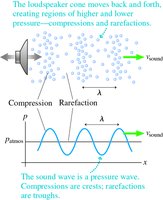
Sound waves are longitudinal mechanical waves that propagate through compressions and rarefactions in a medium such as air. The speed of sound depends on the properties of the medium (e.g., temperature, density).
Compressions: Regions of higher pressure where particles are close together.
Rarefactions: Regions of lower pressure where particles are farther apart.
Frequency Range and Applications
Humans can hear frequencies from 20 Hz to 20,000 Hz.
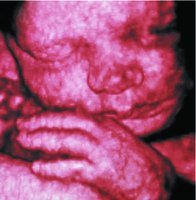
Ultrasound (frequencies above 20,000 Hz) is used in medical imaging and animal echolocation.
Electromagnetic Waves and the Spectrum
Electromagnetic Wave Properties
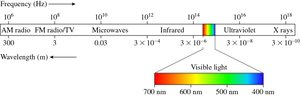
Electromagnetic waves are oscillations of electric and magnetic fields that do not require a medium. All electromagnetic waves travel at the speed of light in a vacuum (\(c = 3.00 \times 10^8\) m/s).
Visible light is a small part of the electromagnetic spectrum, with wavelengths from about 400 nm (violet) to 700 nm (red).
Other types include radio waves, microwaves, infrared, ultraviolet, X-rays, and gamma rays.
Wave Intensity and Energy
Intensity and Power
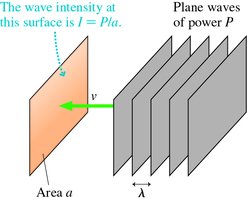
The intensity of a wave is the power transmitted per unit area:
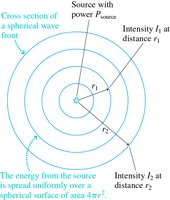
For spherical waves, intensity decreases with the square of the distance from the source due to the spreading of energy over a larger area.
Loudness and the Decibel Scale
Sound Intensity Level
The sound intensity level is measured in decibels (dB) and is defined as:
where \(I_0 = 1.0 \times 10^{-12}\) W/m2 is the threshold of hearing.
Each increase of 10 dB corresponds to a tenfold increase in intensity.

The Doppler Effect and Shock Waves
Doppler Effect
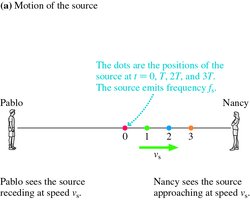
The Doppler effect is the change in observed frequency due to the relative motion of the source and observer. It explains phenomena such as the pitch change of a passing siren.
For a moving source and stationary observer:
For a stationary source and moving observer:

Shock Waves and Sonic Booms
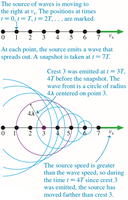
When a source moves faster than the speed of sound in a medium, it produces overlapping wave fronts called a shock wave. The sudden change in pressure is heard as a sonic boom.
Summary Tables
Wave Types and Properties
Wave Type | Particle Motion | Examples |
|---|---|---|
Transverse | Perpendicular to wave direction | String, electromagnetic waves |
Longitudinal | Parallel to wave direction | Sound, seismic P-waves |
Key Equations
Quantity | Equation | Description |
|---|---|---|
Wave speed | Speed of wave propagation | |
Intensity | Power per unit area | |
Sound intensity level | Measured in decibels (dB) | |
Doppler effect (moving source) | Observed frequency shift |
