 Back
Two-Dimensional Kinematics and Projectile Motion
Study Guide - Smart Notes
 Tailored notes based on your materials, expanded with key definitions, examples, and context.
Two-Dimensional Kinematics
Introduction to Motion in Two Dimensions
Two-dimensional kinematics studies the motion of objects in a plane, where both the x (horizontal) and y (vertical) components must be considered. The analysis of such motion is foundational for understanding projectile motion and other real-world phenomena.
Independent Components: The motion in the x- and y-directions can be analyzed separately.
Constant Velocity: If velocity is constant, the object moves in a straight line.
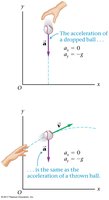
Acceleration: In projectile motion, the only acceleration is due to gravity, acting downward.
Solving Motion in Two Dimensions
To analyze two-dimensional motion, break the motion into x- and y-components and solve each independently using kinematic equations.
x-direction: Usually, there is no acceleration ().
y-direction: Acceleration is due to gravity ().
Projectile Motion: Basic Equations
Assumptions and Principles
Projectile motion describes the path of an object launched into the air, subject only to gravity (ignoring air resistance and Earth's rotation). The acceleration is independent of the velocity's direction.
Gravity: downward
Acceleration: ,
Equations of Projectile Motion
The following equations describe the position and velocity of a projectile at any time t:

Projectile Motion with Zero Launch Angle
Definition and Characteristics
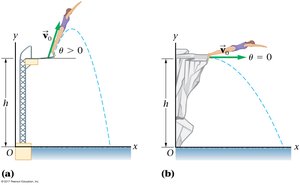
When a projectile is launched horizontally (zero launch angle), its initial velocity has only an x-component. The y-component of the initial velocity is zero.
Initial Conditions: , ,
Trajectory: The path is a parabola.
Equations for Zero Launch Angle

Trajectory and Graphical Representation
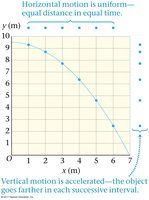
The trajectory of a horizontally launched projectile is a parabola. The horizontal motion is uniform, while the vertical motion is accelerated.
Eliminating Time to Find y(x)
By eliminating time from the equations, the vertical position as a function of horizontal position is:

Finding the Landing Point
The landing point (range) can be found by setting and solving for :

Projectile Motion with General Launch Angle
Initial Velocity Components
For a projectile launched at an angle θ with initial speed :
Equations of Motion for General Launch Angle

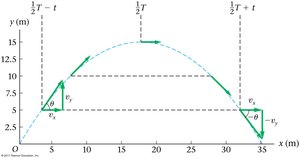
Trajectory Example
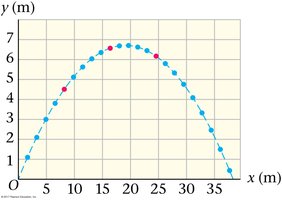
Snapshots of a projectile's trajectory at different times show the parabolic path and the changing vertical position.
Key Characteristics of Projectile Motion
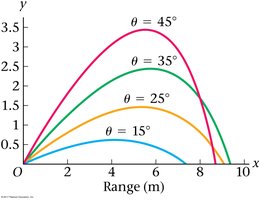
Range of a Projectile
The range is the horizontal distance a projectile travels. If the initial and final elevations are the same, the range is given by:

Maximum Range and Launch Angle
The range is maximized when the launch angle θ is 45°.
Symmetry in Projectile Motion
Projectile motion is symmetric: the path up and down are mirror images, and the time to reach maximum height equals the time to descend from it.
Summary of Two-Dimensional Kinematics
Components of motion in the x- and y-directions can be treated independently.
In projectile motion, the acceleration is in the vertical direction.
If the launch angle is zero, the initial velocity has only an x-component.
The path followed by a projectile is a parabola.
The range is the horizontal distance the projectile travels.
