 Back
BackUnits, Physical Quantities, and Vectors – Foundations of Physics
Study Guide - Smart Notes
 Tailored notes based on your materials, expanded with key definitions, examples, and context.
Units, Physical Quantities, and Vectors
Introduction to Physics and Its Branches
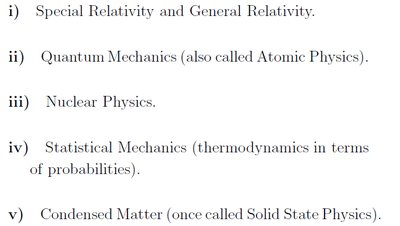
Physics is the study of the behavior and composition of matter and energy, as well as their interactions. It is divided into several main branches, including classical mechanics, thermodynamics, fluid mechanics, electromagnetism, optics, wave mechanics, relativity, quantum mechanics, nuclear physics, statistical mechanics, and condensed matter physics. These branches form the foundation for understanding the physical universe.
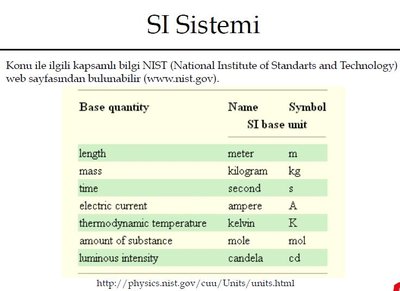
Fundamental Quantities and SI Units
Physics relies on a set of fundamental quantities, each with a standard unit of measurement. The International System of Units (SI) is the most widely used system in science and engineering.
Length – measured in meters (m)
Mass – measured in kilograms (kg)
Time – measured in seconds (s)
Electric current – measured in amperes (A)
Thermodynamic temperature – measured in kelvin (K)
Amount of substance – measured in moles (mol)
Luminous intensity – measured in candelas (cd)
Derived Quantities and Units
Many physical quantities are derived from the fundamental quantities. For example:
Velocity: (meters per second, m/s)
Density: (kilograms per cubic meter, kg/m3)
Energy: (joules, J)
SI Prefixes
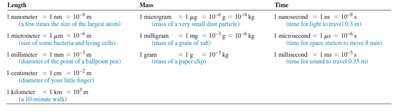
SI prefixes are used to denote multiples or submultiples of units, making it easier to express very large or very small quantities. For example, 1 kilometer (km) = meters, and 1 millisecond (ms) = seconds.
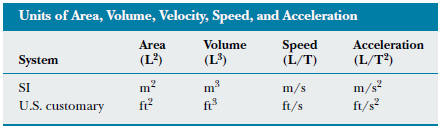
Comparison of SI and U.S. Customary Units
Different systems of units are used around the world. The SI system is standard in science, while the U.S. customary system is still used in some countries.
System | Area (L2) | Volume (L3) | Speed (L/T) | Acceleration (L/T2) |
|---|---|---|---|---|
SI | m2 | m3 | m/s | m/s2 |
U.S. customary | ft2 | ft3 | ft/s | ft/s2 |
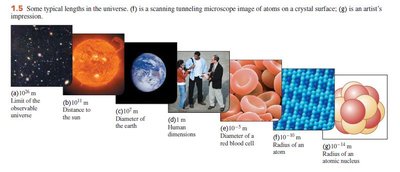
Typical Lengths, Masses, and Times in Physics
Physics deals with quantities that span many orders of magnitude. For example, lengths can range from the size of atomic nuclei ( m) to the observable universe ( m).
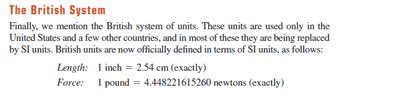
The British System of Units
The British system is used primarily in the United States and a few other countries. Key conversions include:
1 inch = 2.54 cm (exactly)
1 pound = 4.448221615260 newtons (exactly)
Unit Conversion and Dimensional Analysis
Unit conversion is essential for solving physics problems. Dimensional analysis helps check the consistency of equations and ensures that both sides have the same dimensions.
Example: To convert 1.84 in3 to cm3:
To convert 30.2 cm3 to m3:
Measurement, Uncertainty, and Significant Figures
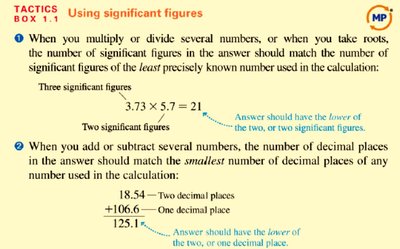
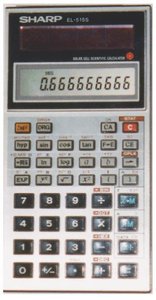
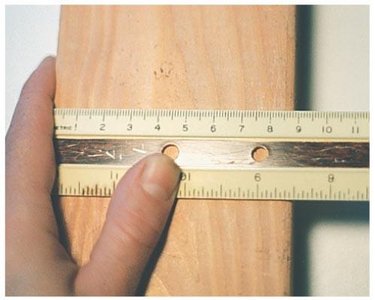
All measurements have some uncertainty due to instrument limitations and human error. The number of significant figures in a measurement reflects its precision.
Significant figures are the reliably known digits in a number.
Rules for significant figures:
When multiplying/dividing, the result has as many significant figures as the least precise measurement.
When adding/subtracting, the result has as many decimal places as the least precise measurement.
Relative Uncertainty and Error
Relative uncertainty is the ratio of the uncertainty to the measured value, expressed as a percentage:
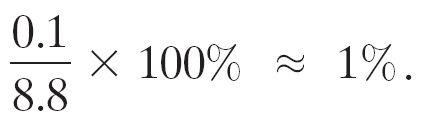
Accuracy refers to how close a measurement is to the true value, while precision refers to the repeatability of measurements. Both are important in scientific experiments.
Order of Magnitude Estimation
Order of magnitude estimation involves rounding numbers to the nearest power of ten to quickly estimate quantities. This technique is useful for rapid calculations and checking the plausibility of results.
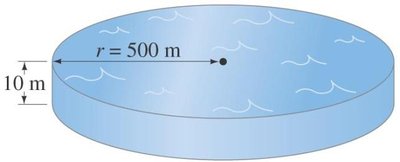
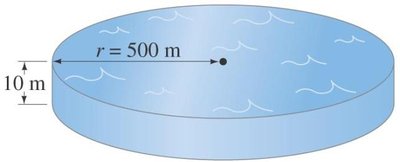
Example: Estimating the volume of a lake with radius 500 m and depth 10 m:
Scalars and Vectors
Physical quantities are classified as either scalars or vectors:
Scalar: Described by a single number and unit (e.g., mass, temperature, energy).
Vector: Has both magnitude and direction (e.g., displacement, velocity, force).
Vector Representation and Operations
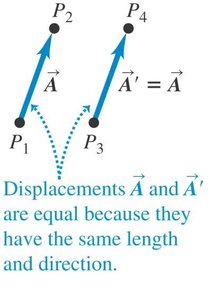
Vectors are represented as arrows, with length indicating magnitude and direction indicating orientation. Vectors can be added graphically (head-to-tail or parallelogram method) or analytically using components.
Negative vectors have the same magnitude but opposite direction.
Vector Components and Unit Vectors
Any vector in a plane can be resolved into x and y components using trigonometry:
Unit vectors (, , ) are used to specify direction along the x, y, and z axes, respectively.
Vector Addition and Subtraction Using Components
Vectors can be added or subtracted by combining their components:
Resultant vector:
Magnitude:
Direction:
Scalar (Dot) Product
The scalar product (dot product) of two vectors yields a scalar:
Commutative:
Applications: Calculating work done by a force, finding the angle between vectors
Vector (Cross) Product
The vector product (cross product) of two vectors yields a vector perpendicular to both:
Direction is given by the right-hand rule.
Not commutative:
Applications: Torque, angular momentum
Summary Table: SI Base Quantities and Units
Base quantity | Name | Symbol | SI base unit |
|---|---|---|---|
Length | meter | m | m |
Mass | kilogram | kg | kg |
Time | second | s | s |
Electric current | ampere | A | A |
Thermodynamic temperature | kelvin | K | K |
Amount of substance | mole | mol | mol |
Luminous intensity | candela | cd | cd |
Additional info: This guide covers the foundational concepts of Chapter 1 in a typical university physics course, including units, physical quantities, significant figures, uncertainty, and vector mathematics. Mastery of these topics is essential for all subsequent chapters in physics.
