 Back
BackUnits, Physical Quantities, and Vectors: Study Notes for College Physics I
Study Guide - Smart Notes
 Tailored notes based on your materials, expanded with key definitions, examples, and context.
Units, Physical Quantities, and Vectors
The Nature of Physics
Physics is the study of the fundamental principles governing the natural world. It involves quantifying physical phenomena using units, measuring physical quantities, and applying mathematical tools such as vectors to describe motion and forces.
Solving Physics Problems
Physics problems require careful attention to units, significant figures, and the distinction between scalar and vector quantities. Consistent use of units and proper handling of uncertainties are essential for accurate calculations.
Standards and Units
Physical quantities are measured using standardized units, such as the International System of Units (SI). Common SI units include meter (m) for length, kilogram (kg) for mass, and second (s) for time.
Unit Consistency and Conversions
All calculations in physics must use consistent units. Conversion between units is often necessary, using appropriate conversion factors.
Uncertainty and Significant Figures
Measurements in physics are subject to uncertainty, which is reflected in the number of significant figures reported. Significant figures indicate the precision of a measurement.
Multiplication or Division: The result can have no more significant figures than the factor with the fewest significant figures.
Addition or Subtraction: The number of significant figures is determined by the term with the largest uncertainty (fewest digits to the right of the decimal point).
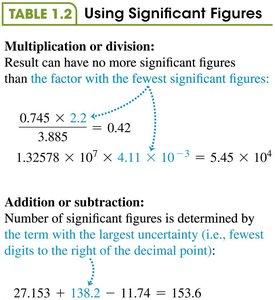
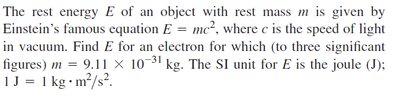
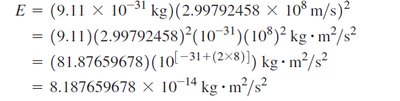
Example: Calculating the rest energy of an electron using Einstein's equation and rounding to three significant figures.

Vectors and Scalars
Physical quantities are classified as either scalars or vectors:
Scalar: Described by a single number (magnitude only). Examples: distance, mass, temperature.
Vector: Has both magnitude and direction. Examples: displacement, velocity, force.
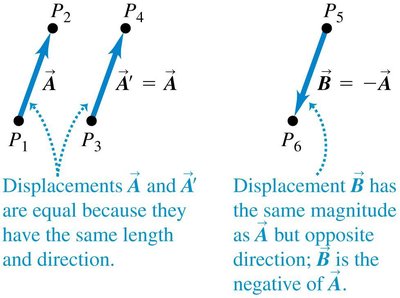
Vectors are represented by arrows; the length indicates magnitude, and the direction indicates orientation in space.
Vector Addition and Subtraction
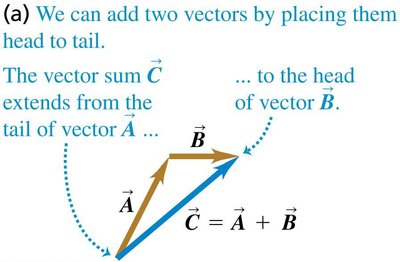
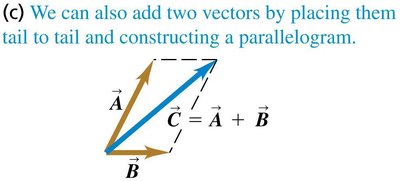
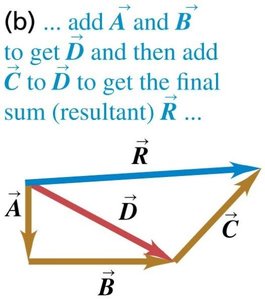
Vectors can be added or subtracted graphically and algebraically. The most common graphical methods are the tip-to-tail method and the parallelogram method.
Tip-to-tail method: Place the tail of one vector at the tip of another; the resultant vector extends from the tail of the first to the tip of the last.
Parallelogram method: Place vectors tail-to-tail and complete the parallelogram; the diagonal represents the sum.
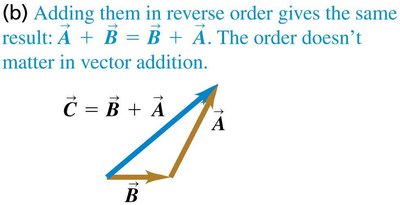
Commutative Law: Vector addition is commutative: .
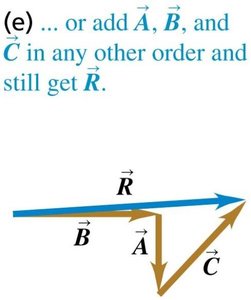
Associative Law: Vector addition is associative: .
Special Cases:
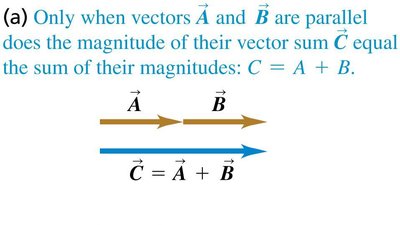
When vectors are parallel:
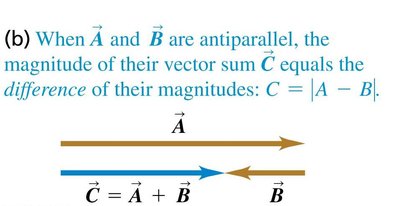
When vectors are antiparallel:
Adding Multiple Vectors
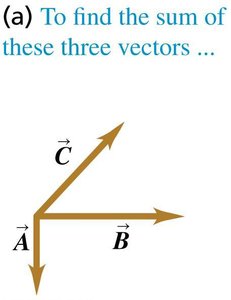
To find the sum of three or more vectors, add them sequentially using the tip-to-tail method or combine them in any order due to the associative property.
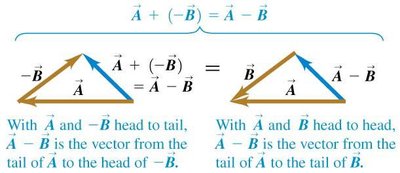
Vector Subtraction
Subtracting a vector is equivalent to adding its negative. The negative of a vector has the same magnitude but opposite direction.
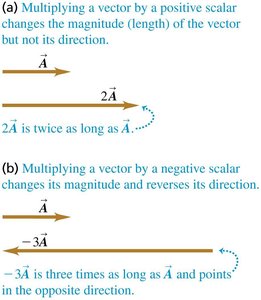
Multiplying a Vector by a Scalar
Multiplying a vector by a positive scalar changes its magnitude but not its direction. Multiplying by a negative scalar reverses its direction.
has magnitude
If , direction is unchanged; if , direction is reversed.
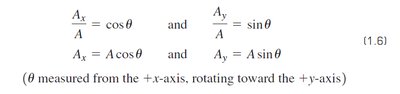
Components of a Vector
Any vector in a plane can be resolved into components along the x- and y-axes. The vector forms a right triangle with its components.
Magnitude:
Direction:
Component formulas: ,
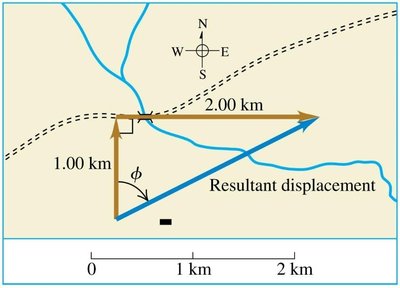
Example: A cross-country skier travels 1.00 km north and 2.00 km east. The resultant displacement is at east of north.
Trigonometric Functions in Vector Analysis
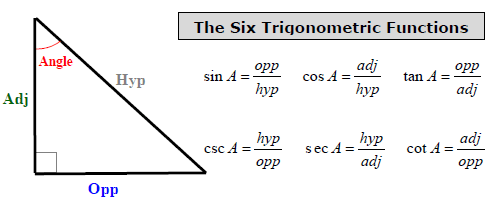
Trigonometric functions relate the sides of a right triangle to its angles, which is essential for resolving vectors into components.
Additional info: These notes cover the foundational concepts of Chapter 1: Units, Physical Quantities, and Vectors, including definitions, examples, and graphical representations. All images included are directly relevant to the explanation of the adjacent paragraphs.
