 Back
BackVector Addition and Displacement Problems in College Physics
Study Guide - Smart Notes
 Tailored notes based on your materials, expanded with key definitions, examples, and context.
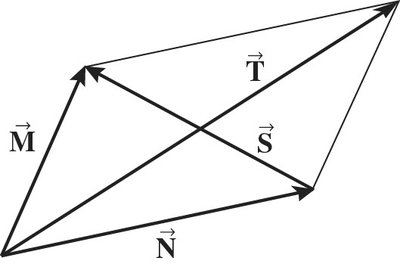
Q3. (A) In the figure below, which vector equation correctly represents the vector \( \vec{S} \)?
Background
Topic: Vector Addition and Subtraction
This question tests your understanding of how vectors are added and subtracted graphically and algebraically. You need to interpret the diagram and relate the vectors \( \vec{M} \), \( \vec{N} \), and \( \vec{S} \) using vector equations.
Key Terms and Formulas:
Vector addition: means placing the tail of \( \vec{B} \) at the head of \( \vec{A} \).
Vector subtraction: means adding \( \vec{A} \) and the negative of \( \vec{B} \).
Resultant vector: The vector from the starting point to the ending point after following the sequence of vectors.
Step-by-Step Guidance
Examine the diagram and identify the direction and placement of each vector. Notice how \( \vec{M} \), \( \vec{N} \), and \( \vec{S} \) are arranged.
Recall that vector addition is commutative: .
Try to express \( \vec{S} \) in terms of \( \vec{M} \) and \( \vec{N} \) by following the arrows in the diagram. Consider whether \( \vec{S} \) is the sum or difference of \( \vec{M} \) and \( \vec{N} \).
Write out possible vector equations using the diagram, such as or , and check which matches the direction and magnitude shown.
Try solving on your own before revealing the answer!
Final Answer: \( \vec{S} = \vec{M} + \vec{N} \)
By following the diagram, \( \vec{S} \) is the vector sum of \( \vec{M} \) and \( \vec{N} \), as it connects the tail of \( \vec{M} \) to the head of \( \vec{N} \).
