 Back
BackVector Operations and 1D Kinematics: Study Notes for College Physics
Study Guide - Smart Notes
 Tailored notes based on your materials, expanded with key definitions, examples, and context.
Vector Operations
Definition and Properties of Vectors
Vectors are quantities characterized by both magnitude and direction. They are fundamental in physics for representing displacement, velocity, acceleration, and force. Units must always be included when specifying vectors.
Vector Addition and Subtraction: The tail-to-head rule is used for graphical addition and subtraction of vectors. To add vectors A and B, place the tail of B at the head of A; the resultant vector R points from the tail of A to the head of B.
Vector Subtraction: To subtract B from A, reverse the direction of B to get -B, then add -B to A using the tail-to-head rule.
Vector Components
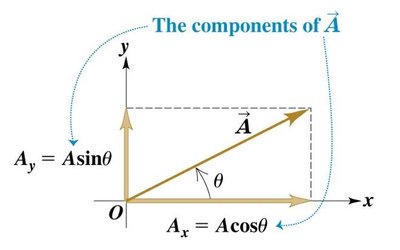
Any vector in a plane can be decomposed into its x and y components using trigonometric functions. This is essential for performing algebraic operations on vectors.
Component Formulas:
Vector Addition/Subtraction by Components:
Products of Vectors
There are two main ways to multiply vectors: the scalar (dot) product and the vector (cross) product.
Scalar (Dot) Product
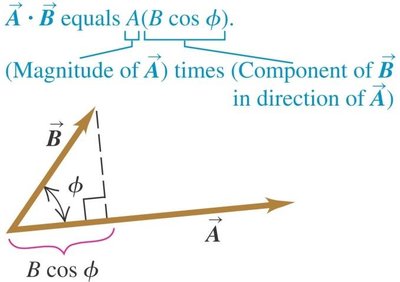
The dot product of two vectors yields a scalar and is defined as:
Where is the smallest angle between the vectors when their tails are co-located.
Result is zero if vectors are perpendicular, maximum if parallel.
Applications: Calculating work, finding angles between vectors.

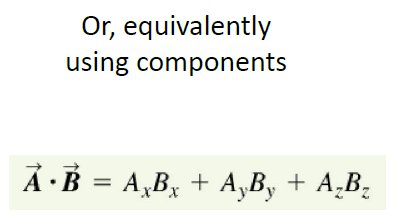
Component form:

Vector (Cross) Product
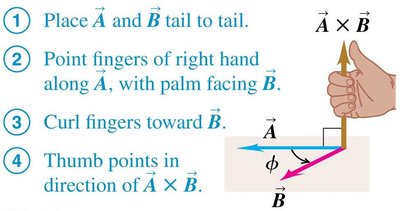
The cross product of two vectors yields a vector perpendicular to both, with magnitude:
Direction is given by the right-hand rule.
Result is zero if vectors are parallel, maximum if perpendicular.
Applications: Calculating torque, angular momentum, rotational velocity, magnetic Lorentz force.
Not commutative:
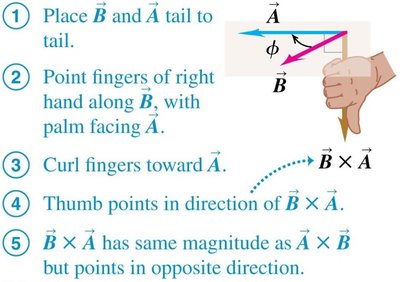
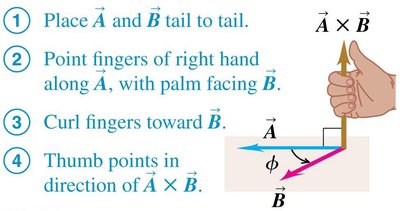
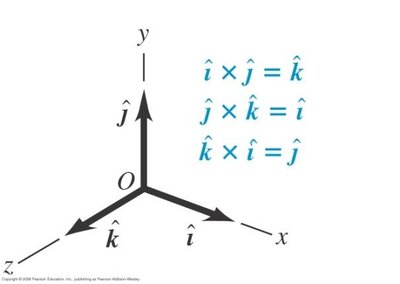
Component form:

Unit vector cross products:
Practice: Vector Operations
Given vectors in component form, you can compute dot and cross products directly using the formulas above. For example:
Dot product:
Cross product:
Motion Along a Straight Line (1D Kinematics)
Position and Displacement
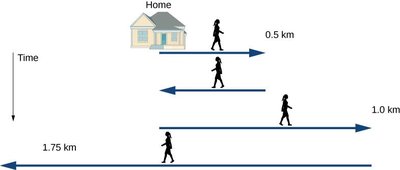
In 1D kinematics, the motion of a particle is described using position, displacement, velocity, and acceleration vectors. The position of an object is specified relative to a reference frame.
Position: is the location of the object at time .
Displacement: is the change in position between two times.
Both position and displacement are vectors with direction.
Velocity
Velocity describes the rate of change of position. It is a vector quantity.
Average velocity:
Instantaneous velocity:
Position-Time Graphs
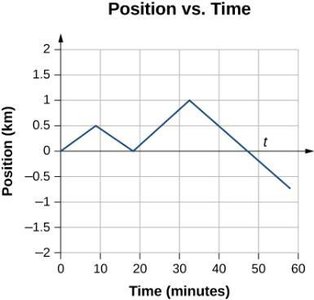
Position versus time graphs are used to visualize motion. The slope of the graph at any point gives the instantaneous velocity.
Speed vs. Velocity
Speed is a scalar quantity representing the magnitude of velocity, while velocity is a vector.
Average speed:
Instantaneous speed:
Speed is always positive; velocity can be positive or negative depending on direction.
Acceleration
Acceleration is the rate of change of velocity. It is a vector quantity.
Average acceleration:
Instantaneous acceleration:
Speeding Up vs. Slowing Down
The relationship between velocity and acceleration determines whether an object is speeding up or slowing down:
If velocity and acceleration have the same sign (direction), the object speeds up.
If they have opposite signs, the object slows down.
Summary Table: Dot vs. Cross Product
Property | Dot Product | Cross Product |
|---|---|---|
Result | Scalar | Vector |
Formula | ||
Direction | None | Right-hand rule |
Zero When | Perpendicular | Parallel |
Commutativity | Commutative | Anti-commutative |
Applications | Work, angle between vectors | Torque, angular momentum |
Practice and Applications
Use vector operations to solve problems in mechanics, such as calculating displacement, velocity, and acceleration.
Apply dot and cross products in physics contexts like work, torque, and rotational motion.
Additional info: Academic context and formulas have been expanded for completeness and clarity.
