 Back
Vector Operations and Representation – Physics with Calculus Study Guide
Study Guide - Smart Notes
 Tailored notes based on your materials, expanded with key definitions, examples, and context.
Q1. Given the vectors \( \vec{A} = 6\hat{i} - 3\hat{j} \) and \( \vec{B} = -6\hat{i} - \hat{j} \), determine the result of the following vector operations:
a) \( \vec{A} + \vec{B} \)
b) \( 2\vec{A} - \vec{B} \)
c) \( \frac{1}{3}\vec{A} - 2\vec{B} \)
d) \( \|\vec{A}\| + \|\vec{B}\| \)
e) \( 3\|\vec{A}\| \)
Background
Topic: Vector Algebra
This question tests your ability to perform basic vector operations (addition, subtraction, scalar multiplication) and to calculate vector magnitudes.
Key Terms and Formulas:
Vector addition/subtraction: Combine corresponding components.
Magnitude of a vector: \( \|\vec{A}\| = \sqrt{A_x^2 + A_y^2} \)
Canonical form: \( \vec{A} = A_x\hat{i} + A_y\hat{j} \)
Step-by-Step Guidance
Write each vector in component form: \( \vec{A} = (6, -3) \), \( \vec{B} = (-6, -1) \).
For each operation, combine the components as required (e.g., for addition, add corresponding components).
For scalar multiplication, multiply each component by the scalar.
To find the magnitude, use \( \|\vec{A}\| = \sqrt{A_x^2 + A_y^2} \).
Set up the expressions for each part, but stop before calculating the final values.
Try solving on your own before revealing the answer!
Final Answer:
a) \( \vec{A} + \vec{B} = (0, -4) = -4\hat{j} \)
b) \( 2\vec{A} - \vec{B} = (12, -6) - (-6, -1) = (18, -5) = 18\hat{i} - 5\hat{j} \)
c) \( \frac{1}{3}\vec{A} - 2\vec{B} = (2, -1) - (-12, -2) = (14, 1) = 14\hat{i} + 1\hat{j} \)
d) \( \|\vec{A}\| + \|\vec{B}\| = \sqrt{6^2 + (-3)^2} + \sqrt{(-6)^2 + (-1)^2} = 6.71 + 6.08 = 12.79 \)
e) \( 3\|\vec{A}\| = 3 \times 6.71 = 20.13 \)
Each operation follows vector algebra rules and magnitude calculations.
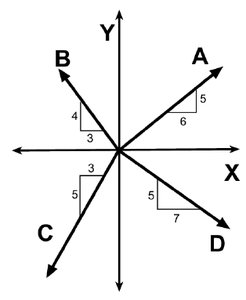
Q2. Determine the components of each vector and write each in canonical notation. Given: \( \|\vec{A}\| = 12 \), \( \|\vec{B}\| = 15 \), \( \|\vec{C}\| = 20 \), \( \|\vec{D}\| = 30 \).
Background
Topic: Vector Decomposition
This question tests your ability to break down vectors into their Cartesian components and express them in canonical form.
Key Terms and Formulas:
Vector components: \( \vec{A} = A_x\hat{i} + A_y\hat{j} \)
Use trigonometry if direction is given: \( A_x = \|\vec{A}\| \cos \theta \), \( A_y = \|\vec{A}\| \sin \theta \)
Step-by-Step Guidance
Identify the magnitude and direction for each vector from the diagram.
Use the right triangle relationships to find the x and y components for each vector.
Write each vector in canonical form: \( \vec{A} = A_x\hat{i} + A_y\hat{j} \).
Set up the expressions for each vector, but stop before calculating the numerical values.
Try solving on your own before revealing the answer!
Final Answer:
\( \vec{A} = 6\hat{i} + 5\hat{j} \)
\( \vec{B} = -3\hat{i} + 4\hat{j} \)
\( \vec{C} = -3\hat{i} -5\hat{j} \)
\( \vec{D} = 7\hat{i} -5\hat{j} \)
Each vector is written in canonical form using its components from the diagram.
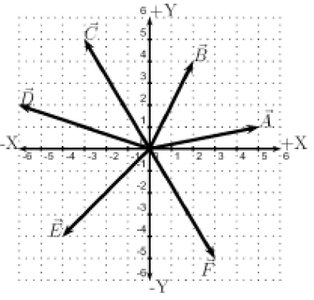
Q3. In the figure, vectors \( \vec{A}, \vec{B}, \vec{C}, \vec{D}, \vec{E}, \vec{F} \) are shown. Write each vector in Cartesian components and determine:
Each vector in Cartesian components
\( \vec{R} = 2(\vec{A} + \vec{B}) - 3(\vec{D} + \vec{E}) + \vec{F} \)
Background
Topic: Vector Addition and Scalar Multiplication
This question tests your ability to express vectors in Cartesian form and perform complex vector operations.
Key Terms and Formulas:
Vector addition: Add corresponding components.
Scalar multiplication: Multiply each component by the scalar.
Canonical form: \( \vec{A} = A_x\hat{i} + A_y\hat{j} \)
Step-by-Step Guidance
Read the coordinates of each vector from the diagram to determine their components.
Write each vector in canonical form.
Set up the operation for \( \vec{R} \) by grouping and multiplying the vectors as indicated.
Combine the components step by step, but stop before the final calculation.
Try solving on your own before revealing the answer!
Final Answer:
\( \vec{A} = (5, 2) \)
\( \vec{B} = (2, 5) \)
\( \vec{C} = (-3, 5) \)
\( \vec{D} = (-5, 2) \)
\( \vec{E} = (-2, -5) \)
\( \vec{F} = (3, -5) \)
\( \vec{R} = 2(\vec{A} + \vec{B}) - 3(\vec{D} + \vec{E}) + \vec{F} = (34, 9) \)
Each vector is written in Cartesian form and the operation is performed stepwise.
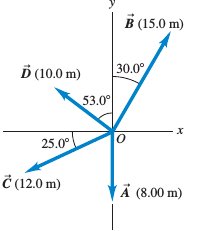
Q4. Write the vectors \( \vec{A}, \vec{B}, \vec{C}, \vec{D} \) shown in the figure in canonical form and determine the magnitude, direction, and sense of the resultant vector \( \vec{R} = \vec{A} + \vec{B} + \vec{C} + \vec{D} \).
Background
Topic: Vector Addition and Resultant Vector
This question tests your ability to add vectors, find the resultant, and determine its magnitude and direction.
Key Terms and Formulas:
Vector addition: Add corresponding components.
Magnitude: \( \|\vec{R}\| = \sqrt{R_x^2 + R_y^2} \)
Direction: \( \theta = \arctan\left(\frac{R_y}{R_x}\right) \)
Step-by-Step Guidance
Identify the components of each vector from the diagram.
Write each vector in canonical form.
Add the components to find \( \vec{R} \).
Set up the formulas for magnitude and direction, but stop before calculating the final values.
Try solving on your own before revealing the answer!
Final Answer:
\( \vec{A} = (0, -8) \)
\( \vec{B} = (15\cos30^\circ, 15\sin30^\circ) = (12.99, 7.5) \)
\( \vec{C} = (12\cos25^\circ, 12\sin25^\circ) = (10.87, 5.07) \)
\( \vec{D} = (10\cos53^\circ, 10\sin53^\circ) = (6.02, 7.98) \)
\( \vec{R} = (29.88, 12.55) \)
\( \|\vec{R}\| = 32.45 \), \( \theta = 22.9^\circ \)
The resultant vector is calculated by summing the components and then finding its magnitude and direction.
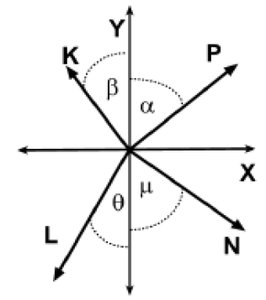
Q5. Determine the components of each vector and write each in canonical notation. Calculate the magnitude, direction, and sense of the resultant vector. Given: \( \|\vec{P}\| = 100 \), \( \|\vec{K}\| = 150 \), \( \|\vec{L}\| = 90 \), \( \|\vec{N}\| = 120 \).
Background
Topic: Vector Decomposition and Resultant Calculation
This question tests your ability to decompose vectors, write them in canonical form, and calculate the resultant vector's properties.
Key Terms and Formulas:
Vector components: \( \vec{P} = P_x\hat{i} + P_y\hat{j} \)
Magnitude: \( \|\vec{R}\| = \sqrt{R_x^2 + R_y^2} \)
Direction: \( \theta = \arctan\left(\frac{R_y}{R_x}\right) \)
Step-by-Step Guidance
Identify the magnitude and direction for each vector from the diagram.
Use trigonometric relationships to find the x and y components.
Write each vector in canonical form.
Add the components to find the resultant vector \( \vec{R} \).
Set up the formulas for magnitude and direction, but stop before calculating the final values.
Try solving on your own before revealing the answer!
Final Answer:
\( \vec{P} = (100\cos\alpha, 100\sin\alpha) \)
\( \vec{K} = (150\cos\beta, 150\sin\beta) \)
\( \vec{L} = (90\cos\theta, 90\sin\theta) \)
\( \vec{N} = (120\cos\mu, 120\sin\mu) \)
\( \vec{R} = \vec{P} + \vec{K} + \vec{L} + \vec{N} \)
\( \|\vec{R}\| \) and \( \theta \) calculated from the sum of components.
Each vector is decomposed and the resultant is found using vector addition and trigonometry.
