 Back
BackVectors and Coordinate Systems: Foundations and Applications
Study Guide - Smart Notes
 Tailored notes based on your materials, expanded with key definitions, examples, and context.
Vectors and Scalars
Definitions and Representations
In physics, quantities are classified as either scalars or vectors. Understanding the distinction is fundamental for describing motion and forces.
Scalar: A quantity fully described by a magnitude (number and units) only. Examples: mass, temperature, wavelength.
Vector: A quantity described by both magnitude and direction. Examples: acceleration, force, magnetic field.
Notation: Vectors are denoted with an arrow over the symbol (e.g., or ). The magnitude of a vector is written without the arrow or with absolute value bars (e.g., or ).
Properties of Vectors
Displacement and Equivalence
Vectors are characterized by their magnitude and direction, not by their specific location in space. Displacement is a key vector quantity in kinematics.
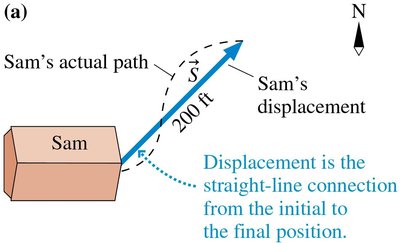
Displacement: The straight-line vector from an initial to a final position, regardless of the actual path taken.
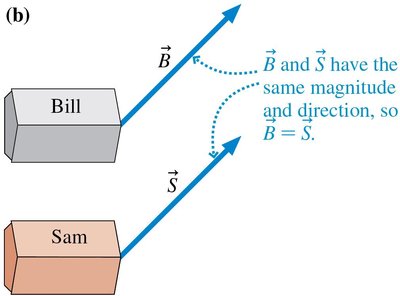
Vector Equivalence: Two vectors are equal if they have the same magnitude and direction, even if their starting points differ.
Vector Addition
Methods of Vector Addition
Vectors cannot be added like scalars because direction must be considered. Two main methods are used:
Graphical Method: Draw vectors to scale and use geometric rules (tip-to-tail or parallelogram). Best for qualitative or visual understanding.
Algebraic Method: Use calculations to determine the resultant vector's magnitude and direction. Preferred for precision and complex problems.
Example: Displacement by Vector Addition
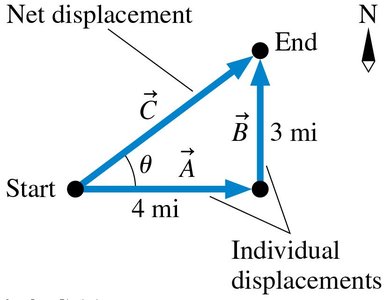
Consider a hiker walking 4 miles east and then 3 miles north. The total displacement is found using the Pythagorean theorem and trigonometry:
Magnitude:
Direction: north of east
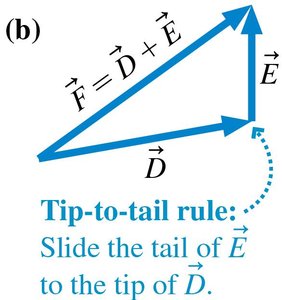
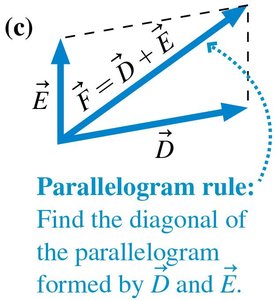
Graphical Addition: Tip-to-Tail and Parallelogram Methods
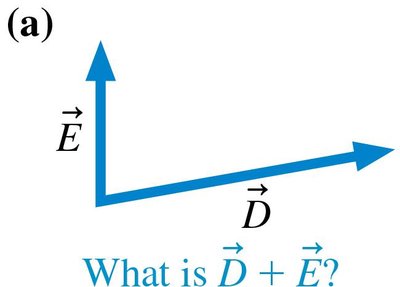
Tip-to-Tail Rule: Place the tail of the second vector at the tip of the first; the resultant is from the tail of the first to the tip of the second.
Parallelogram Rule: Place both vectors with tails at the same point; the resultant is the diagonal of the parallelogram formed.
Vector Math: Additional Methods
Scalar Multiplication, Subtraction, and the Zero Vector
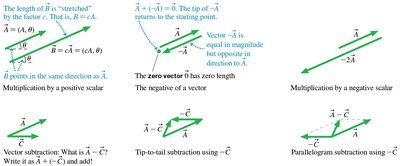
Multiplication by a Scalar: Changes the magnitude, not the direction (unless the scalar is negative, which reverses direction).
Zero Vector: A vector of zero magnitude and undefined direction, denoted .
Vector Subtraction: Adding the negative of a vector (reverse direction).
Coordinate Systems & Vector Components
Choosing and Using Coordinate Systems
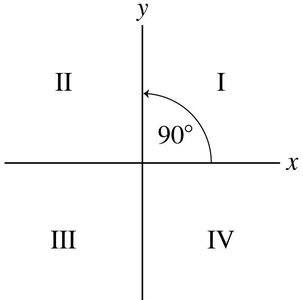
A coordinate system is an artificial grid imposed to simplify vector calculations. The most common is the -coordinate system with four quadrants, but any perpendicular axes can be used to suit the problem.
Decomposition into Components
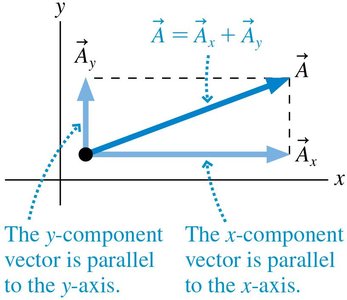
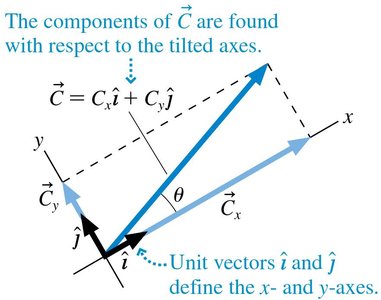
Any vector can be decomposed into components parallel to the axes of the chosen coordinate system. This process is called decomposition.
Component Vectors: (along ) and (along ) such that .
Component Values and Signs
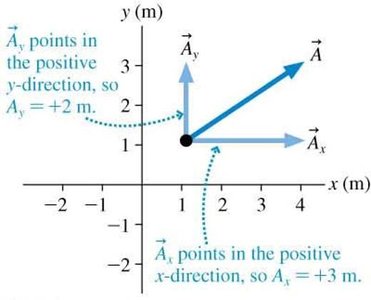
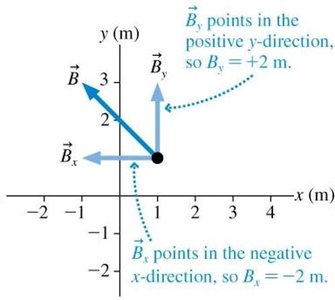
Each component is described by a number (its magnitude) and a sign (its direction along the axis).
Connecting Geometric & Component Representation
From Components to Magnitude and Direction
Given components and , the magnitude and direction of are:
Magnitude:
Direction:
From Magnitude and Angle to Components
Note: The association of cosine and sine with and depends on the definition of the angle. Always draw a diagram to confirm.
Unit Vectors
Definition and Usage
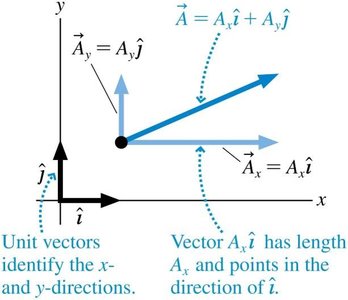
Unit vectors have a magnitude of 1 and indicate direction along an axis. They are used to express vectors in component form:
: + direction
: + direction
: + direction
Other common unit vectors include (radial) and (normal to a surface).
Vector Algebra with Unit Vectors
Component Form and Operations
Vectors are often written as:
This form simplifies addition, subtraction, and scalar multiplication:
Add/subtract corresponding components.
Resultant can be written in component or magnitude-angle form.
Tilted Axes and Arbitrary Directions
Choosing Convenient Axes
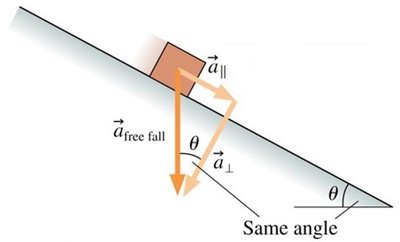
Coordinate axes can be tilted to align with features of a problem (e.g., an inclined plane). As long as axes are perpendicular, vector math remains valid.
Example: On an inclined plane, axes are chosen parallel and perpendicular to the surface to simplify calculations.
Summary Table: Vector Operations
Operation | Description | Formula |
|---|---|---|
Addition | Sum components | |
Subtraction | Subtract components | |
Scalar Multiplication | Multiply each component by scalar | |
Magnitude | Length of vector | |
Direction | Angle with respect to -axis |
