 Back
Vectors and Coordinate Systems: Foundations for Physics with Calculus
Study Guide - Smart Notes
 Tailored notes based on your materials, expanded with key definitions, examples, and context.
Vectors and Coordinate Systems
Scalars and Vectors
In physics, quantities are classified as either scalars or vectors. Scalars are quantities described by a magnitude (numerical value) and appropriate units, but no direction. Examples include mass, temperature, and volume. Vectors, on the other hand, possess both a magnitude and a direction. Common vector quantities include velocity, acceleration, and force.
Scalar: Only magnitude (e.g., 5 kg, 20°C)
Vector: Magnitude and direction (e.g., 10 m/s east)

Magnitude and Equal Vectors
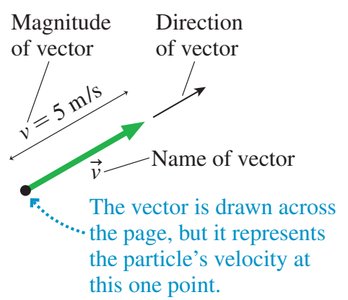
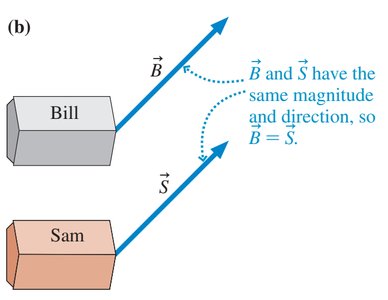
The magnitude of a vector is a scalar representing its length. Two vectors are considered equal if they have the same magnitude and point in the same direction, regardless of their initial position.
Vector Representation and Displacement
Vectors are often represented as arrows. The length of the arrow corresponds to the magnitude, and the arrow points in the direction of the vector. The position of the arrow on the page does not affect the vector it represents. Displacement is a vector that shows the change in position of an object.
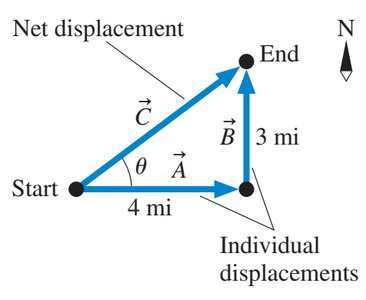
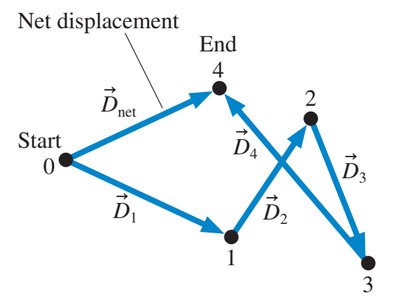
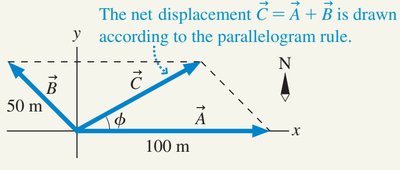
Example: A hiker travels 4 miles east, then 3 miles north. The net displacement is the vector sum of these two movements.
Resultant Vectors and Vector Addition
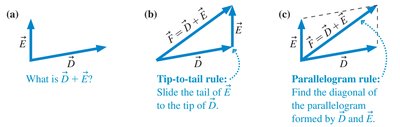
The resultant vector is the sum of two or more vectors. Vector addition can be performed graphically using the tip-to-tail method or the parallelogram rule. The order of addition does not affect the resultant (vector addition is commutative).
Tip-to-tail method: Place the tail of the next vector at the tip of the previous vector.
Parallelogram rule: Place vectors tail-to-tail and complete the parallelogram; the diagonal is the resultant.
Adding Multiple Vectors
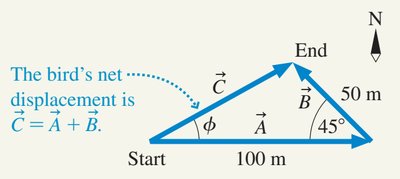
When adding more than two vectors, continue the tip-to-tail method for each additional vector. The resultant vector connects the initial position to the final position.
Multiplying a Vector by a Scalar
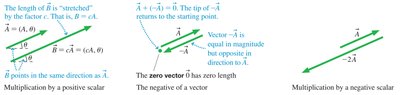
Multiplying a vector by a positive scalar changes its magnitude but not its direction. Multiplying by a negative scalar reverses the direction.
Example: , where is a scalar.
Vector Subtraction
Vector subtraction is performed by adding the negative of a vector. The negative of a vector has the same magnitude but points in the opposite direction.
Formula:

Coordinate Systems
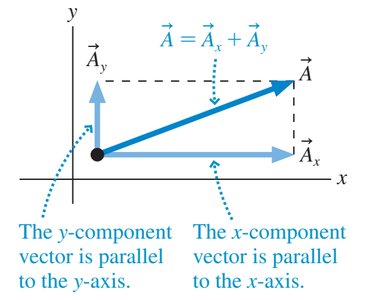
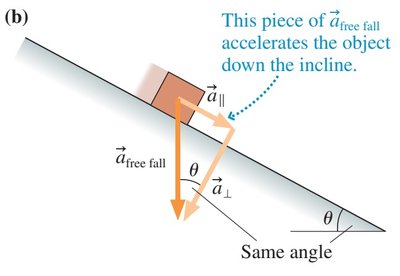
To describe vectors quantitatively, a coordinate system is chosen. This involves selecting an origin, orienting the axes (usually perpendicular), and labeling the positive directions. The choice of axes can simplify problem-solving, especially in cases involving inclines or non-standard orientations.
Component Vectors and Decomposition
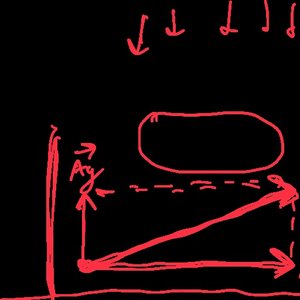
Any vector in a plane can be decomposed into two component vectors that are parallel to the coordinate axes. This process is called decomposition. The original vector is the sum of its components:
Formula:
Signed Components
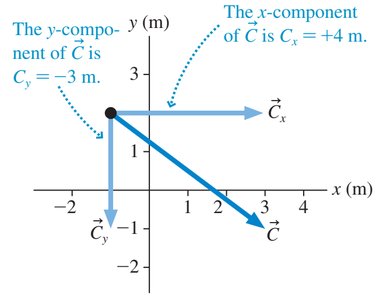
Components of vectors can be positive or negative, depending on their direction relative to the axes. Right or up is typically positive; left or down is negative.
Finding Components from Magnitude and Direction
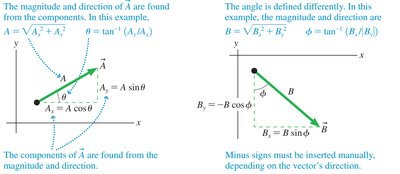
Given a vector's magnitude and direction, its components can be found using trigonometric functions:
Unit Vectors
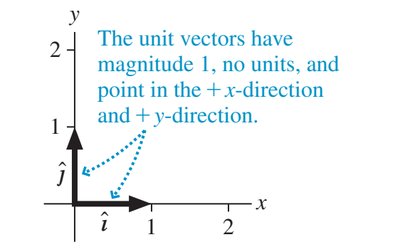
Unit vectors are vectors of magnitude 1 (without units) that indicate direction along the axes. In two dimensions, points in the +x direction and in the +y direction. Any vector can be written as:
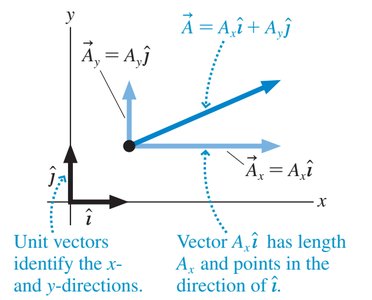
Vector Algebra with Components
Vectors can be added, subtracted, and multiplied by scalars using their components. For example, if , then:
Magnitude and Direction from Components
The magnitude and direction of a vector can be found from its components:
(check the quadrant for correct angle)
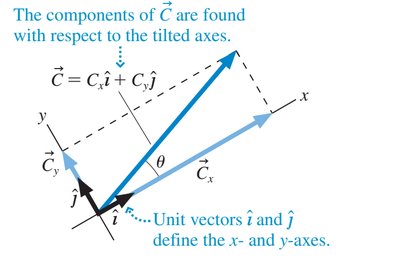
Tilted Coordinate Axes
Sometimes, it is convenient to tilt the coordinate axes to align with the direction of motion or an inclined surface. Components are then found relative to these axes:
Summary Table: Scalars vs. Vectors
Quantity | Scalar | Vector |
|---|---|---|
Definition | Magnitude only | Magnitude and direction |
Examples | Mass, Temperature, Volume | Displacement, Velocity, Force |
Mathematical Representation | Number with units | Arrow (length = magnitude, direction = direction) |
Additional info: This guide covers the essential concepts of vectors and coordinate systems, foundational for all subsequent topics in calculus-based physics. Mastery of these ideas is critical for understanding motion, forces, and more advanced topics in mechanics and electromagnetism.
