 Back
Vectors and Motion in One Dimension: Foundations of Physics with Calculus
Study Guide - Smart Notes
 Tailored notes based on your materials, expanded with key definitions, examples, and context.
Scalars and Vectors
Definitions and Key Differences
In physics, quantities are classified as either scalars or vectors. Scalars are described completely by a magnitude (number and unit), while vectors require both magnitude and direction for a full description.
Scalar quantities: Examples include temperature, distance, area, volume, and speed.
Vector quantities: Examples include velocity, displacement, and force.
Combining Scalars: Scalars are added or subtracted using ordinary arithmetic rules.
Combining Vectors: Vectors require both magnitude and direction to be considered in operations such as addition, subtraction, and multiplication by scalars.
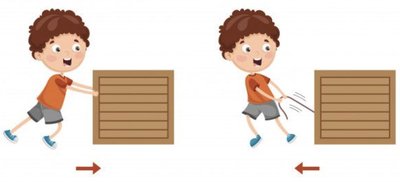
Distance and Displacement
Understanding the Concepts
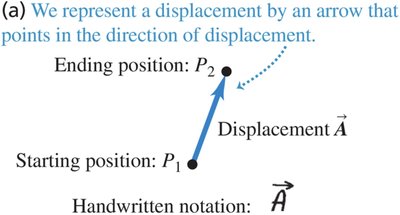
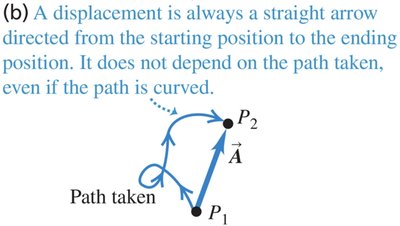
Distance is a scalar quantity representing the total length of the path traveled, regardless of direction. Displacement is a vector quantity representing the change in position from the initial to the final point, with both magnitude and direction.
Distance: Total path length (scalar).
Displacement: Straight-line vector from start to end position.
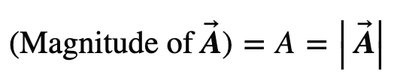
Magnitude of a Vector: The length of the vector, denoted as .
Vector Equality and Negation
Comparing and Reversing Vectors
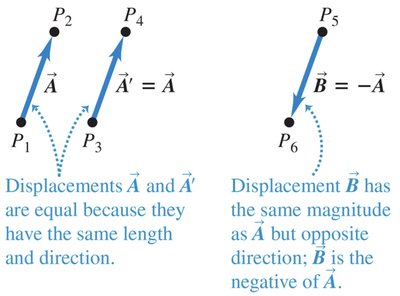
Two vectors are equal if they have the same magnitude and direction, regardless of their initial points. The negative of a vector has the same magnitude but the opposite direction.
Vector Addition
Graphical Methods
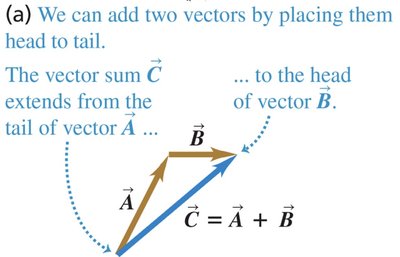
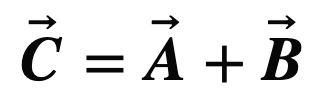
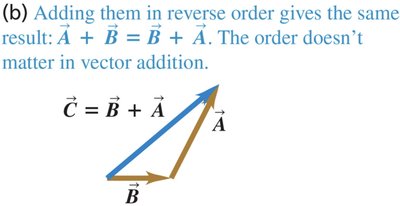
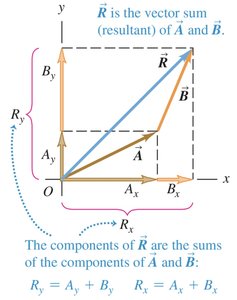
Vectors can be added using the head-to-tail method or by constructing a parallelogram. The resultant vector extends from the tail of the first vector to the head of the last vector.
Commutative property:
Parallelogram method: Place vectors tail-to-tail and complete the parallelogram; the diagonal is the sum.
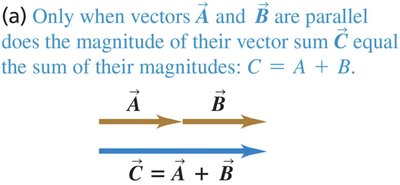
Special Cases: Parallel and Antiparallel Vectors
When vectors are parallel, their magnitudes add. When they are antiparallel (opposite directions), their magnitudes subtract.
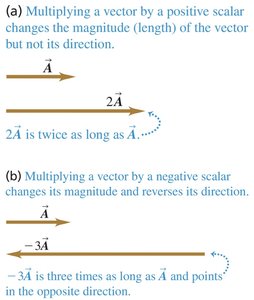
Multiplying Vectors by Scalars
Scaling Vectors
Multiplying a vector by a positive scalar changes its magnitude but not its direction. Multiplying by a negative scalar reverses the direction.
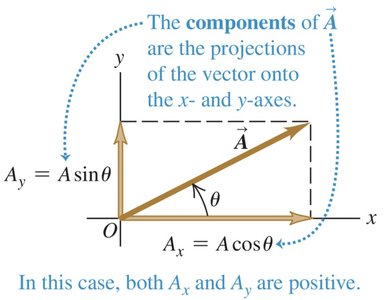
Vector Components
Breaking Vectors into Components
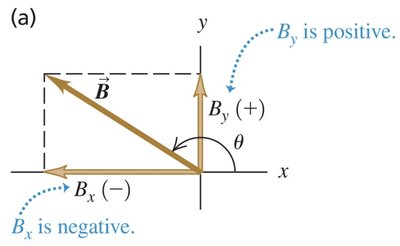
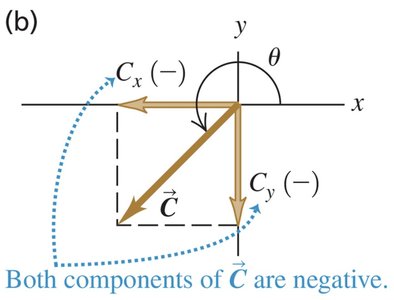
Any vector in a plane can be resolved into components along the x- and y-axes. The components are found using trigonometric functions:
Adding Vectors Using Components
To add vectors, sum their respective components:
Unit Vectors
Expressing Vectors in Component Form
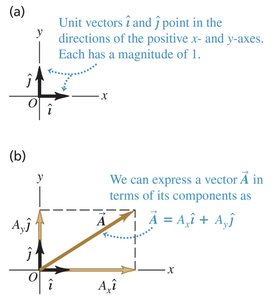
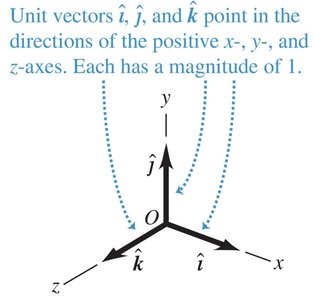
Unit vectors , , and point in the directions of the positive x-, y-, and z-axes, respectively, and have a magnitude of 1. Any vector can be written as a sum of its components multiplied by the corresponding unit vectors:
Example: Vector Operations in Three Dimensions
Finding the Magnitude of a Vector Expression
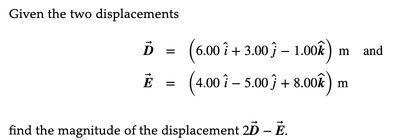
Given m and m, find the magnitude of .
First, compute m
Then, m
Magnitude: m
Applications: Relative Velocity
Example: Airplane Velocities
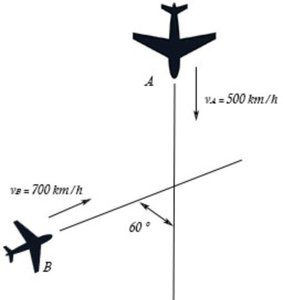
When analyzing the motion of two airplanes, their velocities are vectors that can be added or subtracted to find relative velocity. For example, if plane A is moving at 500 km/h downward and plane B at 700 km/h at a 60° angle, their relative velocity can be found using vector addition.
Summary Table: Scalar vs. Vector Quantities
Quantity | Scalar or Vector | Example |
|---|---|---|
Distance | Scalar | 5 m |
Displacement | Vector | 5 m east |
Speed | Scalar | 60 km/h |
Velocity | Vector | 60 km/h north |
Force | Vector | 10 N right |
Key Equations
Magnitude of a vector:
Vector addition (components):
Displacement:
