 Back
BackVectors and Motion in Two Dimensions: Structured Study Notes
Study Guide - Smart Notes
 Tailored notes based on your materials, expanded with key definitions, examples, and context.
Vectors and Motion in Two Dimensions
Introduction
This chapter explores the fundamental concepts of vectors and their application to motion in two dimensions. Understanding vectors is essential for describing physical quantities that have both magnitude and direction, such as displacement, velocity, and acceleration. The chapter also covers projectile motion, motion on ramps, circular motion, and relative motion, providing a comprehensive foundation for analyzing two-dimensional physical systems.
Scalars and Vectors
Definitions and Properties
Physical quantities are classified as either scalars or vectors:
Scalar: A quantity described only by its magnitude (e.g., speed, time, mass).
Vector: A quantity described by both magnitude and direction (e.g., displacement, velocity, acceleration, force).
Vector notation: Vectors are typically denoted by boldface letters with arrows above them.
Vector Operations
Equality, Addition, and Subtraction
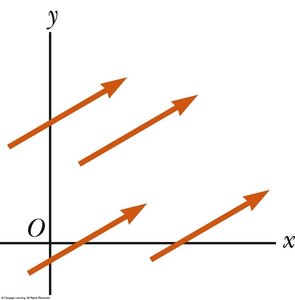
Vectors are equal if they have the same magnitude and direction. They can be moved parallel to themselves in diagrams without changing their properties.
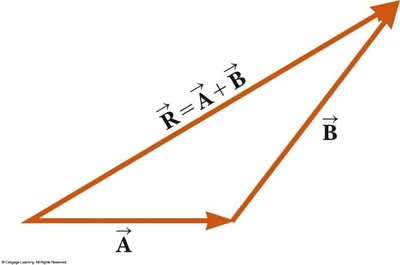
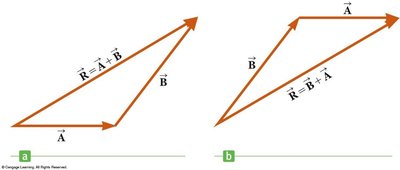
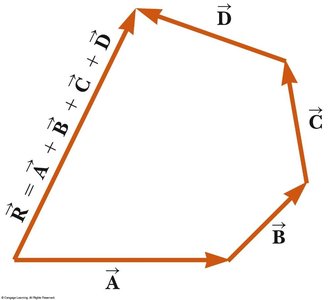
Geometrical (Triangle) Method: Place the tail of the second vector at the tip of the first; the resultant vector is drawn from the tail of the first to the tip of the second.
Commutative Law: The order of addition does not affect the result:
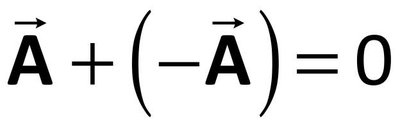
Negative Vector: A vector with the same magnitude but opposite direction.
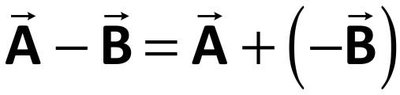
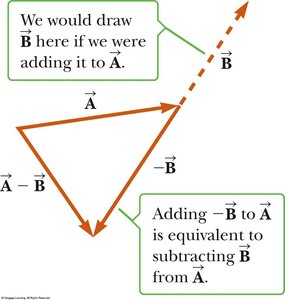
Vector Subtraction: Subtracting a vector is equivalent to adding its negative:

Multiplying and Dividing Vectors by Scalars
Scalar Multiplication
Multiplying or dividing a vector by a scalar changes its magnitude but may also affect its direction:
If the scalar is positive, the direction remains unchanged.
If the scalar is negative, the direction is reversed.
Vector Components and Coordinate Systems
Rectangular Components
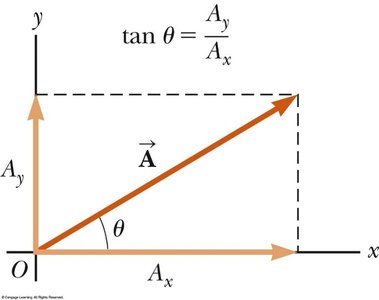
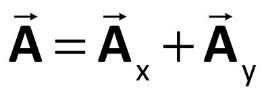
Any vector in the xy-plane can be represented by its rectangular components:
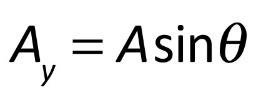
x-component: Projection along the x-axis.
y-component: Projection along the y-axis.
Components are the legs of a right triangle whose hypotenuse is the vector.
Angle is measured with respect to the positive x-axis.
Component Equations
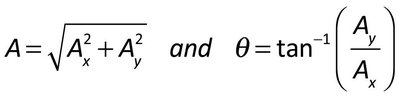
Other Coordinate Systems
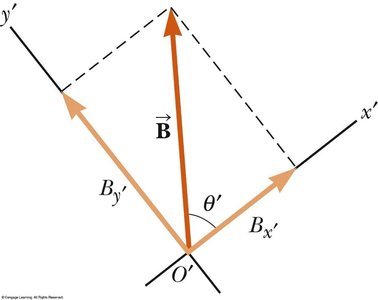
Sometimes, it is convenient to use axes that are not horizontal and vertical but are still perpendicular. Adjust the components accordingly.
Adding Vectors Algebraically
Component Method
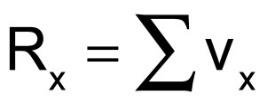
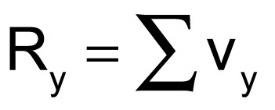
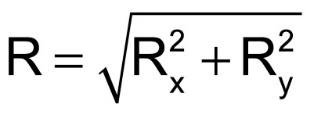
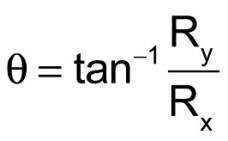
Vectors are often added algebraically by summing their components:
Motion on a Ramp
Inclined Plane Analysis
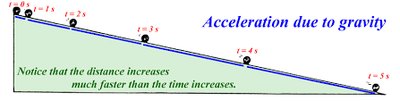
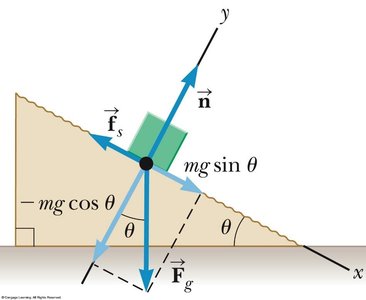
Motion on a ramp involves resolving forces and accelerations along the incline:
Acceleration down the ramp:
Static friction and normal force must be considered for objects at rest.
Maximum angle before slipping:
Motion in Two Dimensions
Position, Displacement, Velocity, and Acceleration
Motion in two dimensions involves changes in both x and y directions:
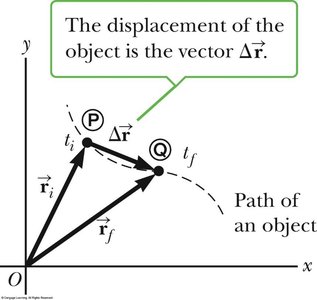
Position vector: Drawn from the origin to the object's location.
Displacement: Change in position vector:
Average velocity:
Instantaneous velocity:
Average acceleration:
Instantaneous acceleration:
Projectile Motion
Basic Principles
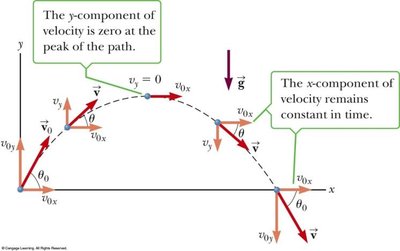
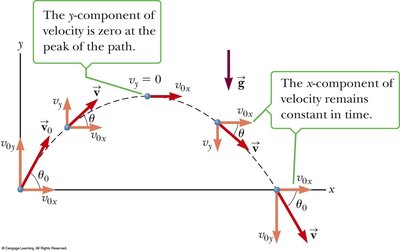
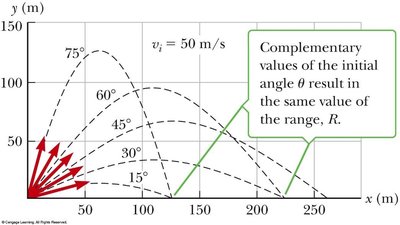
Projectile motion is a special case of two-dimensional motion where an object is launched, shot, or thrown. The path is parabolic, and the x- and y-directions are independent:
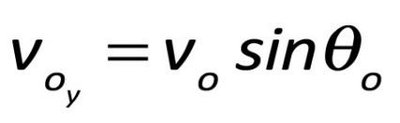
Initial velocity components: ,
x-direction: Uniform motion (),
y-direction: Free fall ()


Projectile Motion Equations
(constant)
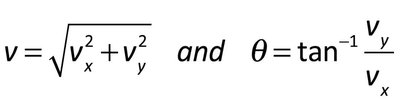
Magnitude and direction of velocity: ,
Projectile Motion: Solving Problems
Example Problems
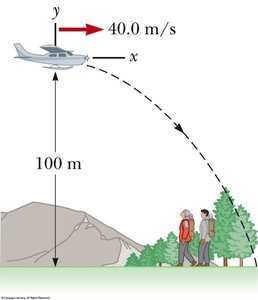
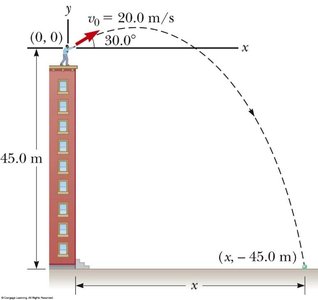
Solving projectile motion problems involves breaking the motion into x and y components, applying the relevant equations, and combining results:
Find time of flight, range, and impact velocity using the equations above.
Use quadratic equations for vertical displacement when necessary.
Circular Motion
Definitions and Radian Measure
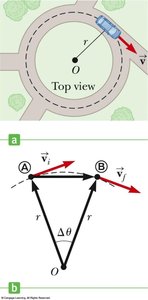
Circular motion describes objects moving in a circle or turning on an axis:
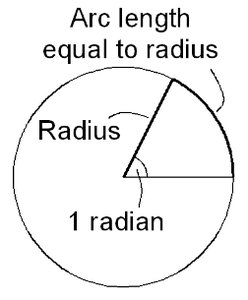
Radian: The angle subtended at the center of a circle by an arc equal in length to the radius.
Conversion: rad = 360° = 1 revolution
Centripetal Acceleration
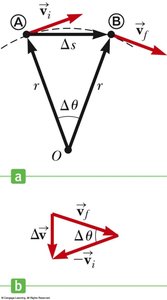
Objects in circular motion experience centripetal acceleration directed toward the center:
Acceleration is due to the change in direction of velocity, not its magnitude.
Relative Motion
Frames of Reference
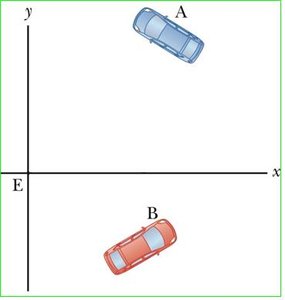
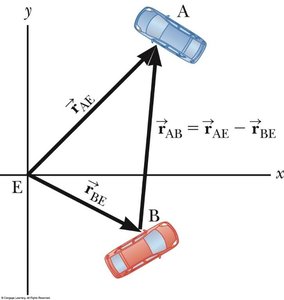
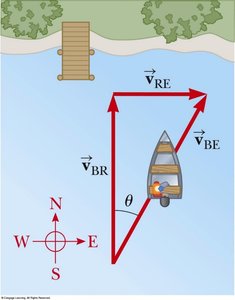
Relative motion involves comparing measurements from different observers or frames of reference:
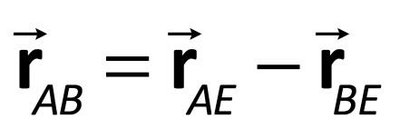
Position of A relative to B:
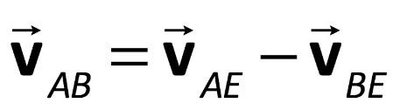
Velocity of A relative to B:
Physics Glossary
Key Terms
Scalar: Magnitude only
Vector: Magnitude and direction
Negative vector: Opposite direction, same magnitude
Component of vector: Projection along axes
Geometrical method of adding vectors: Triangle/tip-to-tail method
Algebraical method of adding vectors: Component-wise addition
Position vector: Vector from origin to object
Displacement: Change in position vector
Average velocity: Displacement/time interval
Instantaneous velocity: Limit of average velocity as time interval approaches zero
Average acceleration: Change in velocity/time interval
Instantaneous acceleration: Limit of average acceleration as time interval approaches zero
Two-dimensional motion: Motion in both x and y directions
Projectile motion: Parabolic motion under gravity
Frame of reference: Coordinate system for measurements
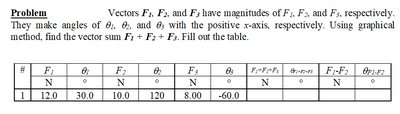
Sample Table: Vector Addition Problem
This table demonstrates the graphical method for vector addition, showing how to sum vectors and determine their resultant magnitude and direction.
# | F1 (N) | θ1 (°) | F2 (N) | θ2 (°) | F3 (N) | θ3 (°) | F1+F2+F3 (N) | θ(F1+F2+F3) (°) | F1-F2 (N) | θ(F1-F2) (°) |
|---|---|---|---|---|---|---|---|---|---|---|
1 | 12.0 | 30.0 | 10.0 | 120 | 8.00 | -60.0 | N | ° | N | ° |
Additional info: The table is used to practice vector addition and subtraction using graphical and algebraic methods.
