 Back
BackVectors and Trigonometry: Vector Math and Motion on Ramps
Study Guide - Smart Notes
 Tailored notes based on your materials, expanded with key definitions, examples, and context.
Vectors and Trigonometry in Physics
Scalar and Vector Quantities
Physical quantities in physics are classified as either scalars or vectors. Scalars are described by a single value with units, while vectors require both magnitude and direction for a complete description.
Scalar Quantities: Examples include length, time, temperature, mass, distance, and speed. Notation: non-bold italic letters (e.g., m, t, d).
Vector Quantities: Examples include position, displacement, velocity, acceleration, and force. Notation: non-bold italic letters with an arrow above (e.g., , , ).
Vectors are represented in diagrams as arrows, where the arrow's direction indicates the vector's direction and its length is proportional to the magnitude.
Using Vectors
Vector Addition (Graphical Methods)
Vectors can be added graphically using two main methods: the tip-to-tail method and the parallelogram method. The result of vector addition is called the resultant vector.
Tip-to-Tail Method: Place the tail of the second vector at the tip of the first. The resultant vector points from the tail of the first to the tip of the last vector.
Order Independence: Vector addition is commutative: .
Parallelogram Method: Place both vectors tail-to-tail, construct a parallelogram, and the diagonal from the common tail gives the resultant.
Never add only the magnitudes of vectors; direction must always be considered.
Multiplication by a Scalar (Graphical Method)
Multiplying a vector by a scalar changes its magnitude but not its direction (unless $c$ is negative, in which case the direction reverses).
If , points in the same direction as with magnitude .
If , points in the opposite direction with magnitude .
Vector Subtraction (Graphical Method)
The negative of a vector has the same magnitude as but points in the opposite direction. To subtract vectors, add the negative: .
Coordinate Systems and Vector Components
Resolving Vectors into Components
For quantitative calculations, vectors are resolved into components along coordinate axes, typically and . This allows for straightforward addition, subtraction, and scalar multiplication of vectors.
Any vector in the -plane can be written as .
The components are found using trigonometry:
where is the magnitude and is the angle with respect to the positive -axis.
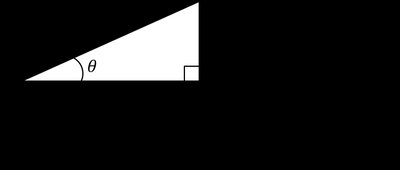
If the angle is measured from a different direction, use SOH-CAH-TOA and assign negative signs as needed based on direction.
Vector Operations Using Components
Once vectors are expressed in components, operations become straightforward:
Addition: ,
Subtraction: ,
Scalar Multiplication: ,
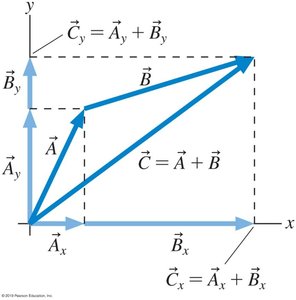
The tip-to-tail graphical method is equivalent to adding vectors by their components.
Magnitude and Direction from Components
Given components and , the magnitude and direction of are:
If the vector lies in quadrant II or III, add to the calculator result for the correct angle.
Motion on a Ramp
Analyzing Motion on Inclined Planes
When analyzing motion on an inclined surface (ramp), it is convenient to use a tilted coordinate system:
The -axis is aligned along the ramp surface.
The -axis is perpendicular to the ramp surface.
Acceleration and force vectors are resolved into components along these axes.
Example: For a sled sliding down a frictionless hill at angle , the acceleration along the ramp is .
Equation Summary
Concept | Equation |
|---|---|
Vector components | , |
Magnitude and direction | , |
Addition (components) | , |
Subtraction (components) | , |
Scalar multiplication | , |
Motion on a ramp | Use tilted axes: along ramp, perpendicular |
