 Back
BackVectors and Vector Addition: Foundations for Classical Mechanics
Study Guide - Smart Notes
 Tailored notes based on your materials, expanded with key definitions, examples, and context.
Vectors and Vector Addition
Introduction to Scalars and Vectors
In physics, quantities are classified as either scalars or vectors. Understanding the distinction between these two types is fundamental for describing physical phenomena, especially in classical mechanics.
Scalar Quantity: A physical quantity described by a single number (magnitude) and appropriate units, but no direction.
Examples of Scalars: Speed, mass, temperature, and distance traveled.
Vector Quantity: A physical quantity that has both magnitude and direction in space.
Examples of Vectors: Displacement, velocity, acceleration, and force.
Displacement Vector
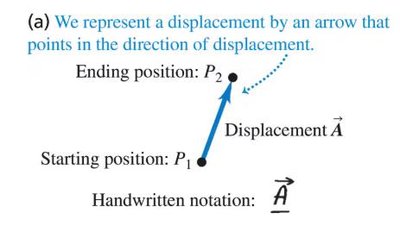
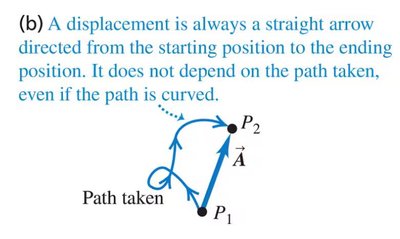
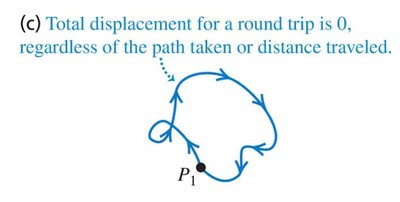
Displacement is a vector that represents the change in position of an object. It is depicted as an arrow pointing from the starting position to the ending position, regardless of the path taken.
Notation: Vectors are often denoted with an arrow above the letter (e.g., ).
Key Properties: The displacement vector depends only on the initial and final positions, not on the actual path traveled.
Magnitude of a Vector
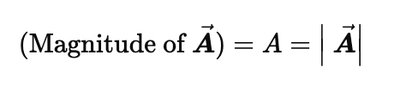
The magnitude of a vector is the length of the arrow representing the vector. It is always a positive number and is denoted as or simply .
Formula:
Interpretation: The magnitude gives the "how much" or "how big" aspect of the vector, while the direction specifies "which way".
Equality of Vectors
Two vectors are equal if they have the same magnitude and direction, regardless of their initial points in space.
Key Point: The location of the vector does not affect its equality; only magnitude and direction matter.
Vector Addition
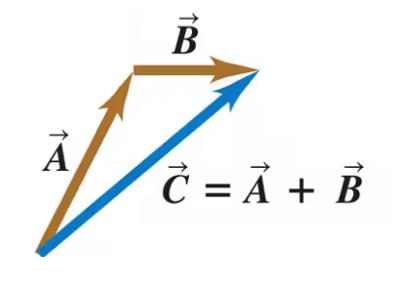
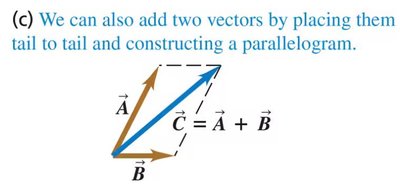
Vectors can be added graphically or analytically. The resultant vector is the vector sum of two or more vectors.
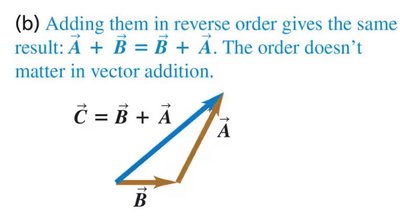
Graphical Methods: The tip-to-tail method and the parallelogram method are commonly used.
Commutativity: Vector addition is commutative: .
Resultant: The resultant vector is drawn from the tail of the first vector to the tip of the last vector.
Special Cases in Vector Addition
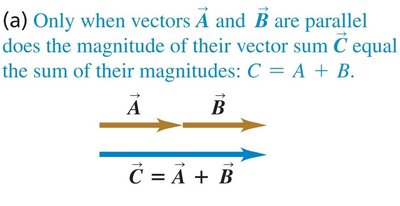
Parallel Vectors: When vectors are parallel, the magnitude of their sum is the sum of their magnitudes: .
Antiparallel Vectors: When vectors are in opposite directions, the magnitude of their sum is the difference of their magnitudes: .
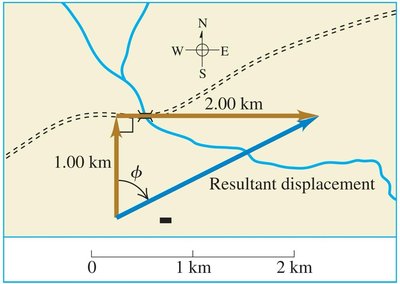
Example: Resultant Displacement
Consider two displacement vectors at right angles: one of 1.00 km north and one of 2.00 km east. The magnitude of the resultant displacement is found using the Pythagorean theorem:
Vector Subtraction and Opposite Vectors
Subtracting a vector is equivalent to adding its opposite. The opposite of a vector has the same magnitude but points in the opposite direction.
Formula:
Multiplying a Vector by a Scalar
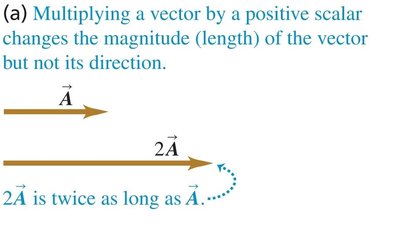
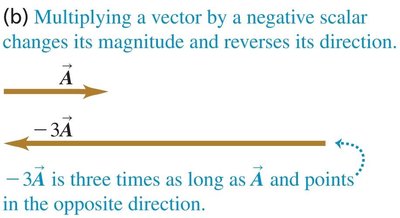
Multiplying a vector by a scalar changes its magnitude but not its direction (if the scalar is positive). If the scalar is negative, the direction is reversed.
Positive Scalar: has magnitude and the same direction as if .
Negative Scalar: has magnitude and the opposite direction if .
Review of Trigonometry for Vectors
Trigonometric functions are essential for resolving vectors into components and for calculating resultant vectors.
Sine:
Cosine:
Tangent:
Radians and Degrees: radians = 180 degrees
Components of Vectors
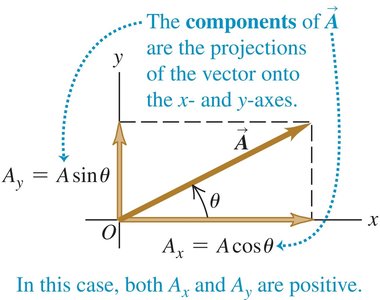
Any vector in a plane can be resolved into two perpendicular components, typically along the x- and y-axes. The components are the projections of the vector onto these axes.
x-component:
y-component:
Key Point: The choice of angle and the sign of the components depend on the vector's orientation.
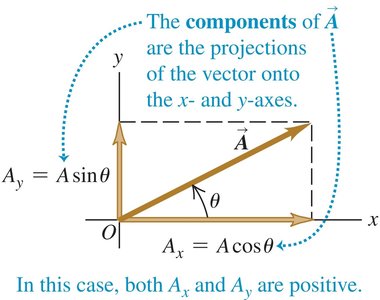
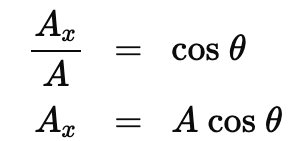
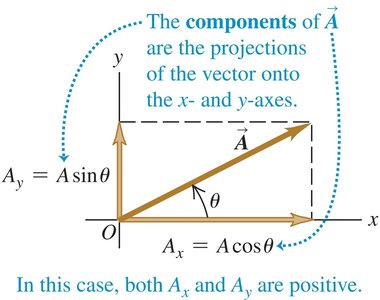
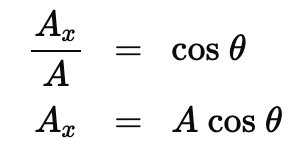
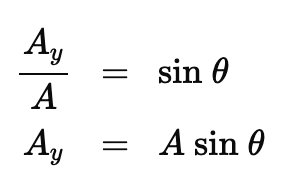
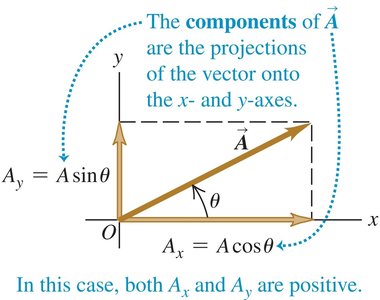
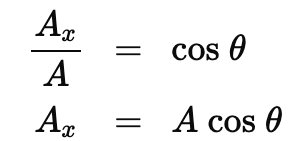
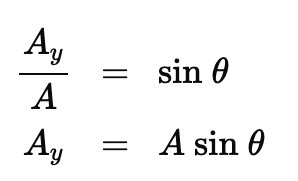
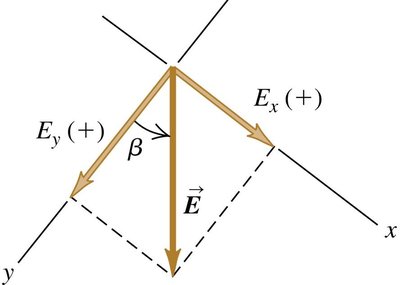
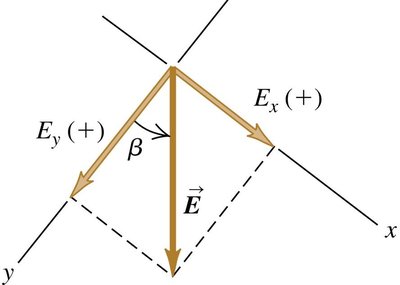
Formulas:
Note: Always consider the orientation of the vector and the reference angle when resolving components. Do not blindly memorize formulas; analyze the geometry of each problem.
Additional info: This guide covers the foundational concepts of vectors, their properties, and operations, which are essential for all subsequent topics in classical mechanics and physics in general.
