 Back
Vectors in Physics: Definitions, Operations, and Applications
Study Guide - Smart Notes
 Tailored notes based on your materials, expanded with key definitions, examples, and context.
Vectors in Physics
Introduction to Vectors
Vectors are fundamental mathematical objects in physics, used to represent quantities that have both magnitude and direction. Understanding vectors is essential for describing motion, forces, and many other physical phenomena.
Scalar: A quantity described by a single number (magnitude) only. Examples: mass, temperature, length.
Vector: A quantity described by both magnitude and direction. Examples: displacement, velocity, force.
Why Study Vectors?
Many physical quantities require both magnitude and direction for a complete description. For example, specifying only the distance traveled does not indicate the final position unless the direction is also given.
Example: "I drove 40 miles east" specifies both the distance and the direction, making it a vector quantity (displacement).
Vector Notation and Representation
Vectors are typically represented graphically by arrows. The length of the arrow indicates the magnitude, and the orientation shows the direction.
Notation: Vectors are often written as \( \vec{A} \) or \( \mathbf{A} \). The magnitude is written as \( A \) or \( |\vec{A}| \).
Graphical Representation: The arrow's length is proportional to the vector's magnitude, and its direction shows the vector's direction.
Scalars vs. Vectors
Scalars | Vectors |
|---|---|
Described by magnitude only | Described by magnitude and direction |
Examples: mass, temperature, energy | Examples: displacement, velocity, force |
Mathematical Operations with Vectors
Vectors can be added, subtracted, and multiplied in specific ways. Operations include:
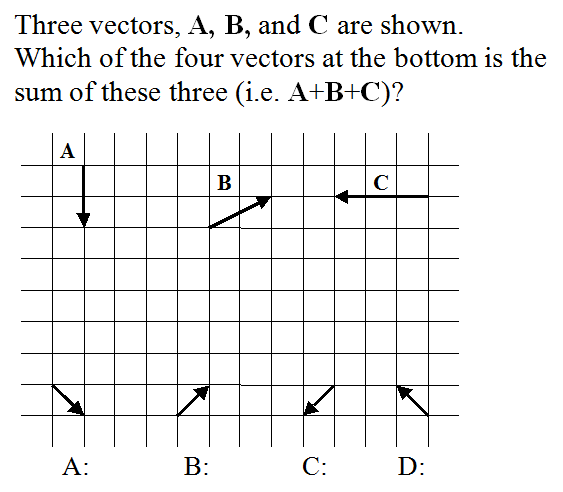
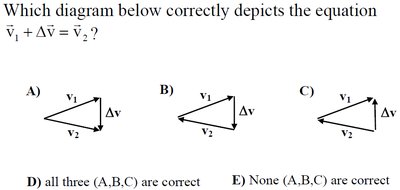
Addition: The sum of two vectors is a vector. Graphically, place the tail of the second vector at the head of the first; the resultant vector goes from the tail of the first to the head of the second.
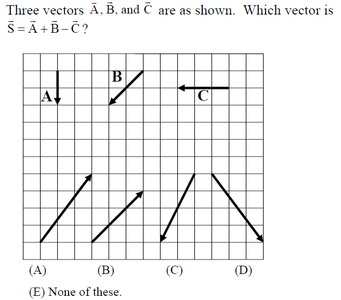
Subtraction: Subtracting a vector is equivalent to adding its opposite (reverse direction).
Multiplication by a Scalar: Multiplies the magnitude, keeps or reverses direction depending on the sign of the scalar.
Dot Product (Scalar Product): \( \vec{A} \cdot \vec{B} = |\vec{A}| |\vec{B}| \cos(\theta) \) yields a scalar.
Cross Product (Vector Product): \( \vec{A} \times \vec{B} \) yields a vector perpendicular to both \( \vec{A} \) and \( \vec{B} \).
Properties of Vector Addition
Commutativity: \( \vec{A} + \vec{B} = \vec{B} + \vec{A} \)
Associativity: \( (\vec{A} + \vec{B}) + \vec{C} = \vec{A} + (\vec{B} + \vec{C}) \)
Examples and Applications
Example 1: Can two vectors of unequal magnitude sum to zero? No, only vectors of equal magnitude and opposite direction can sum to zero.
Example 2: Can three vectors of equal (but non-zero) magnitude sum to zero? Yes, if they are oriented 120° apart in a plane (e.g., forming an equilateral triangle).
Vector Notation Quiz
Correct notations for a vector include: \( \vec{A} \), \( \mathbf{A} \), and boldface A.
Vector Multiplication: Scalar (Dot) Product
The dot product of two vectors results in a scalar and measures how much one vector extends in the direction of another.
Definition: \( \vec{A} \cdot \vec{B} = |\vec{A}| |\vec{B}| \cos(\theta) \)
Special Cases:
Parallel vectors (\( \theta = 0 \)): \( \vec{A} \cdot \vec{B} = AB \)
Anti-parallel vectors (\( \theta = 180^\circ \)): \( \vec{A} \cdot \vec{B} = -AB \)
Perpendicular vectors (\( \theta = 90^\circ \)): \( \vec{A} \cdot \vec{B} = 0 \)
Physical Meaning: The dot product quantifies the component of one vector along the direction of another.
Sample Problems and Diagrams
Below are sample vector addition and subtraction problems, as well as diagrams illustrating vector operations.
Summary Table: Vector Operations
Operation | Result | Formula |
|---|---|---|
Addition | Vector | \( \vec{A} + \vec{B} \) |
Subtraction | Vector | \( \vec{A} - \vec{B} \) |
Multiplication by Scalar | Vector | \( k\vec{A} \) |
Dot Product | Scalar | \( \vec{A} \cdot \vec{B} = AB\cos\theta \) |
Cross Product | Vector | \( \vec{A} \times \vec{B} \) |
Key Takeaways
Vectors are essential for describing many physical quantities in physics.
Vector operations follow specific mathematical rules and have important physical interpretations.
Understanding vector addition, subtraction, and multiplication is foundational for further study in physics with calculus.
