 Back
Vectors, Projectile Motion, Circular Motion, and Forces: Study Notes for Physics with Calculus
Study Guide - Smart Notes
 Tailored notes based on your materials, expanded with key definitions, examples, and context.
Vectors and Motion in Two Dimensions
Vector Representation and Components
Vectors are fundamental tools in physics for describing quantities that have both magnitude and direction, such as displacement, velocity, and force. Understanding how to break vectors into components is essential for analyzing motion in two dimensions.
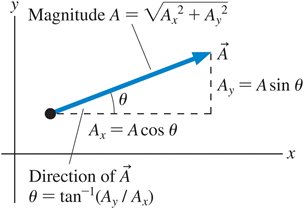
Vector Components: Any vector \( \vec{A} \) can be decomposed into x- and y-components using trigonometry:
\( A_x = A \cos \theta \), \( A_y = A \sin \theta \)
Magnitude: \( A = \sqrt{A_x^2 + A_y^2} \)
Direction: \( \theta = \tan^{-1}(A_y / A_x) \)
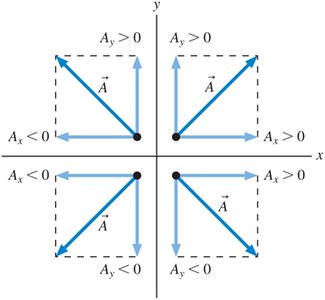
The sign of the components depends on the direction of the vector in the coordinate system.
Acceleration Vector
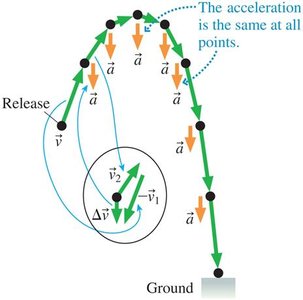
The acceleration vector describes how the velocity of an object changes over time. Acceleration occurs when either the magnitude or direction of velocity changes.
Definition: \( \vec{a} = \frac{d\vec{v}}{dt} \)
Acceleration can be due to a change in speed (magnitude) or a change in direction.
Motion on a Ramp
When an object slides down a ramp, it accelerates parallel to the ramp. The sign of the acceleration depends on the tilt direction.
Projectile Motion
Nature of Projectile Motion
Projectile motion describes the two-dimensional motion of an object under the influence of gravity alone, neglecting air resistance. Examples include balls thrown through the air and long jumpers.
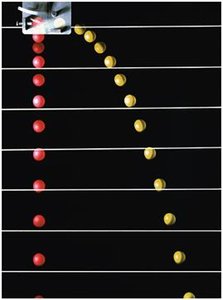
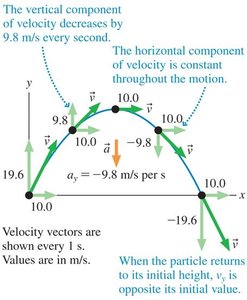
Independence of Components: The horizontal and vertical motions are independent.
Vertical Acceleration: \( a_y = -g \) (downward), \( a_x = 0 \) (horizontal)
Analyzing Projectile Motion
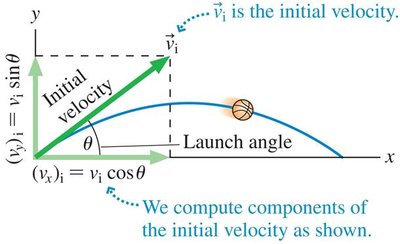
Projectile motion is analyzed by breaking the initial velocity into horizontal and vertical components, using the launch angle.
Launch Angle: The angle above the horizontal at which the projectile is launched.
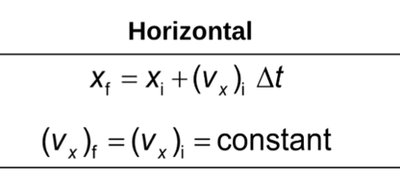
Horizontal Motion: Uniform motion at constant velocity.
Vertical Motion: Free-fall motion under gravity.
Kinematic Equations for Projectile Motion
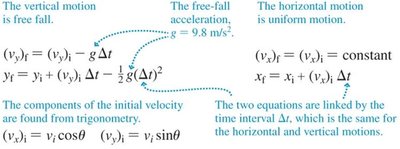
The kinematic equations describe the position and velocity of a projectile as functions of time.
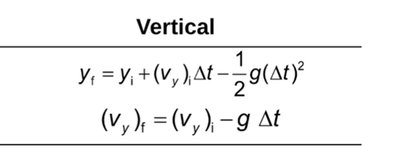
Vertical:
Horizontal:
Example: Dock Jumping
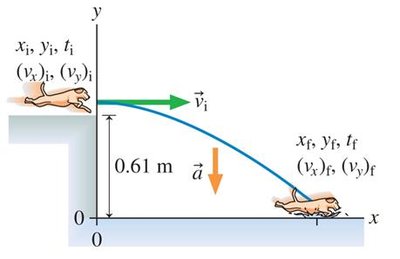
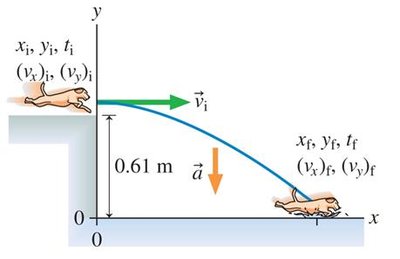
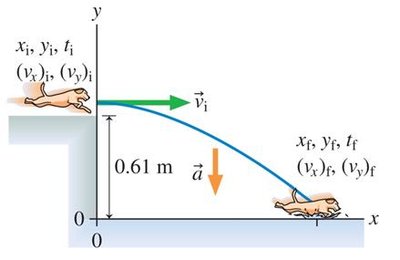
In dock jumping, a dog runs off a dock and lands in water. The horizontal and vertical motions are analyzed separately to determine how far the dog travels.
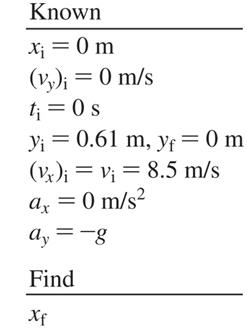
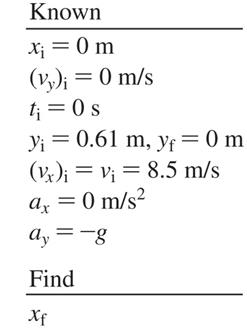
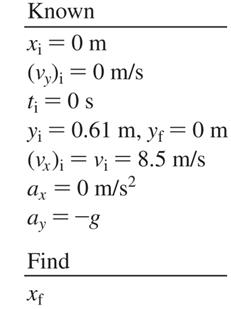
Known values:
\( x_i = 0 \), \( (v_y)_i = 0 \), \( t_i = 0 \), \( y_i = 0.61 \) m, \( y_f = 0 \), \( (v_x)_i = v_i = 8.5 \) m/s, \( a_x = 0 \), \( a_y = -g \)
Find: \( x_f \)
Range of a Projectile
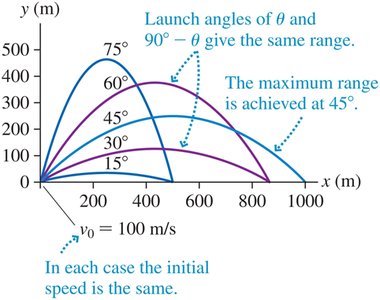
The range is the horizontal distance traveled by a projectile. It depends on the initial speed and launch angle. Maximum range is achieved at a 45° launch angle (neglecting air resistance).
Circular Motion
Uniform Circular Motion
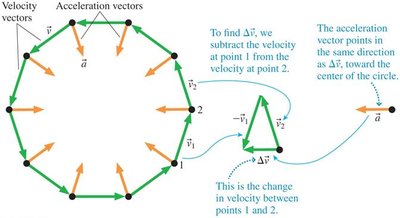
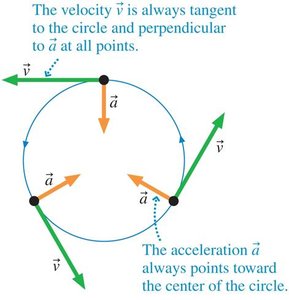
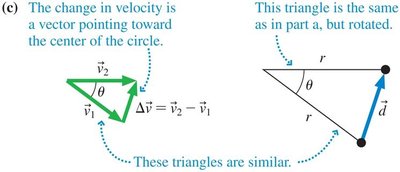
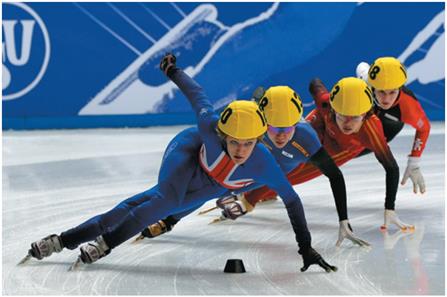
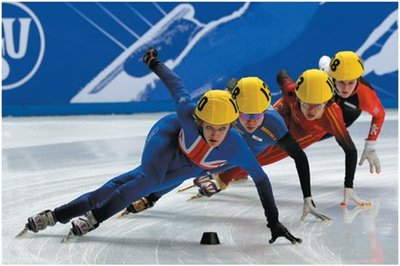
Objects moving in a circle at constant speed experience a continuously changing velocity direction, resulting in acceleration toward the center of the circle (centripetal acceleration).
Centripetal Acceleration: Always points toward the center of the circle.
Formula:
Describing Circular Motion
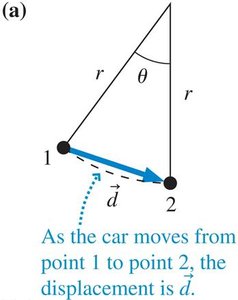
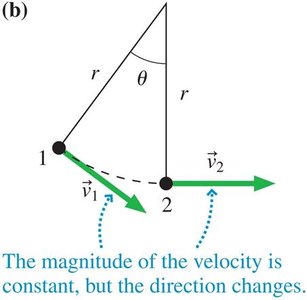
The velocity vector is always tangent to the circle, and the acceleration vector always points toward the center. The change in velocity is geometrically similar to the change in displacement.
Relative Motion
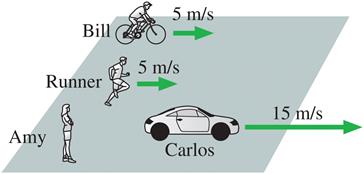
Relative Velocity
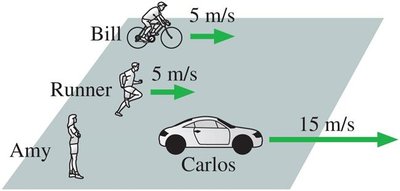
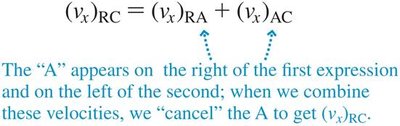
Velocity is always measured relative to a particular observer. The velocity of an object relative to one observer can be found by adding the velocity of the object relative to a second observer and the velocity of the second observer relative to the first.
Formula:
There is no absolute velocity; it is always relative to a reference frame.
Forces and Newton's Laws of Motion
What Is a Force?
A force is a push or a pull exerted by an agent on an object. Forces can be contact (requiring physical touch) or long-range (acting at a distance, such as gravity).
Force as a Vector: \( \vec{F} \) has both magnitude and direction.
Contact Forces: Require physical contact.
Long-Range Forces: Act without contact (e.g., gravity).
Combining Forces
When multiple forces act on an object, they combine to form a net force, which is the vector sum of all individual forces. The net force determines the object's acceleration.
Net Force: \( \vec{F}_{\text{net}} = \sum \vec{F}_i \)
The net force is also called the resultant force.
Newton's First Law
Newton's first law states that an object with no net force acting on it will remain at rest or move in a straight line at constant speed. This law introduces the concept of inertia.
No Force: No acceleration.
Inertia: The tendency of an object to resist changes in motion.
Summary Table: Kinematic Equations for Projectile Motion
Vertical | Horizontal |
|---|---|
|
|
Summary Table: Types of Forces
Type | Description | Example |
|---|---|---|
Contact Force | Acts by physical contact | Push, pull, friction |
Long-Range Force | Acts without contact | Gravity, electromagnetic force |
Additional info: Academic context and expanded explanations were added to ensure completeness and clarity for exam preparation.
