 Back
BackVectors, Scalars, and Basic Physics Quantities: Study Notes
Study Guide - Smart Notes
 Tailored notes based on your materials, expanded with key definitions, examples, and context.
Math Review and Physics Quantities
Scalars and Vectors
In physics, quantities are classified as either scalars or vectors. Understanding the distinction is fundamental for describing motion and forces.
Scalar: A quantity with only magnitude (size). Examples: mass, temperature, time, distance.
Vector: A quantity with both magnitude and direction. Examples: displacement, velocity, acceleration, force.
Quantity | Scalar | Vector |
|---|---|---|
Distance/Displacement | Distance | Displacement |
Speed/Velocity | Speed | Velocity |
Mass | Mass | - |
Force | - | Force |
Acceleration | - | Acceleration |
Additional info: Scalars are added arithmetically, while vectors require vector addition rules.
SI Units and Base Quantities
Physics uses the International System of Units (SI) for consistency. The main base units are:
Second (s): Time
Kilogram (kg): Mass
Meter (m): Length
Ampere (A): Electric current
Kelvin (K): Temperature
Mole (mol): Amount of substance
Candela (cd): Luminous intensity
Forces, Momentum, and Energy
Force, Mass, and Acceleration
Newton's Second Law relates force, mass, and acceleration:
Formula:
Units: Newton (N), where
Work and Energy
Work is done when a force moves an object through a distance:
Formula:
Units: Joule (J), where
Momentum
Momentum is the product of mass and velocity:
Formula:
Units:
Vectors: Representation and Operations
Vector Representation
Vectors are represented by arrows. The length indicates magnitude, and the arrow points in the direction.
Notation: or boldface A
Components: Vectors can be broken into horizontal (x) and vertical (y) components.
Vector Addition and Subtraction
Vectors are added or subtracted using graphical or analytical methods.
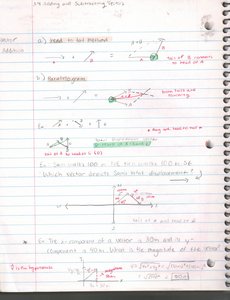
Tip-to-Tail Method: Place the tail of the second vector at the tip of the first. The resultant vector is drawn from the tail of the first to the tip of the last.
Parallelogram Method: Place vectors tail-to-tail and complete the parallelogram; the diagonal is the resultant.
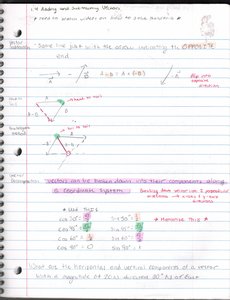
Subtraction: To subtract from , add and (reverse direction of ).
Resolving Vectors into Components
Any vector can be resolved into perpendicular components, usually along the x and y axes. This is essential for analyzing motion and forces in two dimensions.
Horizontal component:
Vertical component:
Magnitude from components:
Direction (angle):
Example: Finding Components
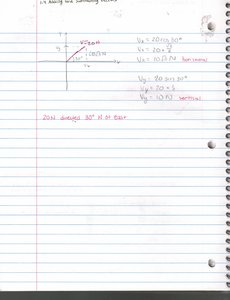
Given a vector of magnitude 20 N at 30° north of east:
(horizontal)
(vertical)
Summary Table: Scalars vs. Vectors
Property | Scalar | Vector |
|---|---|---|
Magnitude | Yes | Yes |
Direction | No | Yes |
Addition Rule | Arithmetic | Vector addition |
Examples | Mass, Time, Speed | Displacement, Velocity, Force |
