 Back
Vectors, Scalars, and Vector Components: Foundations for Physics with Calculus
Study Guide - Smart Notes
 Tailored notes based on your materials, expanded with key definitions, examples, and context.
Vectors vs. Scalars
Definitions and Key Differences
In physics, quantities are classified as either scalars or vectors. Understanding this distinction is fundamental for describing physical phenomena accurately.
Scalar Quantity: A physical quantity that is described completely by its magnitude (size or amount) alone. It has no associated direction.
Vector Quantity: A physical quantity that requires both magnitude and direction for a complete description.
Examples:
Scalar Quantities | Vector Quantities |
|---|---|
Time | Displacement |
Temperature | Velocity |
Distance traveled | Acceleration |
Speed | Momentum |
Mass | |
Energy | |
Power |

Magnitude: The size or strength of a quantity, always positive for vectors.
Direction: The orientation in space of a vector quantity.
Example: Speed (scalar) tells you how fast you are moving, while velocity (vector) tells you how fast and in what direction.
Vector Notation and Representation
How Vectors Are Written and Interpreted
Vectors are typically represented in boldface (e.g., A) or with an arrow overhead (e.g., ). The magnitude is written as (italicized, always positive), and the direction is specified by an angle or other conventions.
Full Vector: or A (includes both magnitude and direction)
Magnitude Only:
Direction: (measured from a reference axis, usually the positive x-axis, counterclockwise is positive)
Other ways to specify direction include compass bearings (measured from North) and descriptive phrases (e.g., "degrees above the horizontal").
Example: The initial velocity of a soccer ball: at above the horizontal.
Vector Components
Breaking Vectors into Perpendicular Parts
Any vector in a plane can be expressed as the sum of its components along the x- and y-axes. This is essential for analyzing motion and forces in physics.
Component Form (2D): or
Component Form (3D): or
Unit Vectors: (x-direction), (y-direction), (z-direction)
Finding Components:
Here, is the magnitude and is the angle measured from the positive x-axis.
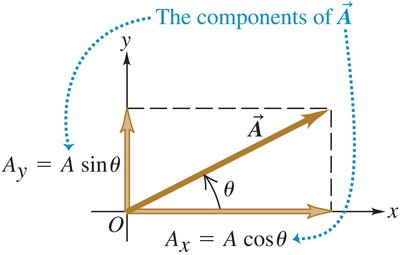
Example: For at above the horizontal:
Converting Between Magnitude/Direction and Components
Using Trigonometry to Switch Forms
Given the components and , the magnitude and direction of the vector can be found using:
Magnitude:
Direction: (be careful with the quadrant!)
When using inverse trigonometric functions, always check which quadrant the vector lies in to determine the correct angle.
Example: If and , then:
(after adjusting for the correct quadrant)
Review: Properties of Vectors and Scalars
Quick Facts and Common Questions
The magnitude of a vector is always positive and can have units.
Vector components can be positive or negative and have the same units as the vector.
Scalars never have direction; vectors always do.
Example Table: Classification of Quantities
Quantity | Scalar or Vector? |
|---|---|
Time | Scalar |
Temperature | Scalar |
Displacement | Vector |
Distance traveled | Scalar |
Velocity | Vector |
Speed | Scalar |
Acceleration | Vector |
Mass | Scalar |
Energy | Scalar |
Power | Scalar |
Momentum | Vector |
Summary Table: Scalar vs. Vector Quantities
Scalar Quantities | Vector Quantities |
|---|---|
Time | Displacement |
Temperature | Velocity |
Distance traveled | Acceleration |
Speed | Momentum |
Mass | |
Energy | |
Power |
